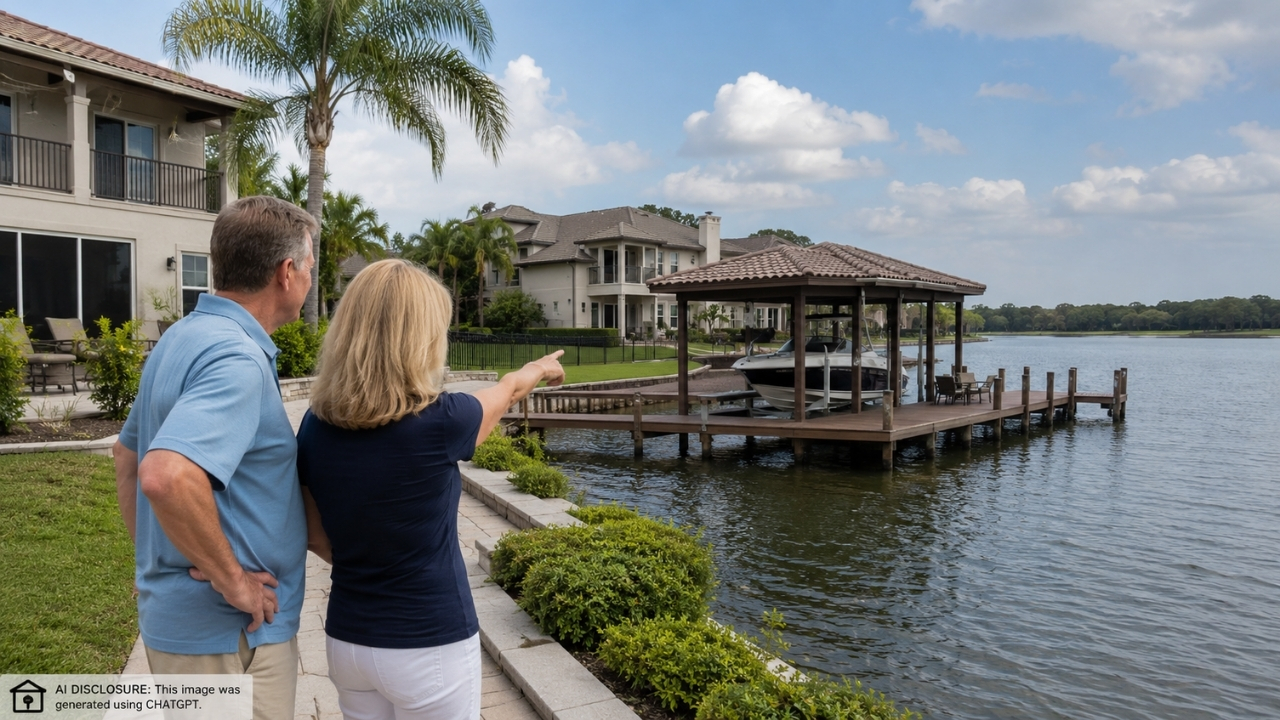
Lakefront Homeowners Find the Neighbor’s Dock and Boathouse Sitting Off Their Shoreline — Then a Court Rules Riparian Rights Do Not Let Them Eject It
Photo credit: AI-generated image created using ChatGPT. Illustrative only.
Buying a lakefront place comes with a certain mental picture: coffee on the patio, a clean sightline to open water, and your own easy path down to the shoreline. For one Orange County, Florida couple, that picture got complicated when they realized the neighbor’s dock and boathouse sat out in front of the lake they thought they were paying for.
The dispute ended up in court, and the result wasn’t what many homeowners expect when they hear “my neighbor’s structure is in front of my property.” In the court’s decision, Florida’s Sixth District Court of Appeal sided with the dock owner—saying riparian rights don’t automatically let a lakefront owner “eject” a neighbor’s dock and boathouse just because it affects their view or sits off their shoreline.
The first time they really noticed, it wasn’t just an eyesore
The neighbors were Bradley and Sarah Geise and Peter and Kari Fleck, owners of adjoining lakefront homes on Lake Down. The Flecks had owned their property since 1999, and some version of their dock/boathouse had been reaching into the lake since 1983—long before the Geises arrived.
The Geises bought next door in 2017. After that purchase, they took the position that the Flecks’ rebuilt dock and boathouse interfered with two things lakefront buyers care about most: seeing the water and getting to it.
This is where lake living gets real, fast. A dock isn’t just a structure—it’s also “where the action is.” It changes where boats idle, where people gather, and how the shoreline feels from your yard. Even when everyone’s polite, that kind of change can turn into a daily irritant.
When “property line” logic hits the water, it gets messy
On land, most homeowners have a simple framework for disputes: survey pins, fences, and the idea that you can point to a line and say, “That’s mine.” The Geises tried to apply a version of that logic to the lake, arguing for a rule that would essentially divide up the submerged area in front of neighboring lakefront lots.
But there was a key wrinkle that shaped everything: the lake bottom didn’t belong to either neighbor. The submerged land under Lake Down was sovereign land owned by the State of Florida and held in trust for the public.
That matters because it undercuts the common assumption that you can extend your side boundaries straight out into the water and claim an exclusive “slice” in front of your yard. This case turned on the court’s refusal to treat the lake like a backyard that can be cleanly partitioned with invisible property lines.
The lawsuit asked for the kind of fix that forces a neighbor’s hand
The Geises didn’t just complain; they sued. Their claims included ejectment, trespass, declaratory relief, and an injunction—specifically, a court order that would have required the Flecks to substantially modify their dock and boathouse.
That’s the point where neighbor tension usually goes from uncomfortable to permanent. Once you’re asking a judge to make someone tear down or rework a major structure, it’s no longer about “being reasonable” over the fence line—it’s about whose rights control the lakefront.
After a three-day bench trial, the trial court rejected the Geises’ position. The judge found the Geises could still see the lake, including toward its center, and still had unobstructed access to the water from their property. In other words: annoyed isn’t the same as blocked.
The court’s test wasn’t “perfect view,” it was “unreasonable interference”
Florida riparian rights give waterfront owners certain important benefits tied to their land—access to the water, reasonable use of the water, and a view of it. There’s also a qualified right to construct docks to reach navigable water.
But those rights don’t exist in a vacuum. Your rights have to coexist with the next owner’s rights, and the appeals court emphasized a practical standard: whether one owner’s use of the lake unreasonably interferes with another owner’s rights.
The Geises argued that an older Florida Supreme Court decision, Hayes v. Bowman, required an “equitable division” of the submerged area in front of the lots—basically a formal splitting of the water space so each owner could point to a defined zone. The appeals court said that was a misreading. Hayes was dealing with very different facts involving dredging, filling, and statutory rights related to submerged lands, and its “equitable distribution” formula doesn’t automatically apply every time neighbors fight about docks or lake access.
Instead of drawing imaginary metes-and-bounds lines into the lake—an approach the court warned could turn shared water into carved-up wedges—the court stuck with the unreasonable-interference test. Applying that test, the Flecks won. Their dock and boathouse didn’t prevent the Geises from accessing the lake and didn’t substantially interfere with their view.
The court also clarified something that lands hard for people who paid extra for water frontage: the right is to a reasonably unobstructed view and access, not a perfectly unobstructed one.
Homeowner reactions tend to split: “get a survey” vs. “welcome to the lake”
Even without a comment thread attached to the decision, you can predict the two main homeowner instincts here. One camp hears “dock off my shoreline” and immediately thinks documentation: photos over time, measurements, permits, and anything that shows when the structure changed and how it affects use.
The other camp looks at the same facts and shrugs—because on many lakes, docks have been rebuilt, modified, shifted, and repaired for decades. A structure that’s been “some version of there” since 1983 feels like a settled part of the shoreline, even if the neighbors change.
This case also has a built-in lesson about assumptions buyers make at closing. A lake view feels like it comes with the land. But if the bottom is sovereign state land and the shoreline has long-standing structures nearby, the “view you saw on showing day” might be more fragile than people realize.
The tension isn’t fully gone, because the bigger legal fight may not be over
The appeals court affirmed the judgment for the Flecks, meaning they did not have to substantially alter their dock and boathouse. The Geises’ riparian rights mattered, but they didn’t override the neighbor’s rights where access remained and the view wasn’t substantially blocked.
One more twist keeps this from feeling truly finished: the court said another Florida appellate court recently misapplied Hayes in a similar case, Brown v. Thomas, and it formally certified a direct conflict between the decisions. That’s the kind of procedural move that can invite Florida Supreme Court review.
For lakefront homeowners watching from their own decks, the takeaway is as practical as it is frustrating. You don’t necessarily own an invisible rectangle of water straight out from your lot, and a neighbor’s dock can impact your enjoyment without crossing the legal line. On a shared lake, “I can still get to the water” and “I can still see the lake” can be the difference between a forced rebuild and a permanent new view.
Like Fix It Homestead’s content? Be sure to follow us.