Tennessee Homeowner Has Used the Same Driveway Since 1975 — Then the Neighbor Claims the Ground Beneath It and a Special Master Is Appointed
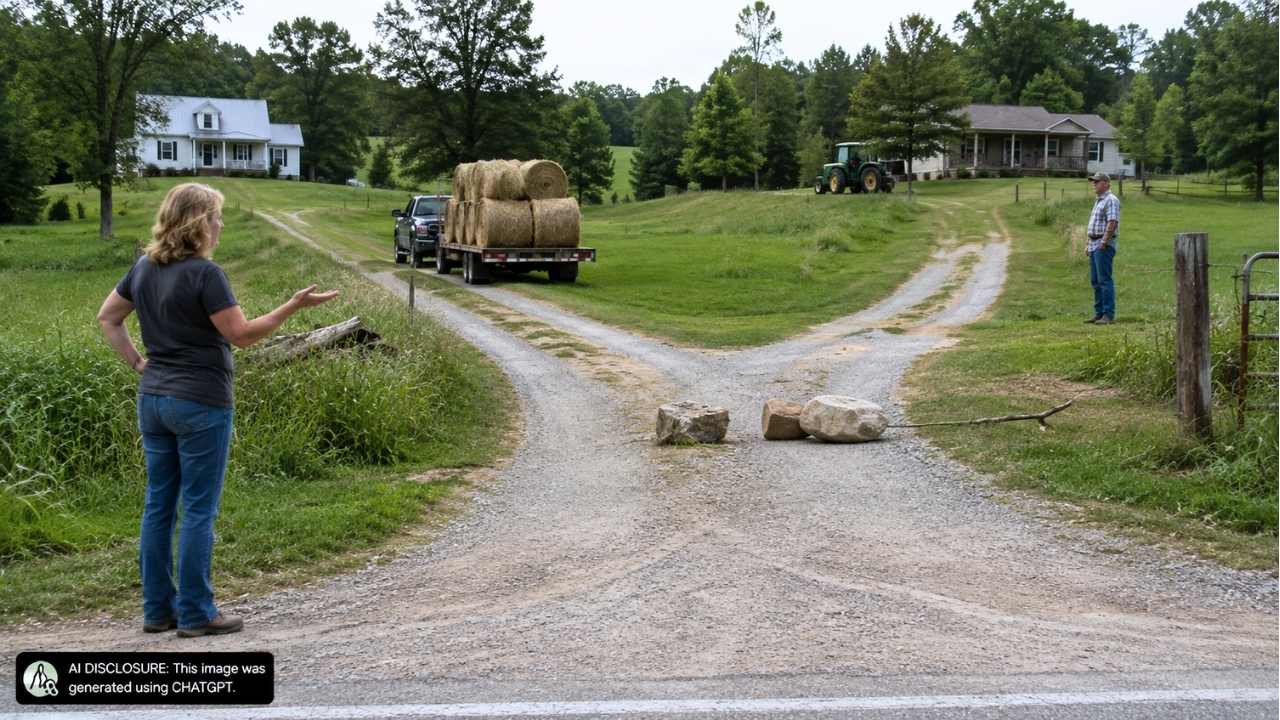
Photo credit: AI-generated image created using ChatGPT. Illustrative only.
In rural property life, a driveway isn’t just a strip of gravel. It’s how you get groceries in, how an ambulance gets to the house, how you haul hay, and how you keep a farm running. In Tennessee, one longtime homeowner found out just how fragile that lifeline can be when a newer neighbor started treating the shared entrance like a private yard.
The fight ended up in court, and the details are laid out in the source post. The short version: a family that had used the same Y-shaped driveway since the mid-1970s was told they could keep using it—dump trucks, tractors, trailers and all—because decades of open, continuous use created a legal right that stuck to the land even after the neighboring parcel changed hands.
A driveway that worked for decades—until it didn’t
Marla Ann Richardson has lived at 5153 East Main Street in Erin, Tennessee, since 1975. The neighboring property at 5155 was purchased by Dianne Moore in 2014, and both properties connect to the main road via a Y-shaped driveway.
For years, that kind of setup can feel informal: you drive where you’ve always driven, you keep it passable, and nobody makes it weird. But once Moore moved in, the vibe changed fast. Richardson said Moore interfered with access and damaged property—things like destroying trees and fencing, placing rocks and debris, and getting in the way of driveway use.
Moore’s side was different. She acknowledged that she initially gave Richardson and her son permission to use the driveway, then said she revoked it once she realized they were driving commercial and agricultural equipment over it. In her view, that heavy traffic was damaging her yard, and the Richardsons should build a different driveway.
When “we’ve always used it” turns into equipment, culverts, and a widened path
This wasn’t just a case of a couple cars rolling through. Richardson testified that after buying the property in 1975, she and her husband used that driveway continuously. As farming became part of their life, they made the route more workable: widening part of it, installing a culvert, removing trees, and modifying a small bridge area to handle tractors and bigger vehicles.
Her son testified that the farm operation started around 1976 or 1977, and he joined in 1984. He said he’d stored commercial equipment on his mother’s property since then and had “always” driven that equipment across the disputed driveway, even as the neighboring property’s ownership changed multiple times.
This is the part that homeowners recognize instantly: there’s the “nice” version of a driveway, and then there’s the version that has to survive weather, washouts, and working vehicles. The Richardsons described maintaining it—repairing washouts, adding gravel in ditches and gullies—because if you don’t, you’re stuck.
The escalation: barricades, police calls, and a property line fight
Once the driveway became a point of control, things got tense. The record describes police being called several times after Moore allegedly barricaded the driveway or otherwise interfered with the Richardsons’ access.
Two longtime local law enforcement officials ended up testifying. The county sheriff, familiar with the area for decades, said he’d never known the Richardson property to be accessed any other way. The police chief backed that up, saying the driveway had long been the only entrance and exit to both the residence and the farm.
Then there was the land itself—because driveway fights often pull property lines into the blast radius. A licensed surveyor testified and concluded that several trees Moore removed were actually on Richardson’s land. The court accepted that boundary survey as credible, even though Richardson didn’t prove enough about the trees’ value to get damages for their removal.
“Just build another driveway” wasn’t realistic
From the outside, it’s easy to say, “Cut a new driveway and be done.” On rural land, that can be fantasy math.
Richardson’s son described an old logging road on the back of the property as dangerously steep, saying vehicles had flipped trying to climb it. He estimated building a usable driveway there could cost several hundred thousand dollars because of rock and terrain.
The sheriff described the property as sitting above a bluff around 25 feet high. So this wasn’t a matter of calling a buddy with a skid steer. It was a terrain problem, a safety problem, and a money problem—all wrapped into one narrow strip of access.
A special master hears it all, and the court draws a line
The case was referred to a special master, who heard from both parties, Richardson’s son, the sheriff, the police chief, and the surveyor. After that, the special master concluded Richardson had established both a prescriptive easement and an easement by necessity over the driveway, based on decades of continuous, open, visible, uninterrupted use and the lack of any reasonable alternative access.
The trial judge adopted those findings. Moore appealed, challenging the survey, the easement by necessity, and—most of all—the idea that heavy equipment traffic should be protected as part of the driveway use.
On appeal, the court wouldn’t overturn the boundary finding. The surveyor had explained his methodology based on deeds, physical markers, terrain, and measurements. Moore said she had another survey, but she didn’t bring that surveyor to testify, and she also claimed her own surveyor had gotten the line wrong. The appellate court didn’t see a basis to reverse the trial court on that point.
The bigger ruling was about the driveway itself. Tennessee requires 20 years of adverse, continuous, open, visible, and uninterrupted use to establish a prescriptive easement. The Richardsons showed more than 40 years—more than enough time for the right to “stick,” even as the neighboring property changed owners. The appellate court held the easement covered not just passenger vehicles, but construction vehicles and commercial farming equipment too.
Because the prescriptive easement was enough to decide the driveway access, the appeals court didn’t even need to rule on the easement-by-necessity issue. Moore also wasn’t hit with Richardson’s appellate attorney fees; the court declined to call the appeal frivolous, even though Moore lost.
The homeowner reactions: “Document everything,” and “driveways aren’t casual”
Cases like this always pull out the same practical instincts from homeowners: get a real survey, keep records, and don’t wait until the relationship is destroyed to figure out what’s actually yours. Here, the survey work mattered, the maintenance history mattered, and the testimony from longtime locals mattered too—because it established that the driveway wasn’t a new convenience. It was the way the property had functioned for generations of ownership.
There’s also the unglamorous reality that “permission” can be a shaky foundation when you’re talking about the only way in and out. Moore argued she had granted permission and then withdrew it. But the Richardsons’ proof focused on long, obvious use that predated Moore entirely—exactly the kind of thing that can bind a later buyer who thought they were purchasing a clean slate.
In the end, this wasn’t really about who waved at whom in the yard. It was about access, heavy equipment, and what happens when a working homestead depends on a route someone else decides to treat like a private lawn. The court affirmed the judgment in full, and the Richardsons kept the right to use that driveway the way they had for decades—because on land like that, “the way we’ve always gotten home” can turn out to be the most important property right of all.
Like Fix It Homestead’s content? Be sure to follow us.