Townhome Owner Sues to Tear Down the Wall His Neighbor Built Beside His Back Deck — Then the Judge Bars Him From Filing Further Motions Without Permission
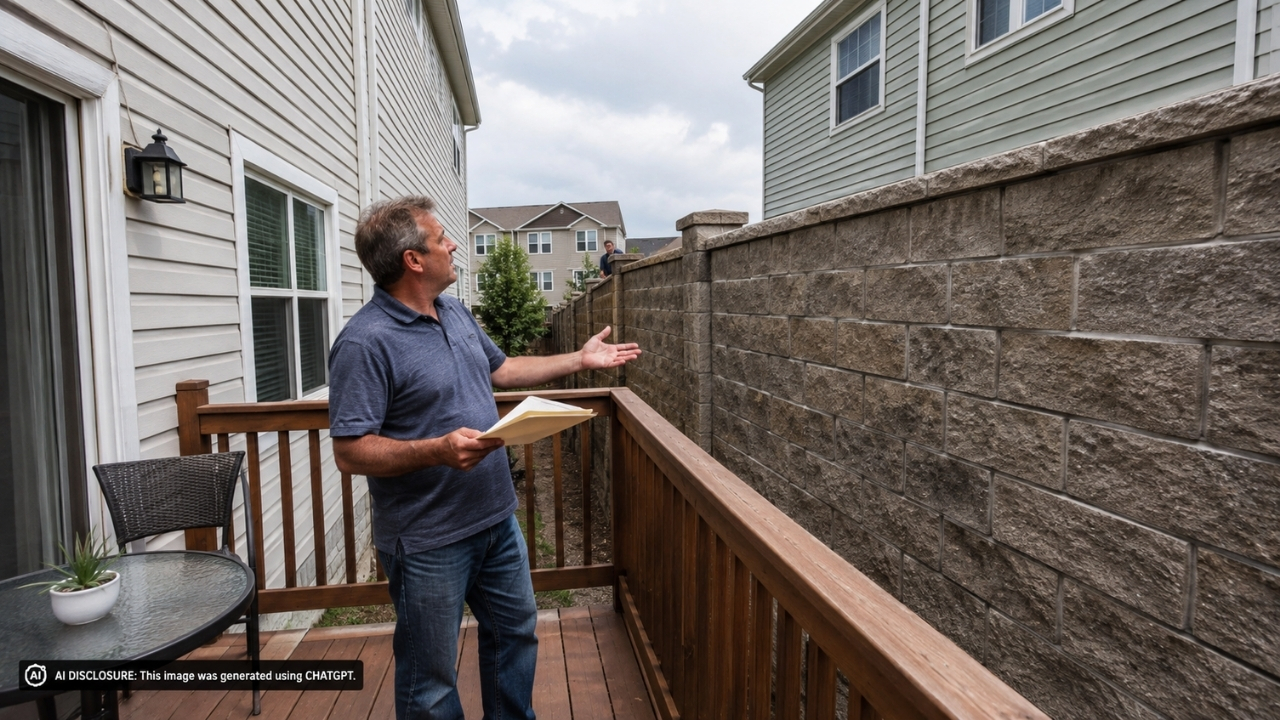
Photo credit: AI-generated image created using ChatGPT. Illustrative only.
It starts the way these townhome disputes usually start: you step out onto your back deck and realize something about the shared space has changed. A wall is suddenly “right there,” close enough to feel like it’s pressing into your daily routine, close enough to make you wonder who approved it and what it’s doing to access, light, drainage, and the basic feeling of being at home.
In Onondaga County, New York, that kind of irritation didn’t stay at the grumbling stage. It turned into a sprawling lawsuit with a long list of defendants and a level of court activity that eventually got the homeowner put on a short leash by the judge. The details come from the discussion of the case, Ryan v. Cunningham, decided by New York’s Appellate Division, Fourth Department.
A wall by the deck turned into an all-hands legal fight
Paul Ryan, a townhome owner, sued his adjoining neighbor Susan Cunningham over a wall built next to his back deck. If you’ve ever lived with shared walls, shared boundaries, and shared expectations, you can already hear the subtext: “Is that on your property, my property, or HOA property?” and “Who signed off on that?”
But Ryan didn’t just sue the neighbor. He also sued several other individuals, the Huntwood Homeowner’s Association, a property-management company, a landscaping company (Murray Landscaping LLC), and even the Town of Manlius.
His lawsuit sought removal of the wall and raised claims including private nuisance. He also leaned on the idea that the wall violated New York’s building code governing “party walls,” which is the kind of phrase that makes homeowners picture a simple rulebook—until they learn how courts treat code language when you try to use it as the basis for damages.
When “it violates code” doesn’t automatically mean “you can sue”
A major part of the appeal centered on Ryan’s push to expand the case against Murray Landscaping LLC. He wanted to amend his complaint again to accuse the landscaping company of unlawfully constructing a party wall in violation of Building Code § 706.1.1.
The appellate court said the trial judge was right to deny that amendment. The important detail here isn’t whether the wall met the code in everyday-common-sense terms—it’s what the code can do in court.
The court explained that a building-code violation can sometimes be used as evidence of negligence, but the Building Code itself does not create a private cause of action. Translation in homeowner language: even if you believe something was built “against code,” that doesn’t always give you a direct lawsuit claim just for the code violation. You may need a different legal hook, and you still have to prove the rest.
The default-judgment attempt hit a paperwork wall of its own
Ryan also tried to get a default judgment against a defendant named David Smart. That’s the move people think is straightforward—“they didn’t respond, so I win”—but courts can be picky for good reason. A default judgment can be serious business.
Here, it failed on procedural grounds. Ryan relied on his original complaint, even though an amended complaint had replaced it as the operative pleading. That’s like trying to get a permit approved using last year’s drawings after you’ve already submitted revised plans.
He also didn’t give the court sufficient proof of the facts underlying the claim. Neither complaint was verified, and he didn’t submit a supporting affidavit laying out those facts. In practical terms, the court wasn’t going to award a judgment just because paperwork was missing on the other side; the person asking for the judgment still had to properly show what they were entitled to.
More than 20 motions before discovery even began
The part that made this case stand out wasn’t only the wall. It was the pace and volume of the court fighting.
Before discovery even started, Ryan had filed more than 20 motions. Discovery is usually where people exchange documents, take depositions, and nail down what actually happened—contracts, HOA approvals, communications, plans, photographs, surveys. In other words, the phase where a property dispute starts turning into provable facts.
Instead, the court was dealing with motion after motion, early and often. And eventually, the trial court did something you don’t see in normal neighbor disputes: it barred Ryan from filing any more motions unless he first got permission from the court.
Ryan argued on appeal that this was overly punitive. The appellate court didn’t buy it. The judges emphasized that while people generally have a right of access to the courts, that right can be restricted when someone abuses the judicial system through meritless, frivolous, or vexatious litigation.
With more than 20 motions filed before discovery even began, the appellate court concluded he had “clearly abused the judicial process.” The order limiting his ability to file further motions stayed in place.
How homeowners reacted: document first, don’t litigate yourself into a corner
In homeowner circles, disputes like this tend to split people into two camps: the “fight it, it’s your property” camp and the “slow down and build a file” camp. This case reads like a caution sign for anyone tempted to turn every frustration into an urgent court filing.
The practical-minded reactions usually focus on the basics that courts and HOAs actually respond to: surveys, dated photos, written communications, clear timelines, and the exact governing documents for the HOA. If a wall is near a deck, people also think about access and maintenance—can you still service your siding, clean the area, or address water problems without stepping onto someone else’s space?
And, crucially, there’s the legal reality highlighted by the appeal: “code” is not always a standalone ticket to a win. Even when code matters, you still need the right legal theory and the right proof in the right format, or you can spend months burning energy without moving the ball forward.
The court’s final answer: no expansion, no default win, and motion limits stay
Ryan lost the appeal across the board. The appellate court unanimously affirmed the lower court’s order.
He wasn’t allowed to amend his complaint to add that building-code-based claim against the landscaping company in the way he wanted. He didn’t get the default judgment against David Smart because of the procedural and proof issues. And the most unusual part—the restriction preventing him from filing additional motions without permission—remained in place.
All of it leaves a familiar townhome aftertaste: the original problem was physical and close to home, but the fallout became paperwork-heavy and exhausting. A wall beside a back deck may look like a simple boundary argument from the outside, but once it drags in neighbors, an HOA, contractors, managers, and the town, it can stop being about the wall at all—and start being about who can outlast whom.
Like Fix It Homestead’s content? Be sure to follow us.