Aerial Survey Photos Show the Neighbor’s Patio and Invisible Dog Fence Extend Several Feet Onto Homeowner’s Land — Then the Neighbor Accuses the Company of Cutting Their Fence Line Instead
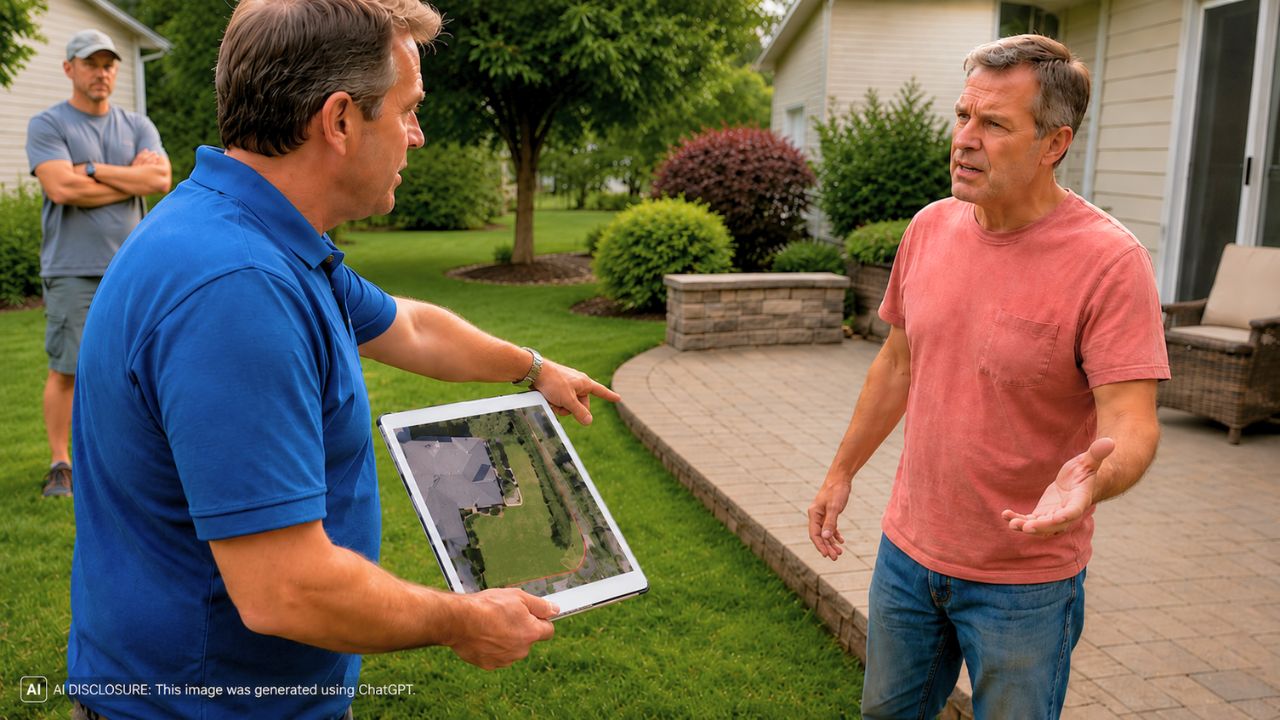
Photo credit: AI-generated image created using ChatGPT. Illustrative only.
It started like one of those “finally, we’re doing it” upgrades: a homeowner with a decent-sized lot in Iowa hired a company to install an invisible dog fence. Nothing flashy, just peace of mind and a clear boundary for a pet. Then the installer got a message from the neighbors saying their invisible fence line had been cut.
The homeowner hadn’t even heard it directly yet. But after checking a county website’s aerial GPS map, they believed the alleged cut point wasn’t on the neighbor’s side at all—it appeared to be a few feet inside the homeowner’s property. The same map also seemed to show something more awkward: part of the neighbor’s patio, by about 2–3 feet, extending over the line. The homeowner laid it all out in the original post, asking how much weight to put on those online property-line tools and what to do next without turning the street into a battleground.
The fence install that triggered a much bigger question
The homeowner’s first instinct wasn’t to accuse anyone. They went looking for a reference point—something objective—because invisible fences are exactly that: hard to “see” and easy to argue about later.
On the county site, the aerial photo looked recent enough to include landscaping and a newer deck the homeowner had built within the last few years. That mattered, because it suggested the map wasn’t decades out of date. Even more convincing, the GPS length line shown on the map appeared to match the property length listed on the deed.
But then came the neighbor’s complaint to the installer: their existing invisible fence line had been cut. The homeowner started connecting dots. If the county map was even close to accurate, the neighbor’s fence line may have been installed inside the homeowner’s property in the first place.
The aerial map seemed to show an encroachment in plain sight
When the homeowner zoomed in on the boundary area, they noticed what looked like a small section of the neighbor’s patio sitting over the property line. Not dramatically—just a couple of feet. But in property terms, “just a couple of feet” is exactly how years-long disputes get born.
What made it stranger was the pattern the homeowner thought they could see: the neighbor’s invisible fence line appeared to route around that patio section. In other words, the fence path itself looked like an unspoken admission that the patio was there and the fence had been designed to accommodate it.
Now the homeowner was stuck with two overlapping problems. One was immediate and practical—an installer being told they damaged someone else’s line. The other was longer-term and messier: a patio encroachment that could become “normal” if nobody ever says anything.
“Decent neighbors” until the boundary actually matters
The homeowner didn’t describe constant feuding. In fact, they called the neighbors “relatively decent” otherwise, which is why this felt so risky. It’s one thing to notice a mowing pattern drifting over the line. It’s another to realize there’s hardscape—literal patio—where it may not belong.
Even if everyone stays polite, these moments tend to force choices. If the neighbor comes over insisting the dog-fence company owes them a repair, does the homeowner stay quiet to keep the peace? Or does the homeowner push back and risk making the patio issue “official” by bringing it up?
And there’s also the contractor angle. The homeowner’s company was the one being approached. If the installer tries to smooth it over by agreeing to fix something, that could accidentally validate a claim that the neighbor’s line was rightfully placed there to begin with.
The history that made this harder to ignore
This wasn’t the first time the homeowner had heard of boundary problems tied to this neighbor. They added an important detail: the same neighbor has a history of encroaching on the land behind the homeowner’s property as well.
According to the homeowner, the neighbor had put up at least two fences on the behind-neighbor’s land in the past, and those fences came down after discussions. That kind of backstory changes the tone. A one-time measuring mistake is easier to chalk up to confusion. A repeated pattern starts to look like strategy—or at least a habit of pushing until someone pushes back.
So now, what could have been a simple “oops, we nicked a wire” conversation begins to feel like a test: will the homeowner treat the county map as enough proof to draw a line, or let it slide because it’s only a few feet?
Why online property lines feel convincing—and why they can still blow up a friendship
The homeowner’s big question was about reliability: how much should they trust a county website’s aerial GPS photo for property lines?
Those maps can look authoritative, especially when they match what’s on a deed and include recent improvements like a new deck. The trouble is that even a small offset—just a few feet—can put a patio, a fence wire, or a landscaping bed on the “wrong” side and escalate something that was never discussed out loud.
In day-to-day life, neighbors rely on visual cues: where the grass changes, where the previous owner mowed, how the yards have “always” looked. Invisible dog fences and patios don’t care about tradition. Once someone claims damage or ownership, the conversation shifts from friendly habit to documentation and liability.
How readers tend to react: document first, then decide how direct to be
Even without a comment thread included in the source material, this type of dispute usually pulls the same practical instincts out of homeowners: don’t argue from a screenshot alone, and don’t let contractors negotiate your property lines for you.
The most common real-world next steps people suggest in situations like this are to get clearer evidence (often a professional survey), keep communication in writing, and avoid making payments or promises until the boundary question is nailed down. Especially when there’s a claim that someone “cut” an invisible fence line, documentation matters—where the installer worked, what was marked, and what was physically found in the ground.
And when there’s already a patio possibly crossing the line, people tend to think long-term: letting it sit unchallenged can turn a small encroachment into a permanent headache when it’s time to sell, replace fencing, or add improvements near the boundary.
The homeowner’s dilemma is the kind that doesn’t feel urgent until it suddenly is. A wire in the ground turned into a question about a patio, a property line, and a neighbor’s pattern of pushing boundaries. Whether the county map is perfectly accurate or not, the bigger issue is now out in the open—at least between the neighbor and the installer—and it’s unlikely to disappear on its own.
Like Fix It Homestead’s content? Be sure to follow us.