Buyer Finds a Neighbor’s Well Sitting Entirely on the Newly Purchased Cottage Lot — Then the Neighbor Says a Decades-Old Verbal Agreement Still Applies
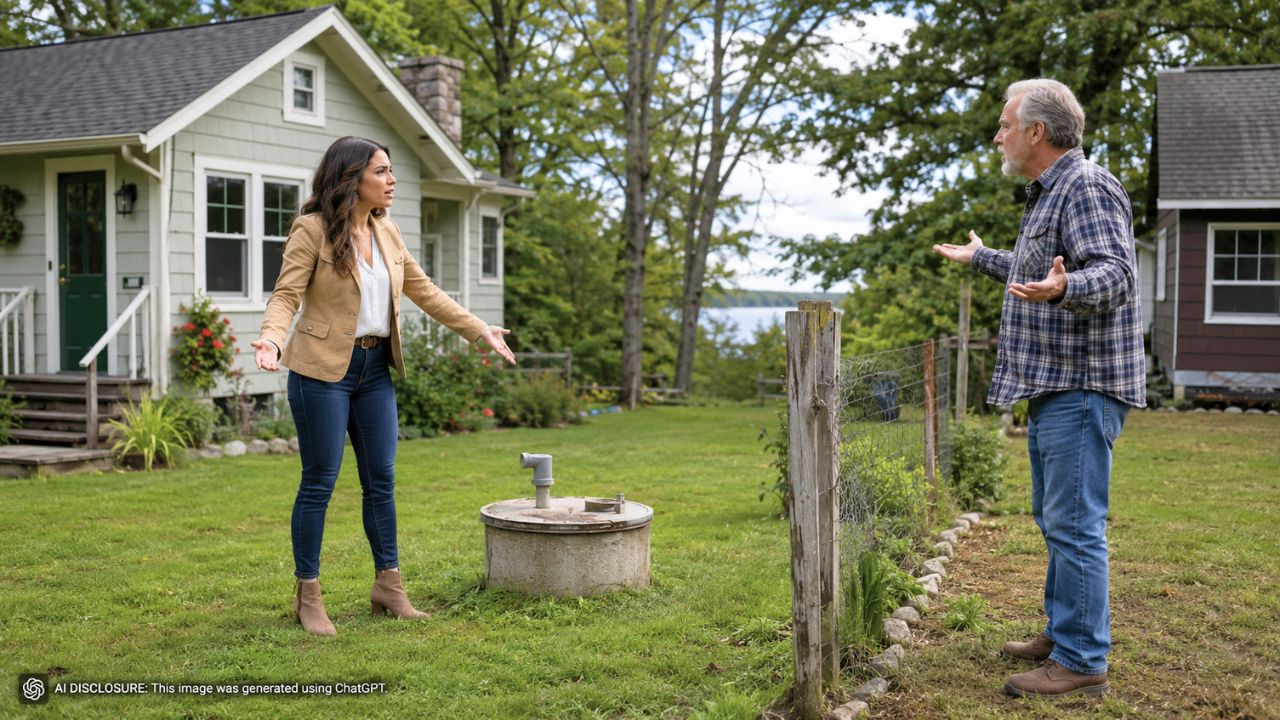
Photo credit: AI-generated image created using ChatGPT. Illustrative only.
Buying a small cottage is supposed to feel like stepping into simpler living: a little land, a little quiet, and the basics under your control. But one new owner in Kern County, California says the first real surprise came not from a creaky roof or old wiring, but from a water source that everyone acted like they owned.
In the original post, the buyer says the property’s well sits on their lot—yet the neighbor has been plumbed into it for years and insists he still has a “half interest” in it based on a decades-old handshake deal made with an owner “two generations ago.” Nothing was recorded, no covenant was attached to the land, and the people who supposedly made the deal are long gone.
The well was on the lot, but the history wasn’t in the paperwork
According to the homeowner, the neighbor’s claim wasn’t new. He says he once had a “third interest for a few years 20 years ago,” tied to an informal arrangement with prior owners. The problem is that the buyer says none of it was recorded, and they never signed anything.
What made it sting more is that the buyer says they were told the agreement was recorded—by their realtor, who is now the neighbor’s realtor. The buyer only learned the truth after checking their title when the neighbor listed his place for sale in July.
That’s when the well stopped being a quirky piece of rural infrastructure and started looking like leverage. The neighbor, the buyer says, wanted something he could sell with his cottage: a documented right to the well.
A cash offer showed what the well was really worth to the neighbor
After the buyer raised the issue—no recorded agreement, no clear right to keep drawing water—the neighbor didn’t quietly reroute his plumbing or start drilling his own well. Instead, the buyer says the neighbor offered “cash (not much)” to get a contract granting him a half interest.
The timing mattered. The neighbor was trying to sell his cottage, and a reliable water source can be the difference between “marketable” and “good luck.” The buyer describes the offer as a way to turn an old, informal practice into something bankable, something that could be represented to a future buyer as a real property right.
From the homeowner’s perspective, it sounded like a retroactive paperwork push: the neighbor had been using the well, and now he needed proof he was allowed to.
Then a tree crushed a water tank and the dispute turned into a health worry
Just when the buyer thought this was headed toward an awkward negotiation, the physical reality of shared water systems showed up. The homeowner says an oak tree crushed the neighbor’s rooftop water tank, leaving it “gapping open.”
The neighbor tried to patch the tank with duct tape. The buyer didn’t see it as a temporary eyesore—they saw a contamination risk. With an open, damaged tank, you’re not just dealing with a leak. You’re potentially dealing with debris, animals, bacteria, and whatever else can get inside.
So the buyer cut off the neighbor’s water pipe. At the same time, they proceeded to hook the well up to their own house, noting that when they purchased the cottage, the well wasn’t even plumbed into their place.
It’s the kind of moment that turns a neighbor disagreement into something that feels immediate: water isn’t optional, and water that isn’t safe becomes everyone’s problem fast.
A demand letter arrived with a big number and a daily penalty
The shutoff didn’t lead to a calm sit-down. The buyer says the neighbor and the neighbor’s lawyer are now demanding $20,000 within 10 days, plus an additional $200 per day “until full restoration,” or they’ll sue.
The lawyer’s position, as described by the homeowner, is that the buyer “admitted to vandalism” and acknowledged the existence of an unrecorded agreement. The buyer is left staring at the classic homeowner nightmare: you try to protect your property and your health, and suddenly you’re being treated like the person who caused the damage.
Even if the buyer believes they’re in the right, the pressure campaign is real. Ten days. A large dollar figure. A per-day meter running. It’s designed to make someone panic and pay just to stop the bleeding.
The homeowner asked if it’s extortion and whether they should lawyer up. The question alone shows how quickly this escalated—from “we need to sort out who owns what” to “I could be in court.”
Homeowners zeroed in on proof, paper trails, and the physical pipe
While the post itself is the main record here, the practical instincts that typically surface in disputes like this are easy to predict, because the battlefield is always the same: documentation and boundaries.
When one neighbor claims rights based on old verbal promises, the next steps tend to revolve around what can be proven now—title documents, easements, surveys, and whether any right to use the well was ever legally attached to the neighbor’s parcel. The buyer already took one key step by checking the title themselves and discovering the agreement wasn’t recorded.
And then there’s the plumbing. A shared water line isn’t just a neighborly convenience; it’s a physical connection across property lines. Once lawyers get involved, the questions get very specific: where the line runs, who installed it, whether permits were involved, whether the neighbor’s system creates contamination risk, and whether cutting it off was lawful self-help or actionable interference.
In other words, it’s not just “who owns the well.” It’s “who has the right to access it, connect to it, and rely on it,” and whether that right can be enforced against a new owner who never agreed to it.
The hardest part is living next to someone who needs your water
There’s a particular kind of tension that comes from resource disputes on small properties: you can’t pretend it’s abstract. If the neighbor truly has no alternate supply, every day without water becomes an emergency on their side—and a pressure point on yours.
At the same time, the buyer’s description of a crushed, duct-taped rooftop tank makes it clear why they didn’t want the neighbor’s setup pulling from the same source. Even if the systems aren’t physically mixing back into the well, the optics and fear are enough to keep a homeowner up at night.
The buyer is now using the well for their own home, after buying a place that apparently wasn’t even connected to its own water source. They’re dealing with the practical realities of rural infrastructure and the messy human reality of inheriting a neighbor’s expectations.
And now, instead of settling into the cottage, they’re staring at a demand for $20,000 and $200 a day—over a well that sits entirely on their newly purchased lot, and a “deal” they say was never put on paper.
Like Fix It Homestead’s content? Be sure to follow us.