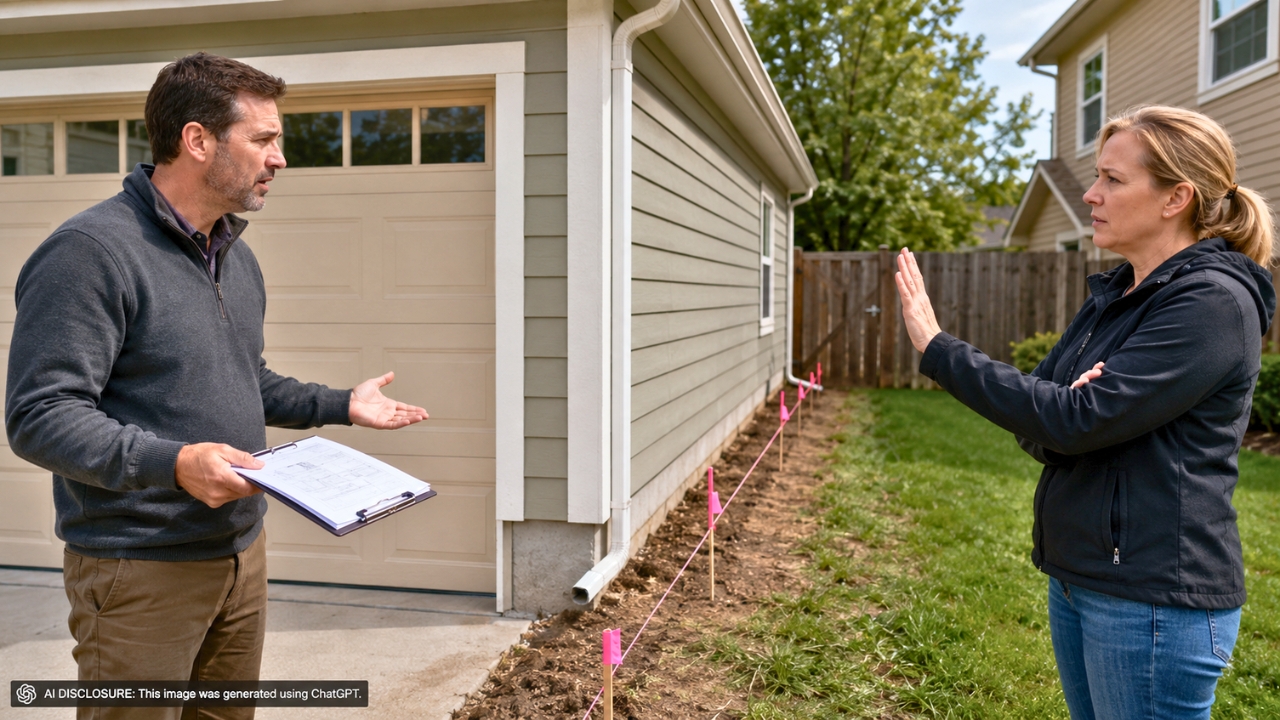
Buyer Finds Out the Seller’s Garage Extends Over the Property Line — Then the Neighbor Refuses to Grant an Easement Before Closing
Photo credit: AI-generated image created using ChatGPT. Illustrative only.
It’s the kind of detail that sounds small until you imagine trying to sell the place later: a detached garage that doesn’t sit entirely on the lot you’re buying. A first-time home buyer in Pennsylvania spotted it in the seller’s disclosure and realized the outbuilding reportedly crosses the neighbor’s property line.
In the original post, the buyer said the disclosure claimed the encroachment was “known and managed” before the current owners purchased the home. But “managed” can mean a lot of things in real life—anything from a handshake agreement that no one remembers clearly, to an actual recorded document that future buyers can rely on.
The disclosure turned a “nice extra” into a big question mark
Detached garages are usually a selling point: storage, a workshop, a place to keep tools dry, maybe even future finished space. But the moment part of that structure is on someone else’s land, it stops being just a garage and starts being a boundary problem with a roof.
The buyer’s immediate worry was straightforward: the current neighbor might be fine with it today, but neighbors change. If the adjoining property sells, a new owner could decide they don’t want someone else’s building on their parcel. And that’s when a “known and managed” arrangement can turn into a crisis at the worst possible time—like when you’re refinancing, remodeling, or trying to sell.
Even before anything escalates, the psychological weight is real. It’s hard to feel settled in a home when a chunk of your outbuilding is essentially sitting on borrowed ground.
“Known and managed” sounds comforting—until you ask managed how?
This is where the story gets tense. The sellers acknowledged the encroachment, but the buyer doesn’t yet know what “managed” means in practice. Was there a written agreement? Was it recorded with the county? Was it something the previous owners simply tolerated?
People do live for decades with informal boundary understandings, especially with older outbuildings. A garage goes up a few feet over a line. Nobody complains. Everyone has more pressing things to do. But informality is fragile, and it often breaks at the exact moment money enters the room—when one property is being sold, when an addition is planned, or when a survey flags the issue in black and white.
The buyer’s question—“can I be in for any headaches down the road?”—isn’t paranoia. It’s the right instinct. The headaches aren’t hypothetical; they’re baked into the way property rights work. If a neighbor decides to push the issue, you could end up facing demands to remove part of the structure, negotiate after you’ve already bought, or fight about access and maintenance.
This is the kind of problem that can blow up at closing
Encroachments have a way of staying quiet until a transaction forces everyone to be precise. A lender, title company, or closing attorney can treat it like a loose thread that needs to be tied off before they’ll proceed.
And if the neighbor is asked to sign something—an easement, a boundary agreement, anything that formalizes the garage’s footprint—that’s when you find out what they really think. A neighbor who was “fine with it” might balk when the paperwork is in front of them. They might worry about liability, future use of their land, or simply resent being asked to give permission for a problem they didn’t create.
That refusal can stop the deal cold, or at least force a renegotiation. Suddenly you’re not debating paint colors. You’re talking about surveys, legal descriptions, and whether a structure that seemed like a perk is actually a long-term risk.
For a first-time buyer, that’s a brutal pivot: one day you’re envisioning moving boxes and a workbench, the next you’re trying to understand what happens if a garage corner sits where it technically shouldn’t.
The practical fallout isn’t just legal—it’s everyday living
Even if no one ever sues anybody, an encroaching garage can create day-to-day friction. Maintenance becomes a question. If siding needs to be replaced on the side that crosses the line, are you allowed to step onto the neighbor’s land to do it? If the roof sheds water onto their side, is that an issue? If the neighbor wants to build a fence, do they now have to work around your building?
Then there’s the future. If you want to rebuild the garage, expand it, pour a new slab, run electrical, or do anything that triggers permits, the encroachment can pop back up. Something that was “managed” quietly may not be “manageable” once a municipality or contractor starts asking for a survey and setbacks.
And the resale question hangs over everything. Buyers get skittish when they hear “part of the garage is on the neighbor’s property,” even if it’s been that way for years. It can narrow your buyer pool or slow down a sale, because the next buyer will ask the same question you’re asking now—only they’ll be asking it about you.
Homeowners in the comments leaned toward proof, not promises
While the source post itself is brief, the tone of the question reflects what seasoned homeowners tend to say when property lines get involved: don’t rely on verbal assurances. “Known and managed” is not the same thing as documented and enforceable.
When people run into boundary surprises, the most practical voices usually focus on getting the facts nailed down early—what a survey shows, what the title history says, and whether there’s anything formally recorded that protects the structure’s existence where it sits. If the only “management” is that nobody complained, that’s not a plan; that’s a pause.
The other common theme in these conversations is leverage: before closing is the one moment when a buyer can insist the problem be resolved by the seller, not inherited. Once you own the house, you’re negotiating from a weaker position because you’re the one who needs a solution.
The tension is deciding whether the garage is worth the gamble
The buyer is left standing at a familiar fork in the road. Option one is to walk away and keep looking—painful, but clean. Option two is to move forward only if the encroachment is addressed in a way that won’t collapse the next time the neighbor changes or the property transfers.
That’s the real drama in this kind of purchase: the house itself might be perfect, and the garage might be the exact space a buyer wanted, but the line on the ground doesn’t care about emotions. It cares about where the boundary is, and what happens when two owners disagree.
For first-time buyers especially, this is one of those early lessons that doesn’t show up on listing photos. The biggest problems aren’t always mold behind the drywall or a roof near the end of its life. Sometimes it’s a few feet of building in the wrong place—and the uneasy feeling that the only thing holding it together is a neighbor’s goodwill.
Like Fix It Homestead’s content? Be sure to follow us.