California Homeowner’s Survey Shows the Neighbor’s New Fence Sitting Two Feet Onto Her Land — Then He Calls It “Close Enough” and Refuses to Move It
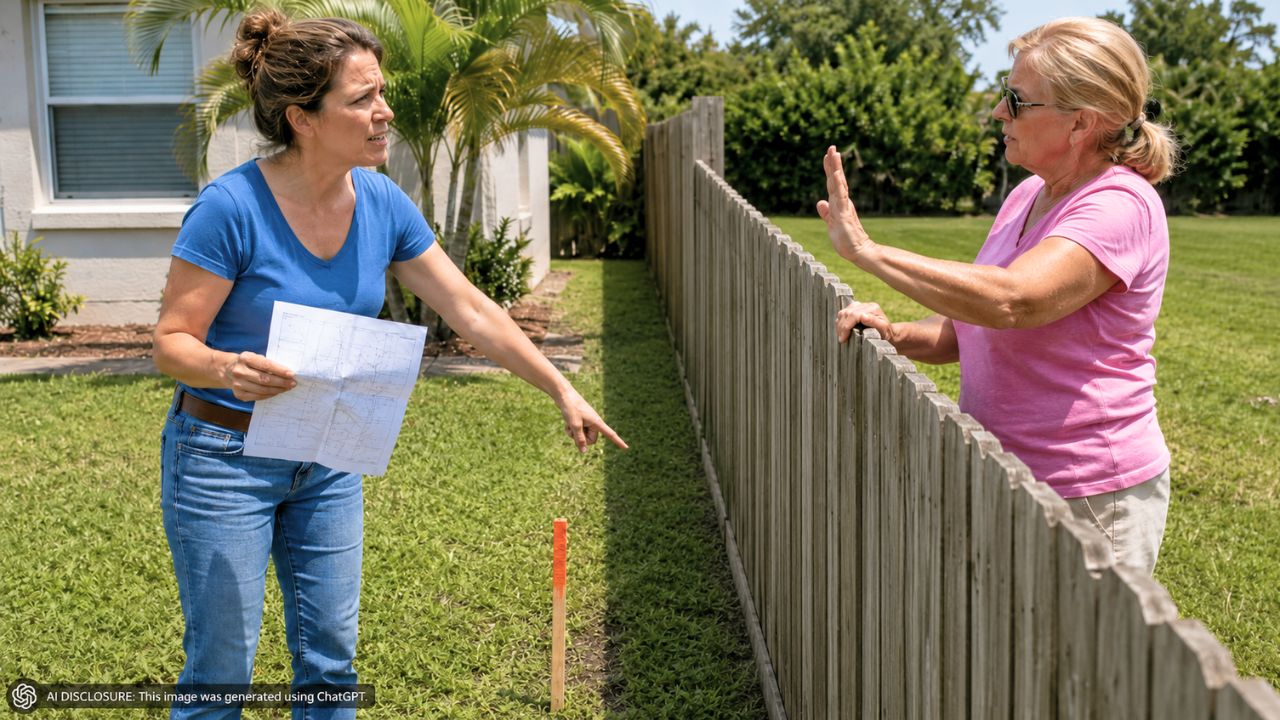
Photo credit: AI-generated image created using ChatGPT. Illustrative only.
It started the way a lot of fence disputes do: a “nice new fence” goes up, the lines look about right from the driveway, and everyone assumes it’s fine. Then a California homeowner paid for a survey and saw the markers didn’t match the new boards at all. The fence wasn’t just a little off—it was about two feet into her yard.
When she brought the paperwork to her neighbor, she didn’t get an apology or an offer to fix it. She got a shrug. According to the original post, the neighbor brushed it off with “it’s close enough, don’t worry about it,” and flat-out refused to move the fence when asked.
Two feet doesn’t sound like much—until it’s yours
In most backyards, two feet feels like a narrow strip. But on the ground, it’s the difference between having room to walk a mower, plant along a border, or get to the side of a house without squeezing. It’s the space where sprinklers get adjusted, where dogs run, where a gate swings open.
And the homeowner’s worry wasn’t just about today’s inconvenience. It was the long-game fear: if she lets it sit, does she slowly “lose” that piece of yard forever?
The survey turned a casual guess into a hard line
Property lines are one of those things neighbors hand-wave until a project makes them real. A fence changes how people move through space, where they store things, and what they assume is theirs. Once the fence is built, it starts to feel permanent—even if it’s sitting in the wrong place.
That’s why the survey matters in this story. The homeowner didn’t eyeball it from the porch or argue from memory. She had the property surveyed, then used that result to show the fence was over the line and technically on her land.
For a lot of homeowners, that’s the moment the tone changes. A fence isn’t just a weekend project anymore; it’s a physical claim that can rewrite daily boundaries.
“Close enough” is how small problems become permanent ones
The neighbor’s response is what makes this feel less like a mistake and more like a test. “Close enough” might fly when you’re planting shrubs or aligning patio pavers. But when the object is a barrier that defines possession—where people walk, store equipment, or assume control—it’s not just cosmetic.
The refusal to move it also pushes the homeowner into a corner. If she ignores it, she’s living with a fence that cuts into her side of the yard. If she presses, she risks a sour relationship with someone she’ll see every day.
That’s the messy reality of property-line disputes: you’re trying to protect something important without turning the next decade into driveway silence and side-eye.
What the homeowner is really asking: can she force a fix?
Her question was simple and practical: can she legally make him remove it, or does she need to take him to small claims court? She emphasized that it’s “not a huge area,” but she doesn’t want to lose part of her yard for good.
That’s a very homeowner way to frame it. She’s not trying to punish him or cash out the square footage. She wants the boundary put back where it belongs, and she wants to know the most realistic path to get there.
In California, the stakes can get bigger than they look from a measuring tape. A fence placed over a line can affect access and maintenance, future improvements, resale disclosures, and the basic ability to treat your whole lot as usable space. Even if a two-foot strip seems minor, the wrong structure in the wrong place can hang over every future project—sheds, drainage work, landscaping, even just replacing the fence again later.
Homeowners focused on proof, paperwork, and not letting it drag out
Even without a full comment thread included, the typical homeowner playbook in disputes like this is easy to predict because the pain points are always the same: emotions don’t move fences—documentation does.
When one neighbor says “close enough,” the other neighbor needs a record that says “actually, no.” That means the survey becomes the anchor document, not just a conversation starter. The next steps people usually push toward are written communication (so the refusal isn’t just verbal), and a clear request for correction rather than a vague argument about fairness.
There’s also a practical reason homeowners get serious about timelines. The longer a misplaced fence sits, the more it becomes the “normal” boundary in day-to-day life. People start placing planters against it, running irrigation along it, treating it like the edge of their responsibility. And once routines form, fixing it feels like taking something away—even if it never belonged to them.
The tension isn’t just legal—it’s living next door after the fight
What makes fence encroachment so stressful is that it’s both a property issue and a relationship issue. You can’t solve it quietly. Someone has to move lumber, reset posts, re-dig holes, repair disturbed landscaping. It’s noisy, visible, and it comes with bruised pride.
On the homeowner’s side, the worry is that doing nothing is interpreted as consent. On the neighbor’s side, the temptation is to treat inconvenience as permission: moving a brand-new fence costs time and money, so the neighbor may hope the homeowner will back down to avoid conflict.
And right now, the homeowner is stuck in the part of the story that feels the most frustrating: she did the responsible thing by getting a survey, she communicated the problem, and she still got an outright “no.” Two feet doesn’t sound like much when someone is dismissing it. It sounds a lot bigger when it’s the line between “my yard” and “not my yard,” marked in boards that won’t move themselves.
Like Fix It Homestead’s content? Be sure to follow us.