Homeowner Builds a Garage Behind the Required Twenty-Five-Foot Setback — Then the Court Orders Him to Tear Out the Driveway Connecting It Within Ninety Days
Photo credit: AI-generated image created using ChatGPT. Illustrative only
Some homeowner projects don’t go sideways because the concrete cracks or the contractor ghosts. They go sideways because the build that looked “close enough” on your lot doesn’t match what the HOA signed off on—down to which street your driveway touches.
That’s the heart of a Texas dispute out of the Rayburn Country subdivision in Jasper County, where a detached garage was approved, built, and then turned into a court-ordered redo. In the discussion in the court record, the appeals court largely upheld an order forcing the homeowner to remove a driveway connection and add the exterior and landscaping the HOA said were required—on a 90-day clock.
It started with a normal garage request
Ryan Hightower owned Tract 31A in the Rayburn Country subdivision. In October 2018, he applied to build a 30-by-30-foot detached garage, and the plans he submitted were pretty specific: a driveway to the garage would connect to Gatewood Court (not Wingate Boulevard), and the garage would include rock or masonry-style siding to match his house.
The association approved the request in November 2018. The approval also came with a landscaping condition—shrubs along the Wingate side of the structure. This is the kind of detail that seems minor when you’re trying to get a build underway, but becomes a big deal later when the “approved plan” is the only thing anyone wants to talk about.
The build finished, and the details didn’t match the paper
By February 2019, the garage was done. The problem was that it didn’t look like the version the HOA approved.
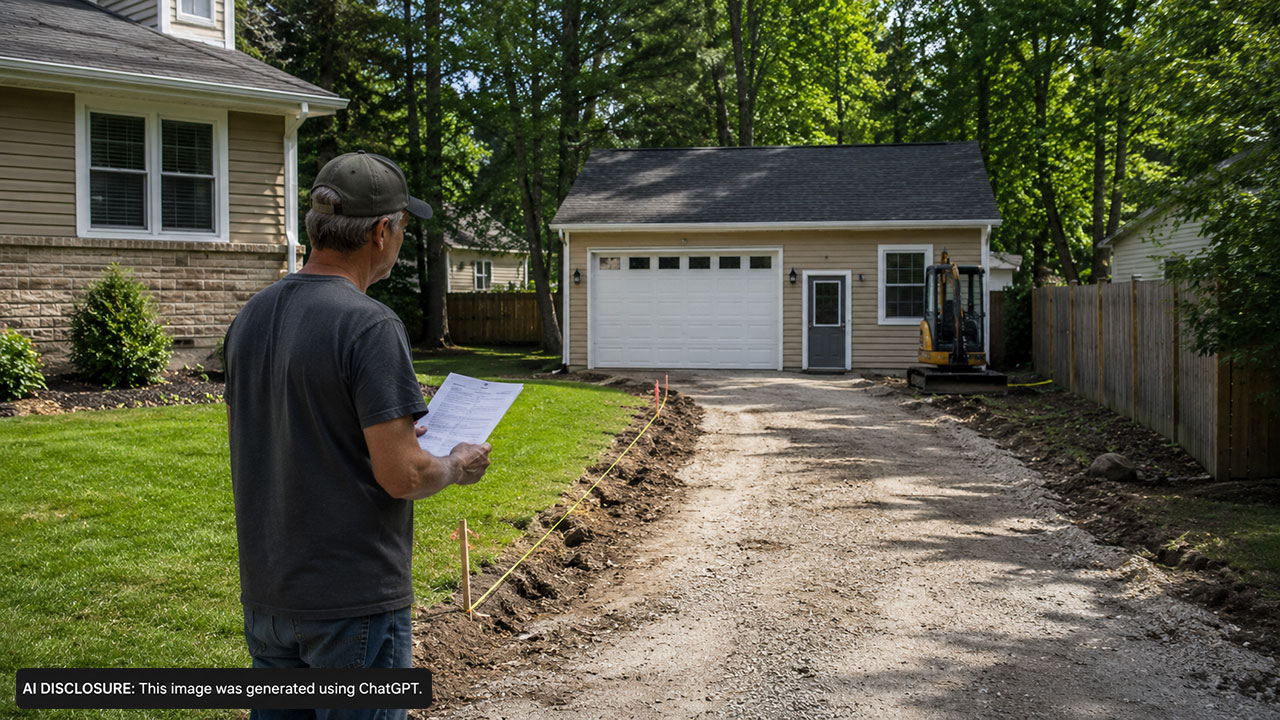
According to the court record, the finished project was missing the rock siding. The required shrubbery wasn’t there either. And the biggest change was access: instead of building the approved driveway connection to Gatewood Court, Hightower installed a green-rock driveway connecting the garage directly to Wingate Boulevard.
Rayburn Country repeatedly asked him to correct what it saw as violations. And from the HOA’s perspective, this wasn’t nitpicking trim or paint color. Board witnesses described Wingate as the main entrance into that residential section, with a greenbelt on either side that was intended to protect safety, privacy, watershed quality, and the neighborhood’s appearance.
The driveway was the flashpoint, and “temporary” became permanent
Hightower’s explanation was that he believed he had permission—at least initially—to use Wingate for access while the garage was being built. He testified that a committee representative verbally allowed a temporary Wingate driveway because the Gatewood route posed construction problems.
The catch was that the permission wasn’t in writing. And Hightower acknowledged the Wingate driveway was originally supposed to be removed after construction. Once he ran into complications with the Gatewood route, he decided not to remove it.
Cost hovered over the whole decision. Hightower estimated a driveway to Wingate would cost roughly $6,500 to $7,000, compared with close to $20,000 for a concrete driveway to Gatewood. If you’ve ever priced out site work—grading, drainage, base material, concrete—you can see how someone gets locked into the cheaper “it’s already done” option, even when that option is the one most likely to get challenged.
He tried the big argument: “These rules don’t apply to my tract”
When the fight escalated, Hightower didn’t just argue about siding and shrubs. He argued the HOA couldn’t enforce the subdivision restrictions against him at all.
Tract 31A had been carved out of an area historically identified as a greenbelt. Hightower contended it was an unplatted tract outside the numbered lots governed by the Section 10 restrictive covenants, meaning Rayburn Country didn’t have the authority to regulate his build like it would on a typical lot.
The appeals court didn’t buy it. The court found enough evidence that Tract 31A remained part of Rayburn Country Section 10 and was subject to the recorded restrictions. Deeds in Hightower’s chain of title described the greenbelt property as part of the subdivision and conveyed it subject to recorded restrictions, easements, covenants, and conditions.
His own actions also undercut the claim. Before building, he submitted an application, paid the required fee, and sought architectural committee approval. The appeals court pointed to that behavior as supporting the HOA’s authority to enforce the approved requirements.
The judge gave him 90 days to undo the visible parts
After a bench trial, the lower court ruled Hightower violated the restrictions by building the Wingate driveway, not installing the rock siding, and not planting the shrubs.
The remedy wasn’t a polite letter or a slap-on-the-wrist fine. The judge ordered him to correct all three within 90 days: remove the Wingate driveway, install rock siding facing Wingate, and plant shrubbery in front of the garage. The court also awarded Rayburn Country $5,000 in trial attorney fees, plus contingent appellate attorney fees.
The trial judge went further, calling the failure to follow the permit a breach of contract and adding a $25-per-day penalty starting on day 91 if he didn’t comply. That part didn’t survive appeal—but the work order did.
The appeal knocked out the penalties, not the teardown order
On appeal, Hightower got two partial wins. The appeals court threw out the breach-of-contract judgment because the HOA hadn’t proven damages—an essential element of that type of claim. The court said it didn’t even need to decide whether the building permit functioned as a contract, because there was no damages award supporting that theory.
The court also struck the $25-per-day civil penalty. While Texas law allows civil damages for restrictive-covenant violations, the appellate court viewed this daily amount as functioning like punitive damages. Without actual damages beyond nominal relief, the extra penalty couldn’t stand.
But the core of the case—whether the restrictions applied and whether the build matched approved plans—stayed intact. The appeals court upheld the declaratory judgment that his property was subject to the restrictions and upheld the permanent injunction. In plain terms: the order to remove the Wingate driveway and complete the siding and landscaping remained enforceable.
The practical reaction: get it in writing, or expect it to vanish
This is the kind of property drama that makes homeowners swap the same advice in comment threads and neighborhood chats: document everything, and don’t build on a handshake when the thing you’re pouring is literally concrete.
Even taking Hightower’s account at face value—that someone verbally okayed temporary use of Wingate—temporary permissions have a way of evaporating when leadership changes, memories fade, or a project becomes permanent. And once the structure is finished, the “fix” isn’t a quick tweak. It’s heavy equipment, a haul-off, and landscaping—done on a court timeline.
In the end, the appeals court did rein in the punishment. But it left the expensive, disruptive part standing: a homeowner being ordered to remove a driveway connection and retrofit the garage exterior and screening to match what was approved. It’s a reminder that the hardest part of an HOA build isn’t always construction—it’s what happens when the finished project doesn’t match the paper you started with.
Like Fix It Homestead’s content? Be sure to follow us.