Homeowner Finds the Neighbor’s Shed, Driveway and Fence All Crossing Onto Her Eighteen Acres — Then the Neighbor Ignores Every Request to Remove Them
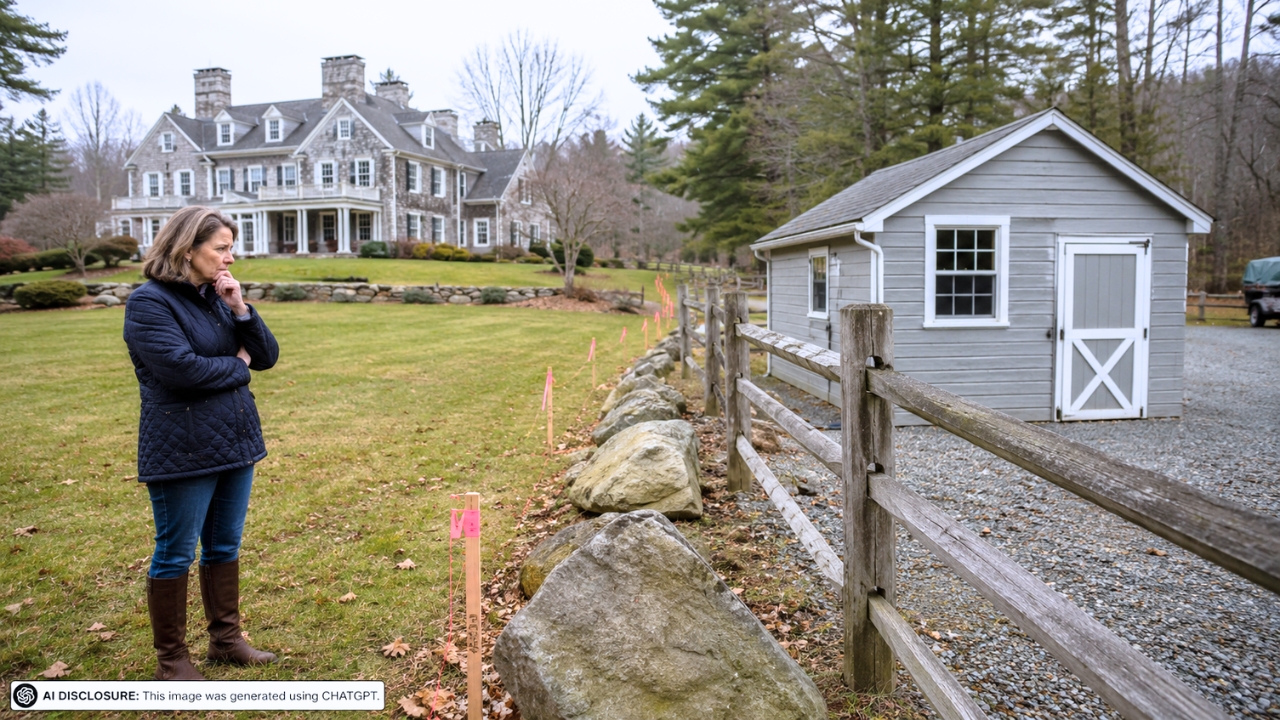
Photo credit: AI-generated image created using ChatGPT. Illustrative only.
Property line problems don’t usually announce themselves with a bang. They show up as a fence that “seems a little off,” a driveway that keeps getting wider, or a shed that looks like it’s sitting just a bit too comfortably near the edge of the woods. And by the time someone finally checks the pins and paperwork, the neighbor’s stuff can already feel permanent.
That’s the core of what’s now playing out in Great Barrington, where Dorinda Medley—known publicly for Blue Stone Manor—filed a lawsuit in Berkshire Superior Court alleging a neighbor’s shed, driveway, and fence cross onto her land, and that the neighbor ignored repeated requests to remove the encroachments. The details are laid out in the source report, and the complaint reads like the kind of boundary dispute homeowners dread—because it’s not just about inches on a map, it’s about access, control, and what happens when “please fix it” turns into “see you in court.”
The land was big, but the problem was right at the edge
Medley’s property, according to land records cited in the reporting, is about 18 acres. The neighbor’s parcel is listed at .67 acres. Those numbers matter because people hear “18 acres” and assume there’s no way a small corner issue can disrupt anything.
But boundary conflicts don’t care how grand the house is or how many trees you have. They happen where daily life meets the lot line: where someone parks, where they cut in for a turn, where they decide a fence “should” go, or where a shed fits best for storage and snow load. If the neighbor’s driveway or fence is even partly over the line, it can change how the owner uses that slice of land, and it can turn into a long-term mess fast.
It wasn’t discovered right away—and that’s when it gets expensive
One detail that will sound familiar to a lot of rural and semi-rural homeowners: the structures weren’t brand new. The lawsuit alleges the shed, driveway, and fence were constructed between 2016 and 2018, but Medley didn’t realize they were on her property until recently.
That timing is exactly why these disputes feel so personal. Once a fence is up for years, it becomes “the fence.” Once a driveway has been used for seasons, plowed in winter, and maybe repaired after mud season, it stops feeling temporary. Even if the paper boundary says otherwise, people get attached to what they’ve been using.
And for the owner on the receiving end, discovering it later can feel like a gut punch: you didn’t sign off on any of it, but now you’re the one who has to prove it, push back, and potentially deal with removal and restoration.
The survey is where the story turns from awkward to official
In May, the lawsuit says Medley hired a land surveyor—BEK Associates—who confirmed items did cross onto her property. That’s the moment these conflicts typically change tone. A conversation can be brushed off. A survey is harder to wave away.
The complaint also alleges that a different shed (not the one said to be on Medley’s land) violates the minimum setback in the zoning district. Even without getting deep into zoning rules, “setback” is the kind of word that makes homeowners’ stomachs drop, because it hints at permits, enforcement, and whether the build was ever properly placed to begin with.
Medley is asking the court to establish the boundary line and order the encroaching portions removed. The complaint also seeks damages and attorney’s fees, and describes the encroachments as “an ongoing and impermissible trespass” causing “irreparable harm.” That’s strong language, but it matches what these disputes feel like when they drag on: the harm isn’t just physical, it’s the daily reality that someone else is using what you own.
When the neighbor won’t move it, every small issue becomes a bigger one
The lawsuit alleges the neighbor, Aine Ungar, ignored multiple requests to remove the encroachments and to stop entering Medley’s property. That refusal—if that’s how it happened—is where the practical homeowner nightmare sets in.
Because once a neighbor won’t cooperate, the question stops being “Where’s the line?” and becomes “What else do I need to protect myself?” If someone is crossing onto your land to access their shed, maintain a fence, or use a driveway they believe is theirs, you start thinking about liability. If someone trips? If a vehicle slides on ice? If a tree falls and the argument becomes “well, this is basically my driveway”? Suddenly it’s not just a messy neighbor issue—it’s risk management.
It also locks the property owner into a documentation mindset. You’re keeping records of contacts. You’re saving emails. You’re logging dates. You’re getting photos when the grass is cut or the plow line changes. It’s exhausting, and it’s why so many people try to avoid escalating—until they can’t.
The reactions usually split into two camps: “survey first” and “stop waiting”
Even without a comment thread attached to this specific report, the pattern of how homeowners react to these stories is pretty consistent. One group focuses on proof and procedure: get a survey, get the boundary clearly marked, keep everything in writing, and don’t rely on handshake understandings when structures are involved.
The other camp is more blunt: if a neighbor has built onto your land and won’t correct it after being asked, stop negotiating in circles. Not because people love court, but because time tends to harden these disputes. The longer a driveway or fence sits in place, the more the neighbor treats it like a settled fact, and the more complicated it can feel to undo—logistically, emotionally, and financially.
This case has that same fork in the road. The surveyor step is already taken, and the next move is no longer just neighbor-to-neighbor communication; it’s formal boundary determination and a request for removal through the court.
Big properties still have small corners that can’t be ignored
Blue Stone Manor is a famous property—an 11,000-square-foot home built in 1902, purchased by Medley’s late husband in 2005, and later featured on Bravo shows. It even had an Airbnb tie-in in 2021 offering limited one-night stays. But stripped of all that, the court filing described in the reporting comes down to a familiar homeowner fact: if someone builds on your land and won’t undo it, you either live with it or you fight about it.
And living with it isn’t always really living with it. It can mean giving up a strip of usable space, accepting unwanted traffic, and losing control over a boundary that’s supposed to be clear. When the neighbor won’t remove what’s allegedly over the line, the landowner is left with the one tool that forces an answer: a judge deciding where the line is and what happens next.
For anyone watching from the sidelines, it’s a reminder that property lines are quiet until they’re not. Once a shed, fence, and driveway are involved, the problem stops being theoretical—and starts being something you can see every day out your window.
Like Fix It Homestead’s content? Be sure to follow us.
- Man Says He Found Out the Fence He Paid For Wasn’t Actually on His Property
- Woman Says Her Neighbor Started Taking Mulch From Her Delivery Pile Before She Could Even Spread It
- I made Joanna Gaines’s Friendsgiving casserole and here is what I would keep
- What Caliber Works Best for Groundhogs, Armadillos, and Other Digging Pests?