Homeowner Offers to Split the Cost of a New Rear Fence — Then the Neighbor Demands a Gate Into Their Yard as a Condition and Builds a Clashing Vinyl Fence Alone
Photo credit: AI-generated image created using ChatGPT. Illustrative only.
When you buy a house, you expect to spend your first year dealing with paint colors and moving boxes—not staring out the back window at a crooked fence that suddenly becomes your problem. That’s where one new homeowner found themselves after moving in March 2025, only to realize the rear dividing fence was in rough shape and leaning into their yard.
They tried to handle it the neighborly way first. In the original post, the homeowner explained they approached the rear neighbor—who owns that particular fence—and offered to split replacement costs. The neighbor initially agreed, even pulling a contractor quote and sending it over for approval. Then the “yes” came with strings attached.
A rotten fence turns into a design and access fight
The existing back fence was wooden and “falling apart,” with missing pieces and a noticeable tilt into the homeowner’s side. It wasn’t just ugly—anything leaning into your yard starts to feel like an eventual collapse, especially when boards are already failing.
The homeowner’s offer was simple: replace what’s there, make it safe, and share the bill. But after the quote was approved, the neighbor introduced two conditions for the new fence: it had to be white vinyl, and it had to include a gate between the yards “in case of an emergency.”
Both points landed badly. The homeowner’s existing fence line is all wood, and they didn’t want one bright vinyl run clashing with everything else. More importantly, they didn’t want a gate that could create access into their yard from someone else’s property, even if the reason given was emergencies.
The deal breaks, and the neighbor builds anyway
Once the conditions were on the table, the homeowner said they couldn’t do it. Vinyl and a shared gate were dealbreakers, and the neighbor said they couldn’t compromise on either.
So the homeowner backed out of paying. The neighbor responded with a clean break: “ok,” and then moved forward alone, paying for the new installation on their own dime.
That’s the moment this went from a joint maintenance plan to a permanent change in what the homeowner has to look at every day. Because even if a fence is technically on the neighbor’s property, it still defines your backyard experience—your sightline, your privacy, and the way your home presents from the inside out.
The new fence shows up—bright, crooked, and centered on the property view
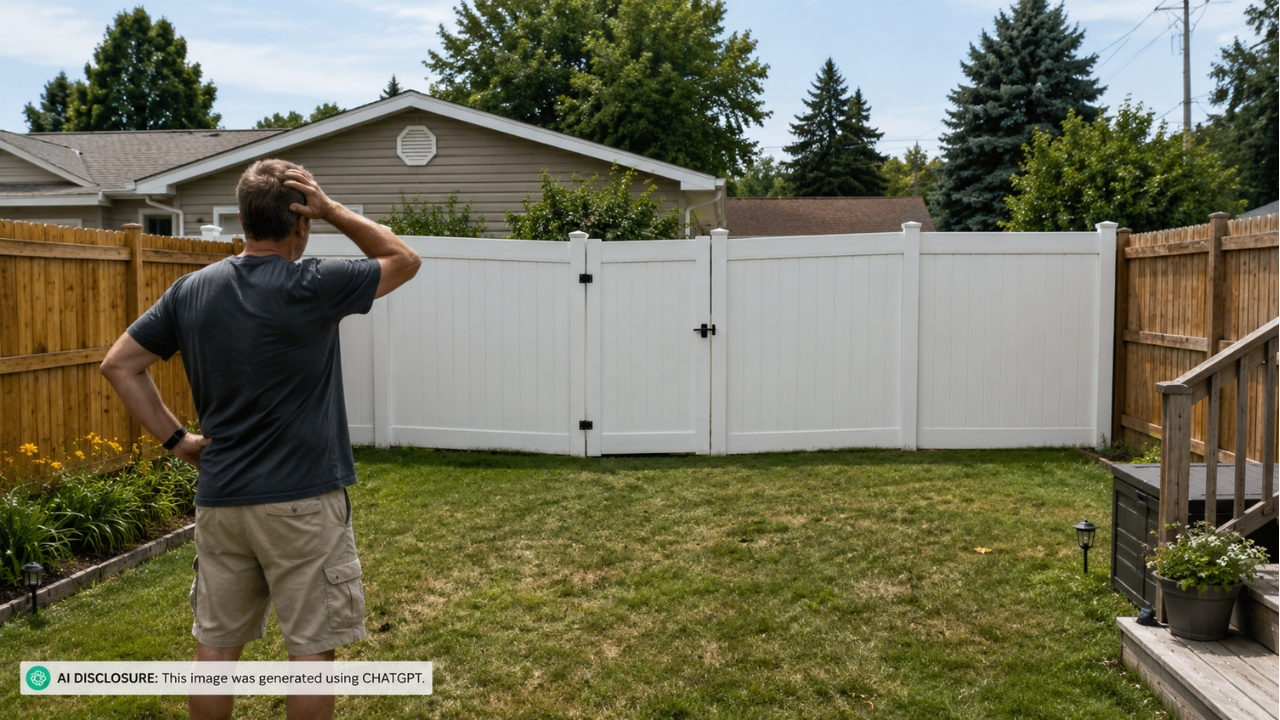
After installation, the homeowner says the result is exactly what they feared: a stark white vinyl fence against a run of wooden fencing. But the visual mismatch wasn’t the only issue. They describe the install as not straight, with “many of the panels between the posts” set at slight angles.
And then there’s the gate. It’s not tucked into a corner or placed where it feels incidental. The homeowner says the gate sits right in the middle of their property line view, making it the focal point from their side.
Even if the neighbor’s intent was practical, the homeowner now sees a direct access point aimed into their yard—one they didn’t agree to and don’t want to live with. To them, it reads less like emergency planning and more like an open invitation that could be used whenever someone feels like it.
A second fence becomes the only way to “take back” the backyard
With the vinyl fence up, the homeowner brought out a contractor to quote building a new fence on their side of the existing one. The idea isn’t to modify the neighbor’s fence; it’s to install a separate barrier fully on their property, effectively creating a double-fence line.
That new fence would completely block the vinyl from view and, as a direct consequence, would block the gate so it can’t function. Not by touching the gate—just by putting an additional wall of wood in front of it.
This is where the emotional math gets tricky. The homeowner isn’t asking if they’re allowed to prefer wood over vinyl. They’re asking if building their own fence now would be a needless escalation, and whether it’s going to poison the relationship with the person whose yard touches theirs every day.
On a practical level, they’re also reacting to quality. A fence that’s visibly angled panel-to-panel doesn’t just look bad; it can hint at rushed work, shifting posts, or a layout that wasn’t squared correctly. Even if it holds up, it’s hard to unsee once you notice it.
How people reacted: document first, then build smart
While the post itself focuses on the homeowner’s frustration and next steps, the common direction in these kinds of neighbor fence disputes tends to be less about “winning” and more about preventing the next surprise. When a neighbor builds something that affects your privacy and sense of security, the advice usually starts with proof and boundaries.
Homeowners in similar disputes often point to three practical concerns. First: property lines. If you’re going to build a new fence close to an existing one, it matters exactly where your boundary is and whether local rules require a setback. Second: drainage and maintenance. A tight gap between two fences can become a trap for leaves, weeds, and moisture, and it can make future repairs harder for both properties.
Third: access and expectations. Even if the neighbor calls it an emergency gate, once a gate exists, it’s easy for “emergency” to turn into “convenience.” Blocking it with a new fence is a clear statement: there is no shared access here. For some neighbors, that clarity prevents future arguments. For others, it’s the start of a new one.
The homeowner’s underlying worry—“Am I risking a poor relationship?”—is the part many people relate to. Backyard borders can turn a casual wave into a years-long cold war, especially when one side feels ignored and the other feels challenged.
The backyard is quiet, but the line between yards isn’t
On paper, the neighbor replaced their own fence at their own cost after the shared plan fell apart. In real life, the homeowner still has to live with the look, the workmanship, and the gate aimed into their space. And because the gate sits in the middle of the view, it’s not something that fades into the background.
Installing a second fence would likely solve the daily irritation—wood matches wood, the white vinyl disappears, and the gate becomes irrelevant. But it also sends a message that can’t be unsent, the kind of message that shows up every time someone steps outside to mow.
This is the part of homeownership no one puts in the listing photos: the property line isn’t just a boundary. It’s a relationship. And once a fence goes up, you’re not just looking at a structure—you’re looking at a decision your neighbor made that you now have to respond to.