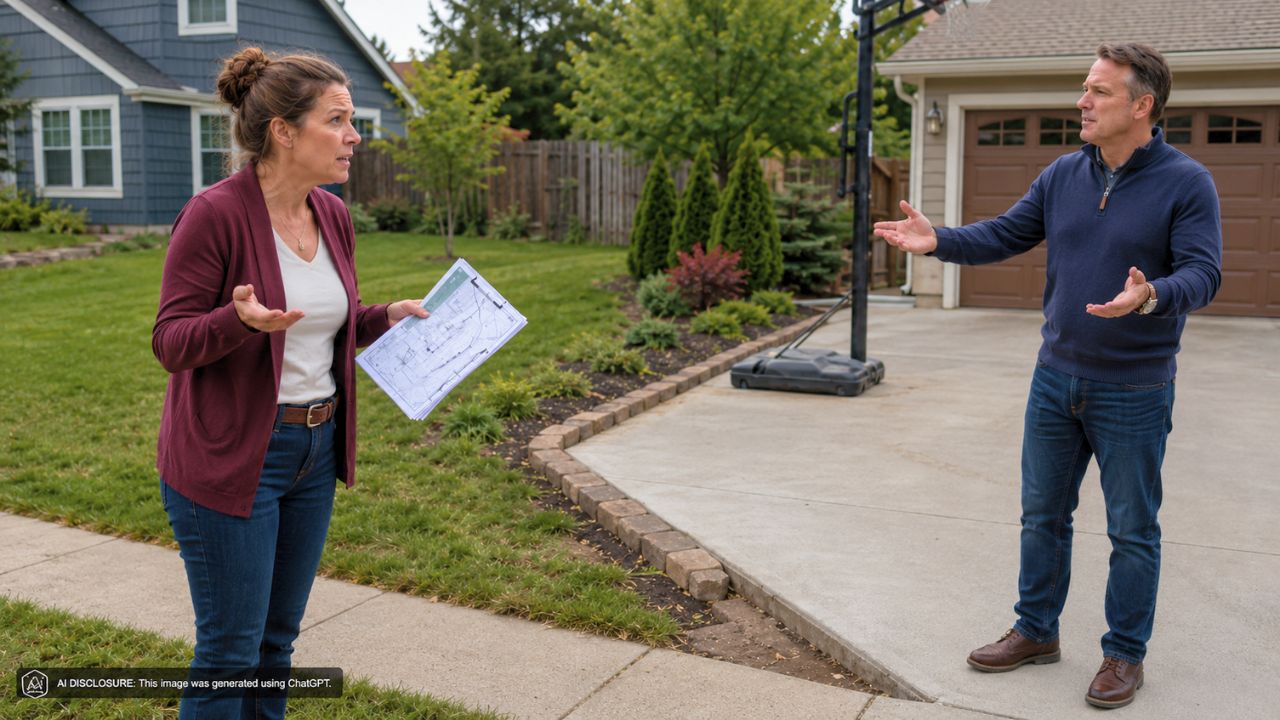
Homeowner’s Survey Reveals the Neighbor’s Driveway Extension, Landscaping, and Basketball Hoop Pad Are All Built on Her Land — Then He Asks Her to Just Deed the Property Over to Him
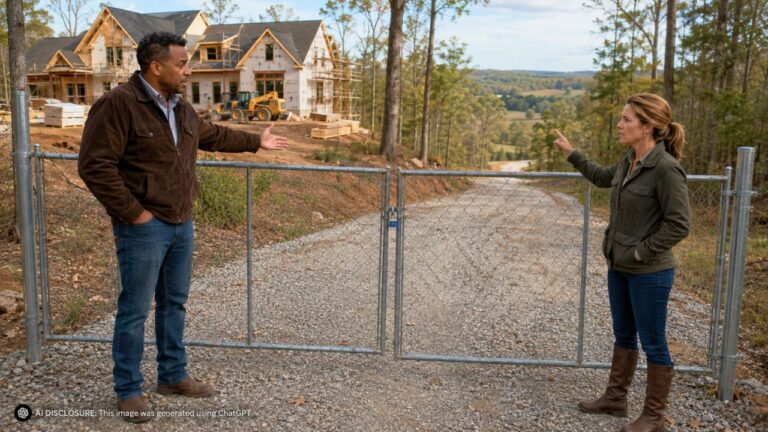
Photo credit: AI-generated image created using ChatGPT. Illustrative only.
It started the way a lot of property-line trouble starts: with improvements that looked nice from a distance. A homeowner watched a neighbor of six years extend a driveway, redo landscaping, and pour a small concrete pad for a basketball hoop. No drama—until a surveyor’s stakes went into the ground for an unrelated backyard project.
When she ordered a survey to plan a shed and her own landscaping work, the boundary lines came back with a surprise. The neighbor’s new driveway extension, landscaping, and basketball hoop concrete weren’t fully on his side. They were sitting on hers, according to the survey described in the original post.
The first sign was easy to brush off
The homeowner didn’t describe an ongoing feud or years of nitpicking. The neighbor’s work had gone in over the last two years, and at the time it read like a normal upgrade: more usable parking, cleaned-up curb appeal, a little recreation spot in the yard.
That’s what makes this kind of thing so common. Most people aren’t walking their lot lines with a tape measure, and improvements near a boundary can look “close but fine” for years. Until the day you need to know precisely where your land starts—because you’re spending money, pulling permits, placing a structure, or dealing with drainage.
In this case, the survey wasn’t ordered to accuse a neighbor. It was ordered to build. And the results turned casual “looks about right” into a black-and-white line on paper.
The survey stakes turned small upgrades into a land grab
Once the homeowner brought it up, the neighbor’s reaction didn’t match what she expected. Instead of offering to remove the encroaching pieces or asking how they could fix it, he asked her to deed the portion of property over so his improvements would be entirely on “his” land.
Not lease it. Not buy it. Not even float a swap or a payment, at least as she described it. Just transfer ownership—framed as the neighborly thing to do.
To the homeowner, that didn’t feel like neighborly at all. She saw it as giving up “a decent portion” of her property because he didn’t check the lot lines before pouring concrete and reworking the area. Even if the strip seems small today, it changes future resale, future fencing, future landscaping plans, and future headaches when the next owner wants everything squared away.
Then came the pressure point that makes homeowners’ stomachs drop: the neighbor’s side implied she was the unreasonable one for not surrendering it.
Lawyers entered, and the friendly option got rejected
Wanting to protect her land without lighting the street on fire, the homeowner hired an attorney. The advice she received wasn’t “sue them into the ground.” It was a compromise document: a “permission to use” letter that would let the neighbor keep the concrete and related improvements in place for their remaining useful life, while clearly stating the land is still hers and the neighbor waives any claim of adverse possession.
That detail matters, because one of the biggest fears with encroachments is time. If a neighbor uses a piece of land openly and continuously long enough—depending on state rules—they may later claim legal rights to it. The homeowner noted that the neighbor had not been there for 15 years, and the improvements were only about two years old, so she didn’t see a valid adverse possession claim right now.
But she also didn’t want to set the stage for one later by staying silent or allowing the use without documentation. The proposed letter was meant to be the “everybody calm down” solution: you can use it, but you’re acknowledging it’s mine.
The neighbor refused to sign.
Instead, he hired his own attorney, who came back asking the homeowner to reconsider changing the deed or granting an easement to reach a “fair and acceptable outcome for all.” The homeowner’s response was basically: fair for who? An easement wasn’t necessary to get in and out of the driveway, she said, and she wasn’t hearing an offer to purchase the land. She was hearing, again, that she should just give it up.
Why “just grant an easement” can haunt a property
To a lot of homeowners, an easement sounds like a simple paperwork fix—like drawing a line and moving on. But in real life, it can follow the property for decades. It can complicate refinancing, selling, or future improvements when title companies and buyers start asking questions.
And easements can be hard to unwind. Even if the neighbor who poured the concrete moves away, the next owner may treat that access or use as a permanent right. The homeowner in this case was also thinking about value: she didn’t want to lose land, and she didn’t want to lose control of it.
There’s also the practical side: concrete and landscaping aren’t just “there.” They change water flow, snow shoveling habits, where cars sit, where basketballs bounce, where people stand and gather. If an injury happens on that pad, if a car slides in winter, if runoff starts cutting into the yard—those aren’t abstract questions anymore. The person who owns the land can get dragged into messy disputes, even if the improvements were built by someone else.
That’s why the homeowner’s attorney aimed for written permission with clear boundaries: it preserves ownership while giving temporary peace. The neighbor rejecting that option signaled he wasn’t looking for peace. He was looking for control.
Homeowners zeroed in on documentation, not vibes
The homeowner’s biggest emotional sticking point was simple: she didn’t want to be at war with the people next door. They weren’t close, she wrote, and they were “very different people,” but she still didn’t want daily tension over driveway edges and yard lines.
At the same time, she knew being “nice” in the moment can become expensive later. The most practical theme in responses to stories like this is almost always the same: don’t argue about memories or assumptions—argue about paper. Surveys. Plats. Property descriptions. Written agreements. Things that survive when neighbors move, moods change, and a friendly verbal “it’s fine” gets forgotten.
Her attorney’s permission letter fits that mindset. It creates a record that the use was allowed and temporary, not hostile or ownership-claiming. The neighbor’s refusal, and pivot to demanding deed changes or easements, is exactly the kind of escalation that makes homeowners double down on formal boundaries.
Once attorneys are writing letters, the tone can shift fast. Even if both sides are trying to sound reasonable, the underlying message becomes: we are building a paper trail for court, if this goes there.
A quiet property line can turn into a permanent neighborhood freeze
For now, the homeowner is stuck in the most uncomfortable phase of these disputes: the improvements are already in the ground, the survey says they’re on her land, and the neighbor is acting like the fix is for her to surrender rights rather than for him to correct his mistake.
She’s not denying him access to his driveway. She’s not claiming he can’t park. She’s trying to prevent a “temporary favor” from turning into a permanent loss. And she’s trying to do it without making every trip to the mailbox feel like a showdown.
Encroachment fights rarely feel proportional, because they’re not really about a strip of dirt. They’re about what happens next: whether a property owner can still trust their boundaries, whether a future buyer will inherit a legal mess, and whether “neighborly” becomes code for “accept the consequences of someone else’s choices.”
The concrete and landscaping may look settled, but the paperwork isn’t. And until it is, both homes are living with the kind of tension that doesn’t show up on a listing—but can shape the whole feeling of a place.
Like Fix It Homestead’s content? Be sure to follow us.