Rural Landowner Finds the Neighbor’s New Gate Has Cut Off Access to Twenty Acres — Then the Neighbor Says the Recorded Easement Does Not Cover That Route
Photo credit: AI-generated image created using ChatGPT. Illustrative only.
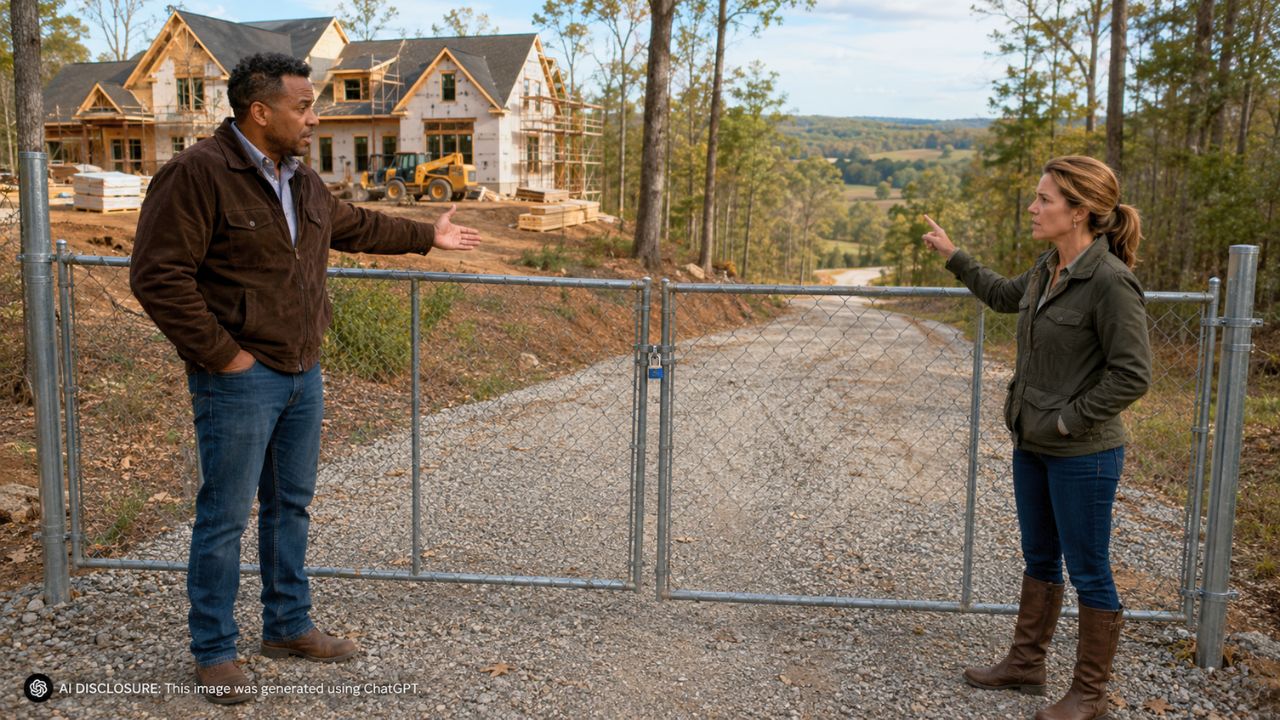
On a quiet private road in rural North Carolina, one new gate turned into the kind of land-access fight that can swallow a whole season. A landowner at the edge of a private subdivision realized the neighbor’s construction gate wasn’t just controlling traffic—it was sitting about 20 feet past where it belonged, cutting off access to the lower portion of their own land. The details came from the original post, where the landowner laid out a problem that sounds small on paper and feels huge when you’re standing at the end of your drive staring at a locked entrance.
The neighbor, according to the landowner, owned a large parcel just outside the subdivision and was landlocked—her only way in and out was a right-of-way through the subdivision’s private road. During construction of a multi-million dollar home, a temporary chain gate went up. And that’s when the boundary between “her access” and “your access” got blurry fast.
The first sign was a “temporary” gate that wasn’t temporary enough
The gate wasn’t installed deep in the woods where no one would notice. It was placed in a way that the landowner says extended roughly 20 feet beyond the neighbor’s property line into the subdivision. That extra 20 feet mattered because it blocked the landowner from getting to the lower part of their own property—the kind of access you don’t think about until you need to mow, clear brush, check a downed tree, or walk a boundary line.
At first, the landowner tried to handle it like neighbors often do: point it out, talk it through, keep it friendly. They brought it to the neighbor’s attention when the chain gate first went in. The hope was that it was a simple placement mistake that would be corrected once the “real” gate arrived.
But the problem didn’t fade away. The neighbor’s team started putting in a permanent gate in the same location, in the same over-the-line spot, with the same consequences.
Access is everything when your land meets a private road
Rural property can look wide open until one choke point controls the whole map. In this case, the landowner lived on a private road inside a private subdivision, and their lot bordered the subdivision’s edge. The neighbor’s parcel sat outside that boundary but relied on the subdivision’s road for access because it was landlocked.
That detail changes the emotional temperature immediately. When someone is landlocked, the access route isn’t a convenience—it’s the lifeline. But when that lifeline turns into a gate that slides onto someone else’s space, it stops being a simple “security” upgrade and becomes a control point.
The landowner made clear that the physical presence of a gate wasn’t the real issue. They even said the placement “really doesn’t bother” them in principle. What bothered them was losing the ability to reach their own land and worrying that the blockage could become “normal” if not dealt with now.
The worry wasn’t just today’s access—it was the next owner’s
Even if you can live with a workaround for a while, landowners think in decades. The poster wasn’t only trying to get to the lower part of the property today. They wanted a way to make sure access remained intact long-term and would transfer cleanly if they ever sold.
That’s where these disputes get sticky. An awkward gate location can turn into a future disclosure problem, a title question, or a buyer who walks because they don’t want to inherit a feud. And when the road is private and the neighborhood has an HOA hovering in the background, nobody wants to be the person who shrugs and says, “It’ll probably be fine.”
The landowner also flagged another reality: the HOA might have its own opinion about a permanent gate sitting partially in the subdivision. Even if the neighbor had every right to a gate on her own land, this installation seemed to spill into common or subdivision-controlled space. That can trigger a whole different layer of enforcement and paperwork.
They went to the “manager,” not the courtroom
Instead of escalating immediately, the landowner reached out to the neighbor’s boyfriend/manager—the person apparently handling the day-to-day details. That move alone tells you the landowner was trying to keep this practical: talk to whoever can move a crew and adjust a plan before concrete gets poured and posts get set.
The two of them, the landowner said, agreed to find out what legal steps were needed to guarantee continued access. That’s a very specific kind of compromise: not “let’s argue about who’s right,” but “let’s make sure this is documented and durable.”
In rural neighborhoods, that’s often the only way anything gets fixed without turning into an endless cold war. Because once a gate is permanent, it’s not just a structure. It’s a message.
Commenters pushed proof, paperwork, and the word “lawyer”
The post drew the kind of responses you’d expect when land lines and access routes come up: people emphasized the importance of documentation and getting the facts pinned down. Not as a threat, but as protection. When one neighbor is landlocked and the other feels boxed out, the only thing that settles it cleanly is what’s written and what’s recorded.
Even in the landowner’s own update, you can see that pressure working. They noted that “mention of a lawyer was definitely helpful,” which is often code for: once the conversation includes real consequences, people suddenly get motivated to solve it the easy way.
That’s not about throwing lawsuits around. It’s about making it clear the problem is real, and that ignoring it could get expensive or complicated.
The simplest fix ended up being the real fix
In the end, the resolution wasn’t dramatic. It was practical. After the discussion and advice, the landowner reported back with an update: they spoke with the owner’s manager and both agreed that moving the gate was the “easiest, fastest, best long-term solution.”
That outcome matters because it’s the rare neighbor dispute that ends with someone choosing the low-friction option before the permanent build locks everyone into years of resentment. A gate can be moved. A relationship, once wrecked, is harder to repair.
The landowner sounded relieved—and grateful—because the fix wasn’t a drawn-out battle over property boundaries. It was a simple correction before the permanent installation made the blockage feel inevitable.
Out on a private road, the difference between “we’ll handle it later” and “we’ll move it now” can decide whether neighbors wave at each other for the next ten years, or stare straight ahead every time they pass. In this case, a 20-foot mistake got addressed while it was still just a gatepost problem—not a forever problem.
Like Fix It Homestead’s content? Be sure to follow us.