How to Keep a Well Pump From Freezing: A Practical Winter Guide
Photo credit: Fix It Homestead
Fix It Homestead is reader-supported. If you buy through links in this article, we may earn a small commission at no extra cost to you. As an Amazon Associate we earn from qualifying purchases.
If you want to know how to keep a well pump from freezing, the core approach is simple: find every part of your system that’s exposed to cold air, insulate it, and add safe, thermostat-controlled heat where insulation alone isn’t enough. For most homesteads, that means the well house or pit, the pressure tank and switch, and any pipe that runs above ground or through an unheated space.
A frozen well usually shows up at the worst time: the first sub-zero morning, with no water for the house or the animals. The good news is most freeze-ups happen in predictable places, and fixing them costs a lot less than a burst pressure tank or a service call in a snowstorm.
This guide walks you through where freezing happens, how to protect each spot, and what to do safely if your system freezes anyway.
Where Well Systems Actually Freeze
The water down in your well stays above freezing. The problems start where water meets cold air.
Submersible pump systems
With a submersible pump, the pump sits down in the well. The water line usually leaves the well casing underground through a pitless adapter, below the frost line, and runs buried to the house.
Weak spots:
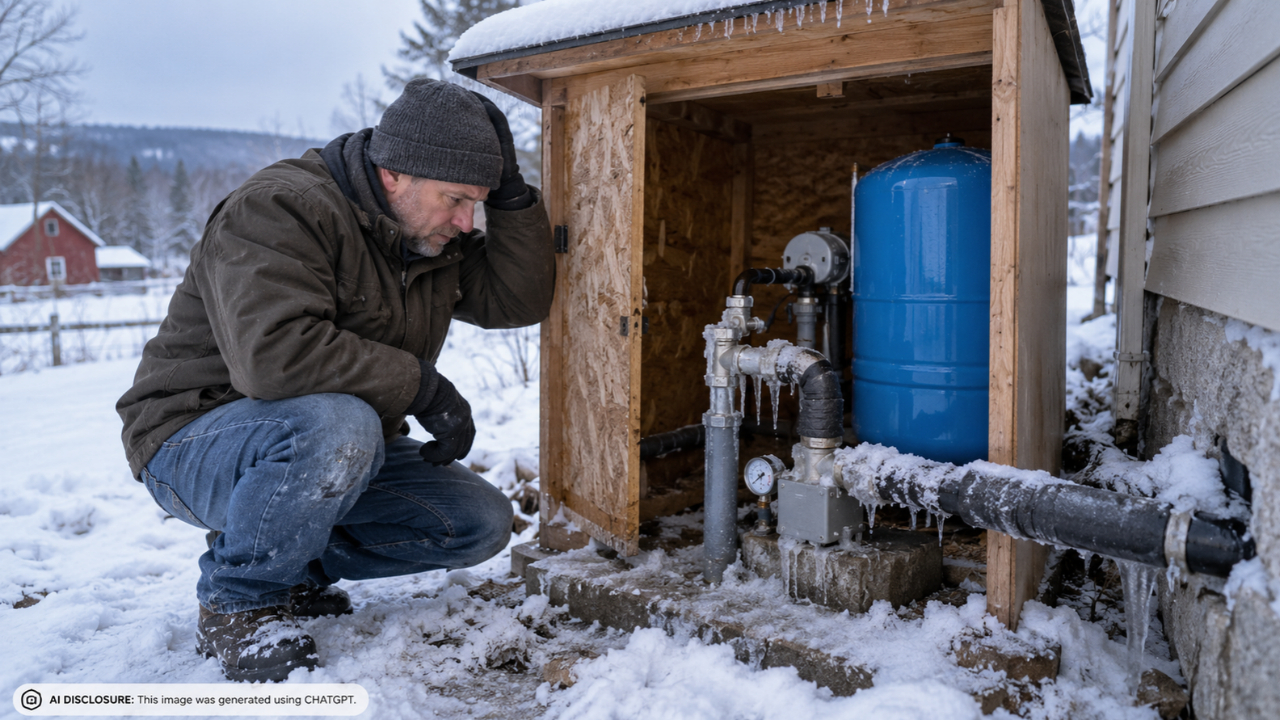
- The pressure tank, pressure switch and gauge if they’re in an unheated garage, crawlspace or well house
- The line where it comes up out of the ground and into the building
- Any well head or casing with exposed piping or fittings
If your system is fully buried and your tank is in a heated basement, you may never have an issue.
Jet pump systems
Jet pumps sit above ground, often in a well house, pump house, basement or pit. The pump itself holds water and is vulnerable.
Weak spots:
- The pump body and its intake piping
- The pressure switch (the small tube feeding it freezes easily)
- The pressure tank and above-ground lines
Well pits
Older properties sometimes have equipment in a pit below ground. Pits are usually warmer than open air, but snowmelt, a loose lid or a cracked cover can let cold in.
Well houses
A small shed over the well and equipment is common on farms. Uninsulated or drafty well houses are among the most frequent freeze culprits.
Step 1: Inspect Your System Before the First Freeze
Take a walk around your setup this weekend, while the ground is still workable.
- Identify your pump type (submersible or jet)
- Trace every pipe from well to house
- Look for any pipe exposed to outside air
- Check well house walls, doors, floor and vents for gaps
- Make sure well caps and pit lids are intact and seated
- Test outlets and GFCI protection
It’s a lot easier to caulk, insulate and run wire on a mild October afternoon than on your knees in the snow in January.
Step 2: Insulate Everything That Holds Water
Insulation slows heat loss. On its own, it won’t stop a long cold snap, but it buys a lot of time and makes any heat source far more effective.
Pipes
- Use foam pipe insulation sleeves on exposed pipe
- Seal seams and joints with tape rated for the job
- Cover fittings, valves and elbows, which are often missed
Foam sleeves are sized to the pipe’s outside diameter, not the nominal pipe size, so measure before you buy. They’re sold in standard 6-foot lengths, come pre-slit with a self-adhesive seam, and are the least expensive part of this whole job. Thicker wall sleeves buy you more time in a hard freeze than the thin builder-grade ones.
See the foam pipe insulation on Amazon
Pressure tank and switch
- Insulate around the tank, but don’t cover the pressure switch cover vents or electrical components in a way that traps heat or blocks access
- Build a small insulated box around the switch and gauge area with removable access if needed
Well house or pump house
- Insulate the walls and ceiling with rigid foam board
- Seal gaps around doors and where pipes and wires enter
- Weatherstrip the door
- Add skirting or insulation around the base if cold air blows under
Rigid foam board comes in several thicknesses and R-values; pick by how cold your winters actually get, and check whether local code requires a covering over exposed foam.
Keep mice out while you’re at it. They love insulated well houses and chew wiring.
Step 3: Add Heat Cable With a Thermostat
Heat cable (often called heat tape) wraps or runs along a pipe and adds gentle heat. For well lines, look for:
- Built-in thermostat or an external thermostat so it only runs when needed
- A cable rated for your pipe material (metal vs plastic)
- A length that matches your pipe run
Frost King’s HC-series automatic heat cable kits are the common off-the-shelf answer. Each kit has a pre-assembled built-in thermostat, and they come in 9-, 18-, 24- and 30-foot lengths, so you can buy close to your actual run instead of coiling up slack. Measure the run first and size up to the next length rather than stretching a short kit, since you cannot cut these cables to fit or splice two together. Whatever brand you buy, check that the cable is approved for your pipe material — some are rated for metal pipe only, and putting one on plastic supply line is asking for trouble.
See the Frost King automatic heat cable kit on Amazon
Heat cable safety rules
- Follow the manufacturer’s instructions exactly. Some cables must never overlap or cross themselves, and some can’t go under certain insulation.
- Plug into a GFCI-protected outlet.
- Don’t use old or damaged cable. Inspect it every fall.
- Don’t use indoor extension cords to reach it.
- Replace it if it shows cracking, discoloration or brittle spots.
Faulty or improperly installed heat tape can start fires, so this isn’t the place to cut corners.
Step 4: Heat a Well House Safely
For well houses, many people grab a heat lamp. It works, but it’s also a real fire risk in a small wooden building full of dust, cobwebs and sometimes insulation or straw.
Safer options
- A small thermostatically controlled heater rated for damp or outdoor locations, with tip-over and overheat protection
- A thermostatically controlled outlet like the Thermo Cube TC-3, which the manufacturer rates to send power through at 35°F and shut it off at 45°F, so your heat source only runs in freezing weather. It’s an inexpensive way to stop a heater or a bulb from cooking a well house through a mild stretch. Watch the model number when you shop, since a TC-3 and a TC-3Z both circulate and the temperature settings differ by version.
See the Thermo Cube TC-3 on Amazon
- An enclosed, guarded incandescent or ceramic bulb fixture if you do use a bulb, mounted securely away from anything combustible
Well house heating tips
- Keep heaters well away from walls, insulation and anything flammable
- Never use unvented fuel-burning heaters (propane, kerosene) in an enclosed well house; they create carbon monoxide and fire risk
- Place a wireless thermometer with a remote sensor and a low-temperature alert inside the well house. Check the specs: many cheap wireless thermometers show an outdoor reading but have no configurable alarm, and the alarm is the whole point.
- If the outlet out there isn’t already GFCI-protected, add a plug-in GFCI adapter rated for outdoor use, and test its trip button at the start of the season. Anything you plug in near a well is sharing space with water.
See the outdoor GFCI adapter plug on Amazon
Step 5: Protect the Pitless Adapter and Buried Lines
A pitless adapter is designed to let the water line exit the casing below frost depth, so it normally doesn’t freeze. Problems happen when:
- Soil has eroded and the line is shallower than it should be
- Snow is scraped away over the line, removing natural insulation
- Driveways and paths compact snow and push frost deeper
Tips:
- Don’t plow or pack down the snow directly over your water line. Snow is an insulator.
- Mulch or add straw bales over shallow sections before winter.
- Call a well contractor if your line repeatedly freezes; it may need to be lowered.
Step 6: Drip Faucets During Extreme Cold
Moving water resists freezing. During the coldest nights:
- Let a faucet on the far end of your system drip slowly
- Open cabinet doors under sinks on exterior walls
Keep in mind dripping adds wear on your pump if it cycles often, and if you’re on a septic system, it adds water load. Use it for short, severe cold snaps, not all winter.
For more on protecting household plumbing before cold weather, see our guide on what to do before your pipes even think about freezing.
What to Do If Your Well Pump Froze
Signs your system is frozen: no water at the taps, a pump that runs but doesn’t build pressure, or a pressure switch that won’t click on.
First, protect the pump
- Turn off power to the pump at the breaker. Running a pump against a frozen line can burn out the motor.
Thaw safely
- Use a hair dryer or heat gun on low, moving it constantly along the pipe
- Wrap the frozen section with warm towels
- Use a space heater placed at a safe distance, never left unattended
- Start near an open faucet so melting water has somewhere to go
- Check the small tube feeding the pressure switch, which often freezes first
Never do this
- No open flame, torches or propane heaters on pipes. They can start fires and damage pipes, fittings and wiring.
- Don’t pour boiling water on plastic fittings or pressure switches.
- Don’t touch electrical components while standing in water.
Once water flows, turn the power back on, check for leaks and watch the pressure gauge for a normal cycle.
When to Call a Pro
Call a licensed well contractor or electrician if:
- A pipe, fitting or pressure tank has cracked or split
- You find leaks after thawing
- The pump runs but won’t build pressure after thawing
- Lines are frozen underground
- You smell burning or see melted wiring
- Your system freezes repeatedly
Frequently Asked Questions
At what temperature will a well pump freeze?
It depends on how exposed and insulated your equipment is. Unprotected above-ground pipes and pressure switches can freeze during extended periods below freezing, especially with wind. Well-insulated or heated setups hold up to much colder weather.
Is heat tape safe for well pipes?
It’s safe when it’s rated for your pipe type, installed exactly as the manufacturer directs, plugged into a GFCI outlet and in good condition. Damaged or improperly installed cables can cause fires.
Can I use a heat lamp in my well house?
Many people do, but heat lamps are a fire risk in small, dusty buildings. A thermostatically controlled heater with safety cutoffs or an enclosed fixture is a safer choice.
Should I let water drip to keep my well from freezing?
During severe cold snaps, a slow drip can help keep lines moving. It also makes your pump cycle more, so use it sparingly and focus on insulation and heat first.
How do I know if my pressure switch is frozen?
If the pump won’t turn on and your pressure gauge is low, check the switch and the small tube feeding it. Frost on the tube or a switch that won’t click are signs of freezing.
Stay Ahead of the Freeze
Learning how to keep a well pump from freezing comes down to finding every exposed spot, insulating it well, adding thermostat-controlled heat where needed, and keeping safety front and center with GFCI protection and no open flames. Take an afternoon in the next week or two to walk your system and fix the weak points, and you’ll have reliable water all winter.