Indiana Homeowner Watches the Elderly Neighbor’s Garage — Built Just Three Feet From Her Own — Get Leveled by a New Landlord — Then Learns He’s Planning New Construction on the Same Narrow Lot
Photo credit: AI-generated image created using ChatGPT. Illustrative only.
In 2022, an Indiana homeowner moved into a place where the back edge of daily life was defined by a tight squeeze: her garage and driveway backed up to the lot behind her, and the elderly neighbor’s garage sat only about three feet away. It wasn’t pretty, but it was familiar—one of those odd, close-built property layouts you learn to live with.
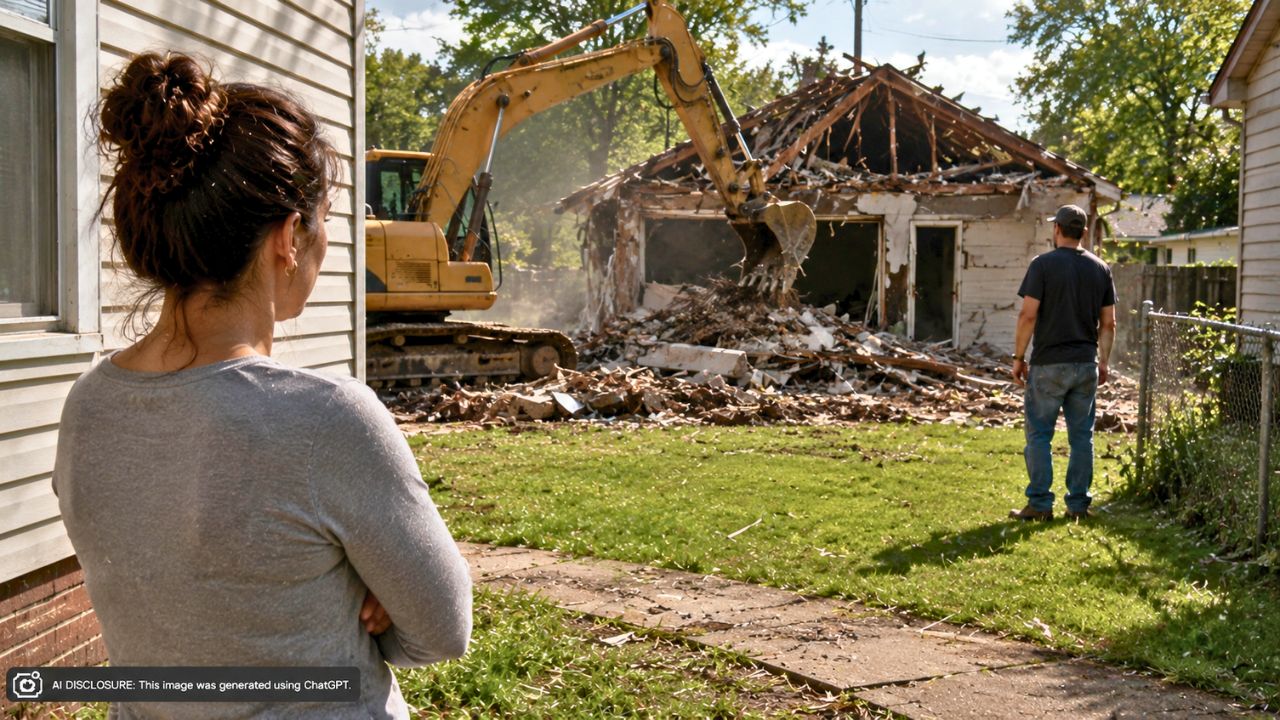
Then the neighbor passed away, the property sold to a landlord, and the first casual heads-up landed: the new owner mentioned he might tear down the old garage and build something new because the garage and the home were on separate lots. According to the original post, he initially decided not to build. Months later, the homeowner came home from work and saw the garage had been leveled anyway.
A narrow lot, a clean slate, and a fast-moving build
The demolished garage wasn’t just a detached structure disappearing from the neighborhood. It was sitting on “a very small and narrow” lot—exactly the kind of parcel where inches matter, and where setbacks, property pins, and utility easements can turn into real-world headaches.
When the homeowner met the landlord after the teardown, he said he was building a house and promised it wouldn’t disturb them much. And at first, the homeowner wasn’t describing a construction nightmare—no mention of constant trespassing, late-night noise, or debris piles in the yard. The anxiety came from something more permanent: where the new build was landing compared to the property line.
That’s the thing about tight lots. You don’t have to be “against” the project to be worried about it. You just have to imagine trying to sell later, when a buyer’s inspector starts pointing at walls, condensers, and eaves and asking, “So… whose land is that actually on?”
The slab looked close, but the framing made it feel real
The first moment the homeowner spoke up was when the slab went down. Standing there with the concrete freshly poured, she told the landlord it looked very close to the property line. He answered with confidence: it was “exactly 3 feet from the line,” which he said matched the city’s setback rule.
But once framing and siding went up, the story didn’t match what her eyes were telling her. She believed the structure was no longer within the setback. And the closer the building got to “done,” the less this felt like a minor discrepancy that could be adjusted with a chalk line and a conversation.
A slab is one thing. Framing is another. Siding is the moment it stops being theory and starts looking like a house that will sit there for decades.
Then the air conditioner showed up on the “wrong” side
The detail that pushed this from “close build” to “possible encroachment” was the air conditioner. The homeowner wrote that the unit was placed on their side and “definitely not within the setback,” and it “may even be on our side of the property line.”
That’s not just aesthetics or a lost view. Mechanical equipment has service needs. It needs access for repairs and replacement. It can create noise, drainage, and vibration issues. And if it’s over the line, it can become the kind of problem that doesn’t show itself until years later—when something fails and a technician needs room to work, or when a title issue becomes everyone’s emergency right before a closing date.
The homeowner also pointed out something that makes these disputes harder: the pin that marks the property line was covered up in dirt and rubble after the street was torn up for new utility lines. When the one hard reference point is buried, it becomes easier for everyone to argue from assumptions and harder for the homeowner to feel secure about what she’s seeing.
It isn’t “ruining life,” but it is changing the property
What makes this story relatable is that the homeowner isn’t presenting as someone looking for a fight. She even says the new house behind theirs “isn’t a huge inconvenience,” even though it makes the backyard feel “boxed in” and they no longer have a view of the sunset.
That’s a big emotional shift for any property. A backyard isn’t just square footage; it’s light, privacy, and the feeling you get when you step outside after work. Losing the sunset view is the kind of change that doesn’t show up on a survey, but it does show up in how a home feels.
Still, her biggest fear isn’t the view. It’s future liability: selling the house and having a new buyer discover that structures are on or over the property line. Even if a buyer loves the home, a lender, insurer, or title company can turn an encroachment into a deal-stopper—or at minimum, a negotiation that costs time and money.
Most reactions center on proof before emotions
The homeowner asked whether she should hire a lawyer, contact the city about a setback breach, or accept that she might be overreacting. Even without a long comment thread included in the source material, the typical practical response to this kind of build is predictable because the stakes are predictable: you document, you verify, and you don’t rely on anyone’s memory of where the line “should be.”
The landlord reportedly claimed he was exactly three feet off the line, but the homeowner’s concern is that the finished structure and the air conditioner don’t match that claim. In disputes like this, the only thing that tends to cut through the fog is a verified boundary—something that can be referenced by both the homeowner and the city if there’s a permit or inspection issue.
There’s also a timing pressure that homeowners feel in their bones: it’s easier to correct a build when it’s early. Once siding is on and utilities are in, every day that passes adds cost and resistance. That doesn’t mean the homeowner should panic. It means she’s right to feel urgency about getting clarity while there’s still room to fix a mistake—if a mistake was made.
The tension now is permanent: a line you can’t see, and a house that won’t move
The landlord’s project is already reshaping how this backyard works. Even if everything ends up technically legal, the home behind theirs is now a close neighbor in a way the old garage never was. If the structure or equipment really is over the line, the homeowner could be staring at a long-term property defect that follows the deed, not the personalities involved.
And if the property pin is buried and the street work left rubble around the boundary markers, it’s easy to see why she feels stuck between two bad choices: say nothing and hope it’s fine, or speak up and risk turning a quiet neighborhood into a cold war of glares and side-yard standoffs.
For now, she’s left watching the build progress on a narrow lot, trying to reconcile what she was told—three feet, city rule, no big disturbance—with what she can physically see from her own garage. The garage behind her is already gone. The new walls are already up. And the question hanging over the property line is the kind that doesn’t fade with time—it usually gets louder the moment someone wants to sell.
Like Fix It Homestead’s content? Be sure to follow us.