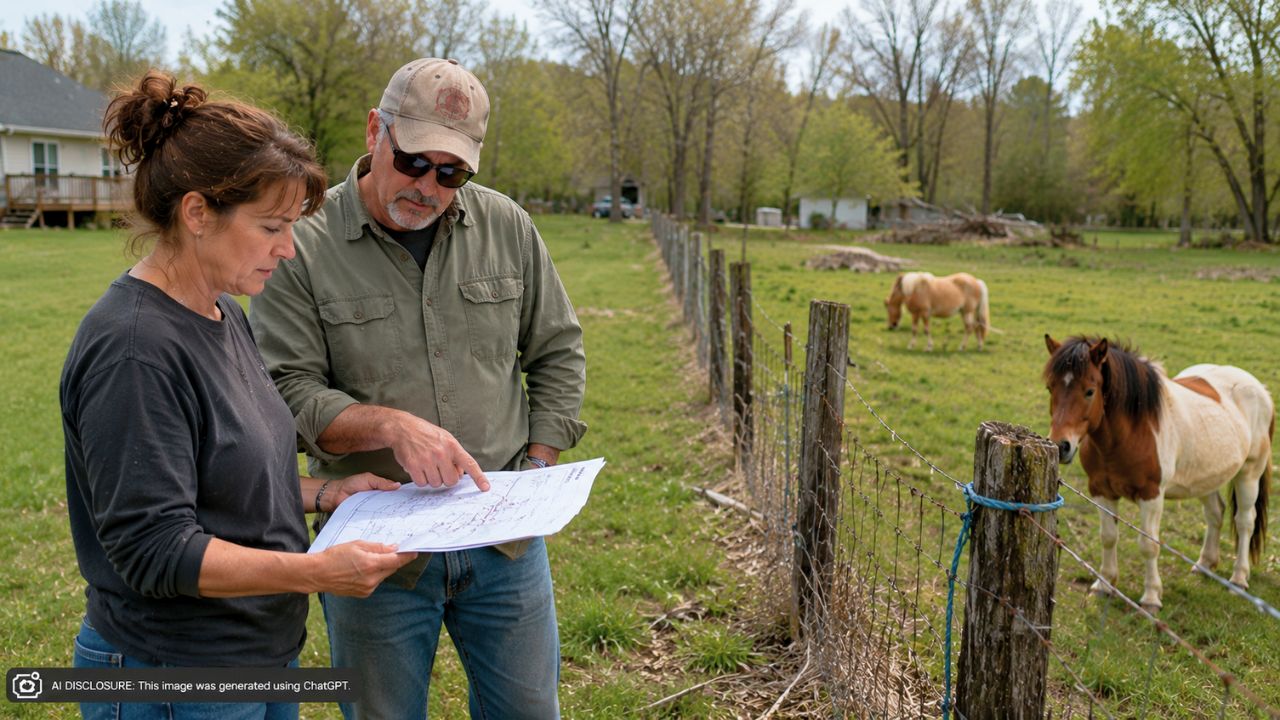
Indiana Landowner Finally Affords a Full Survey of Her Six Acres — Then Learns the Neighbor’s “Junky” Fence Line Is Off by Thirteen Feet, and the Neighbor Leases Out the Disputed Strip for Ponies Anyway
Photo credit: AI-generated image created using ChatGPT. Illustrative only.
Three years after buying a rural Indiana home with nearly six acres, one landowner finally scraped together enough money for a full property survey. She expected it to settle a long-simmering disagreement with the neighbor next door. Instead, the paperwork turned a “we’ll deal with it later” fence dispute into a full-on scramble to protect what she thought she already owned.
In the original post, she explains that the neighbor had long insisted a “junky” old fence marked the boundary—conveniently avoiding the cost of a survey and treating the fence as final. When the survey stakes went in, that fence line wasn’t just a little off. In some spots, it was off by as much as 13 feet, pushing into the homeowner’s land.
A fence everyone treated like “good enough” until it wasn’t
On country properties, it’s common to inherit old fences and old assumptions. People mow to the same line for years. They park the trailer where it’s always been. A propane tank ends up “over there” because it’s the easiest spot to set it.
That’s basically how this one started, except the neighbor wasn’t just casually mistaken. When the homeowner tried to address the boundary earlier, the neighbor refused to split the cost of confirming it and doubled down on the fence: the fence was the line, end of discussion.
Once the homeowner could finally afford the survey—$1,300 for the full near-six-acre property—the dispute stopped being theoretical. Surveyor flags don’t care about anyone’s habits. And the new measurements showed a real bite taken out of the homeowner’s parcel.
The moment the stakes went in, the price of “keeping the peace” went up
The neighbor’s first counteroffer was to pay $1,000 to keep the boundary where the fence already sat. It’s the kind of number that sounds like a compromise until you translate it into what it actually means: paying money to give away land you already pay taxes on.
The homeowner said no. Not only would she be losing part of her property, she’d be doing it after paying for the survey that proved she owned it. She also didn’t want to sell the strip at all.
That’s when things got tense. The homeowner believed the survey should end the argument. The neighbor seemed to treat the survey as an obstacle to work around.
Ponies, a propane tank, and a dog kennel: the “small” encroachments that turn into leverage
Once you start walking the true boundary, the line isn’t just a line. It’s everything sitting on the wrong side of it.
The homeowner says the neighbor’s propane tank and a dog kennel are on her property. At first, she tried to be accommodating—offering to put something in writing that would allow those items to remain until the neighbor no longer lived there, with the understanding that any future owner would have to move them.
But “neighborly” only works if both sides agree to it. The homeowner says that wasn’t good enough for the neighbor, who now wanted to claim more than just the convenience of leaving equipment in place.
And then came the detail that changed the tone: the neighbor reportedly told someone leasing space for ponies that she planned to pay for a lawyer and try to claim the disputed strip through adverse possession. Notably, the ponies were being placed on the very area the survey said belonged to the homeowner.
That’s not just petty. Livestock use can change the day-to-day reality of a boundary fast—more foot traffic, fencing decisions, manure management, and the constant implication that the land is already under someone else’s control.
Handshake agreements don’t mean much when someone starts working behind your back
For a brief minute, it sounded like the two sides were actually moving toward a fix. The homeowner says they met in person with a fence person and discussed building a new fence along the true property line, with both of them wanting a clean separation for farm animals.
But after hearing the neighbor was talking about adverse possession and leasing out the strip anyway, the homeowner’s patience ran out. She describes feeling like she made the mistake of trying to keep the peace, only to find out her “good Christian neighbor” was, in her words, “a snake in the grass.”
That’s the point where many property disputes shift from “let’s be reasonable” to “document everything.” The homeowner texted the neighbor that she was no longer comfortable with the neighbor’s belongings sitting on her property and gave her until July 30 to move everything—more than 30 days, and longer than even the surveyor recommended waiting.
The homeowner’s biggest fear isn’t that she’ll wake up and legally lose 13 feet overnight. It’s the messy in-between: what kind of trouble the neighbor can cause while the new fence is still just a plan, and whether she needs a more formal process to demand removal of the propane tank and kennel.
What people urged: treat it like a paper trail problem, not a personality problem
In these disputes, the practical voices tend to focus on proof, boundaries, and timing. The homeowner already has the single biggest piece of leverage: a completed survey showing the real line, plus the fact that she’s been paying property taxes since purchasing the home.
But commenters in similar property-line threads usually push the same themes: stop relying on casual promises, get everything in writing, and don’t let the neighbor create “normal use” of your land while you’re trying to be polite. A fence can be a fix, but it takes time to schedule, build, and pay for—and that window is where disputes get uglier.
People also tend to warn against signing or “writing up something” without real legal guidance. Even well-intended permission can be misunderstood later. And physical items like propane tanks can raise safety and liability questions if something goes wrong while they’re sitting on the wrong parcel.
The homeowner already took one of the most common recommended steps: she set a clear deadline in writing. Even without courtroom drama, a dated message matters when the story becomes “who said what, and when.”
Living next to someone who won’t accept the line on the map
In the country, you can’t always avoid your neighbors. You see the same driveways, the same fence corners, the same animals. And a 13-foot strip doesn’t sound like much until you picture it running the length of a property—wide enough to matter for mowing, fencing, and access, and big enough to feel like someone is slowly taking bites out of your place.
This homeowner did the hard, unglamorous thing: she paid for the survey and tried to handle the fallout face-to-face. Now she’s stuck in that uncomfortable space where the “fix” is obvious—move the encroachments, build the fence on the true line—but the neighbor is signaling she might fight anyway.
For now, the stakes are literally in the ground, the deadline has been sent, and the next move is whether the neighbor actually clears her tank, kennel, and pony plans off land that isn’t hers. On rural property, that’s when you learn whether the fence was the real boundary—or just the start of the argument.
Like Fix It Homestead’s content? Be sure to follow us.