New Homeowner Finds a Neighbor Mowing Part of the Yard Since Before the House Sat Vacant for Three Years — Then the Neighbor Says Ownership “Was Never in Question”
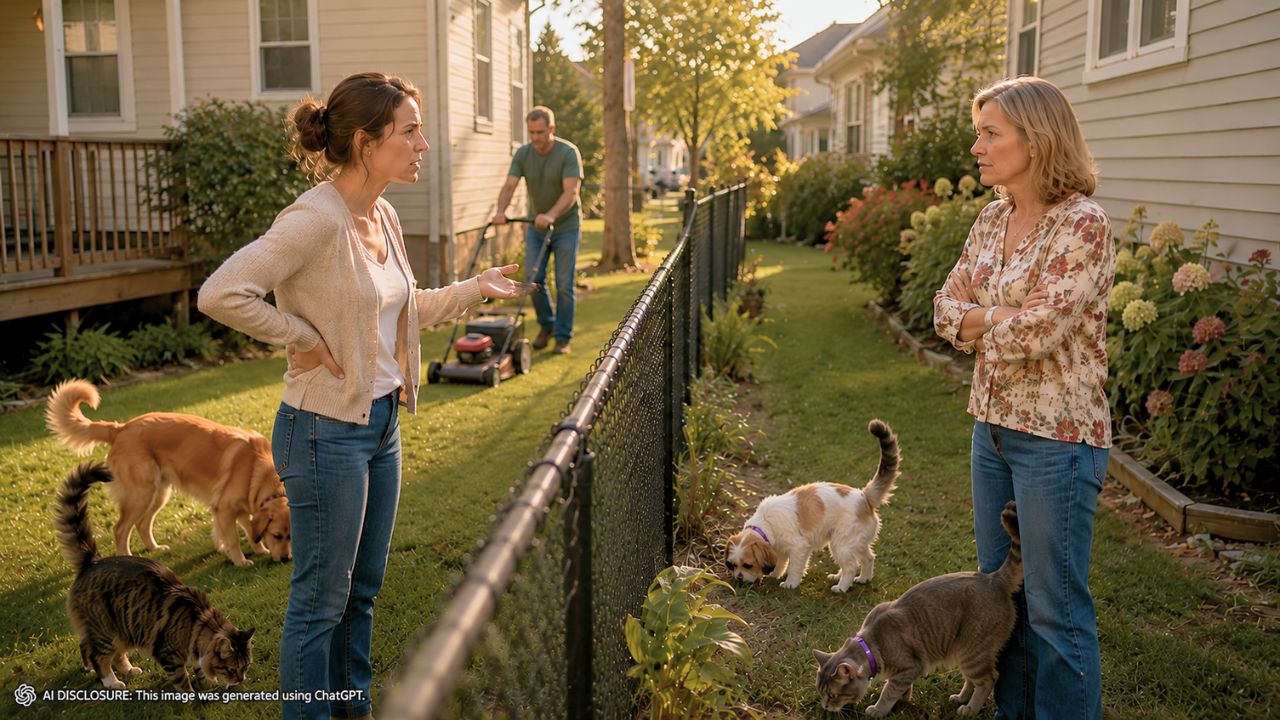
Photo credit: AI-generated image created using ChatGPT. Illustrative only.
The new homeowner thought they’d bought a house with a yard big enough for three kids to run off steam. Instead, they walked into a weird, slow-motion land grab that had apparently been going on long before they ever signed papers.
In the original post, the homeowner in Upstate New York explained they’d just learned—through a different neighbor—that the immediate next-door neighbor had been mowing and treating a “large portion” of what should be the homeowner’s lawn as her own. The backstory made it worse: the house had sat derelict for years, and the neighbor’s landscaper son reportedly kept that strip mowed regularly during that time.
It started years ago, when nobody was watching
The homeowner’s understanding is that the property sat vacant and rundown for a long stretch. In that gap, the neighbor next door allegedly began maintaining part of the lot—enough that, over time, she “eventually claimed ownership” of that portion.
That kind of story spreads quietly in a neighborhood: someone keeps a patch tidy, nobody challenges it, and after enough seasons it starts to feel “normal.” The homeowner didn’t describe a new fence going up or a fresh boundary marker. It was more like the yard line had drifted, and everyone simply got used to it.
Now that the home is occupied again, the homeowner says the effect is obvious. Their lot feels “extremely skinny” compared to nearby homes, while the neighbor has “two gigantic side lawns” that she reportedly doesn’t even use.
The daily friction wasn’t about grass—it was about the kids
This wasn’t just an abstract property-line headache. It became personal the way neighbor conflicts often do: through day-to-day behavior that turns a technical dispute into a household stressor.
The homeowner has three children, and they say the neighbor “regularly tries to chase them off ‘her land.’” What pushed it over the edge wasn’t a letter from an attorney or a surveyor’s stake—it was the neighbor yelling.
The homeowner described the neighbor as a “very grumpy old lady” who “does not in any way, shape, or form, come outside, use her lawn, etc.” Yet she will “plant herself on her front porch to yell at and threaten” the kids. The homeowner said they got into “a big row” over it, emphasizing that if the neighbor has an issue, she should come talk to the adults instead of shouting at children.
And then came the twist: learning that the area being policed might not even belong to the neighbor in the first place.
Learning the yard might be theirs made everything feel sharper
Before the homeowner heard the backstory, the neighbor’s behavior might have felt like plain old boundary-grumpiness—annoying, but not necessarily worth escalating. After the homeowner heard that the strip “should be my land,” it changed the temperature of every interaction.
Suddenly, the neighbor wasn’t just being unfriendly. In the homeowner’s mind, she may have benefited from years when the property had no one to defend it.
The homeowner’s frustration jumps off the page: “Now that I know that should be my land I am even more pissed at her than I was before.” It’s the kind of realization that makes you replay old moments—kids getting shooed away, the neighbor acting possessive—and wonder how long you’ve been living inside someone else’s version of the map.
The homeowner asked if anyone had been through something similar and whether there was a way to “claim that land back.”
When “claimed ownership” comes up, homeowners start thinking about paperwork
The post uses the phrase “assume property rights” and says the neighbor “eventually claimed ownership.” That’s loaded language for any homeowner, because it hints at the scary idea that a person can treat land as theirs long enough that it becomes, in some way, theirs.
Even without diving into legal details, the practical side is clear: once a neighbor believes a strip belongs to them, they act like it. They mow it. They police it. They teach everyone around them to treat that invisible line as real.
That belief can harden into something that’s difficult to unwind socially, even if the deed says otherwise. And if the homeowner is right that the house was derelict and vacant for years, that kind of “nobody’s watching” period is exactly when these informal takeovers happen—one mowing at a time.
The homeowner didn’t mention a recent survey, boundary pins, deed language, or any prior agreement. What they have right now is neighborhood talk and a yard that doesn’t feel like it matches what they thought they bought.
How people typically react: measure first, argue later
When homeowners swap stories like this, the most common instinct is to stop debating from the porch and start dealing in proof. Not because proof instantly fixes the neighbor relationship—but because it stops the argument from turning into endless “I heard” versus “you think.”
In scenarios like the one described, people often point to the same next steps: figure out what the property actually is on paper, then verify what it is on the ground. In real neighborhoods, that can mean pulling the survey from closing documents (if one exists), locating any old markers, and—if things are fuzzy—getting a new survey so the boundary isn’t just a feeling.
Another practical reaction is documentation. When a neighbor is yelling at children and asserting ownership, homeowners tend to start keeping notes: dates, what was said, where people were standing, and any patterns of harassment. It’s not about winning an argument in the moment. It’s about protecting your household if it escalates.
And because the homeowner’s biggest immediate pain point is the way the neighbor interacts with the kids, some people in similar shoes focus on de-escalating that part first—setting clear expectations for adult-to-adult communication—while the property line is sorted out separately.
A skinny lot changes how a family lives in the house
This isn’t just “extra grass.” Yard space is how families spread out, how kids play, how you set up a garden, where you put a shed, even how you think about future projects like a fence or patio.
The homeowner is looking at a neighborhood where other houses apparently have more breathing room, and they’re asking why their own lot feels pinched. Meanwhile, the neighbor has large side lawns she “makes no use of,” which adds a particular sting: it feels less like a needed buffer and more like control for control’s sake.
It also creates a constant low-level stress. If the kids are always one step away from being yelled at, the yard stops being a yard. It becomes a trigger.
The homeowner’s post doesn’t end with a neat resolution. It ends where a lot of real homeowner disputes live for a while: in that uncomfortable space between what the neighborhood “knows,” what the paperwork might say, and what one person has been enforcing loudly from a front porch. For now, the family is stuck with a yard that feels smaller than it should—and a neighbor who’s acting like the question was settled a long time ago.
Like Fix It Homestead’s content? Be sure to follow us.