Landowners Find a $6,524 Fence Built on Their Side of the Boundary — Then the Court Fixes the Line and Orders the Whole Fence Removed
Photo credit: AI-generated image created using ChatGPT. Illustrative only.
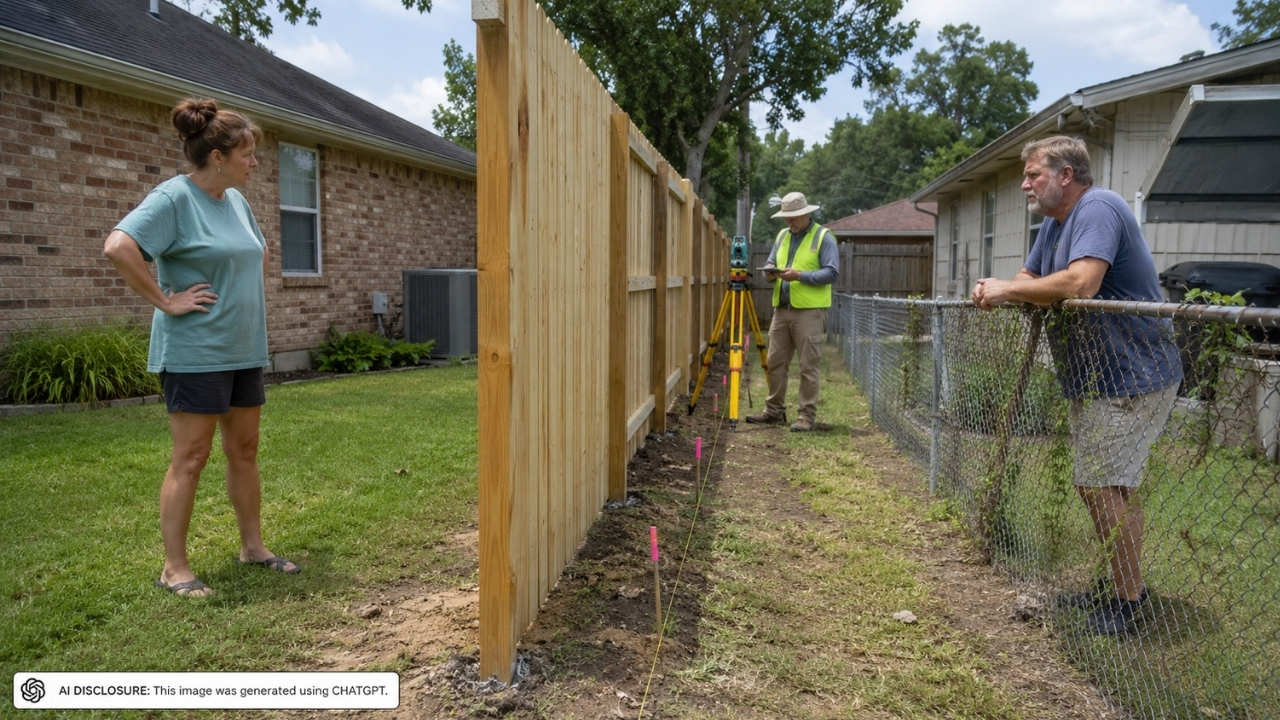
The new privacy fence looked like progress—clean lines, fresh boards, the kind of upgrade people do right after buying a place. But in Benton, Louisiana, that “simple” backyard project turned into a boundary fight that ended with a court-ordered redo of the property line and an order to pull fence sections back off a neighbor’s land. The court record in the source opinion reads like something every homeowner dreads: pins in the dirt, accusations about moved stakes, and the slow realization that what everyone assumed was “the line” might not be the line at all.
At the center were Richard and Gloria Neill and their next-door neighbors, Tom and Amanda Coday. The Neills owned multiple lots in the Neill Acres subdivision—lots 1 and 3—while the Codays bought adjoining lot 2 in 2018. Then a fence went up, and suddenly “my yard” and “your yard” needed an official definition.
The first sign wasn’t the fence — it was the old one
Most people assume the existing fence tells the story. In this neighborhood, that assumption was part of the trap.
The Neills had originally created the subdivision and installed older cyclone fencing, but they placed it several feet inside their own property instead of right on the boundary. That kind of choice can feel harmless—maybe you don’t want to fight with brush, maybe you’re giving yourself room for maintenance—but years later it can become the seed of a major misunderstanding. If the “visual boundary” isn’t the legal boundary, every later project is built on guesswork.
When the Codays went to build their privacy fence, Tom Coday said he relied on property pins he found and believed he was building on the boundary. He later admitted that one rear section ended up about six inches onto the Neills’ property because he had to work around a garage overhang. That’s the kind of detail that sounds minor until you’re the person losing land—then it’s a bright red line.
Once someone mentions “stakes were moved,” it’s no longer a weekend project
This is the moment neighbor disagreements start to harden. Not “your fence is close,” but “you moved the markers.”
Richard Neill accused Tom Coday of moving survey stakes. But he also admitted he never actually saw anyone move them, and the trial judge rejected the accusation. Still, even an unproven allegation like that changes the temperature. It frames the whole dispute as intentional, not mistaken, and it makes informal resolution harder because nobody wants to concede anything.
And here’s the uncomfortable part: the evidence showed the Codays’ fence actually lined up with some pins that appeared to be original pins placed years earlier. In other words, even if the fence was wrong, it wasn’t necessarily reckless. It’s exactly how normal homeowners get burned—doing what looks right in the yard and later finding out the paper says something else.
The judge stopped the trial and brought in a neutral surveyor
The initial proof didn’t settle the big question: where is the true boundary, and where is the fence compared to that boundary?
After both sides initially rested, the trial judge said the evidence wasn’t sufficient to determine the boundary or the fence’s exact position relative to it. Instead of tossing the case out, the judge appointed an independent surveyor, Charles Coyle, to do an updated survey. Neither side objected at the time.
Coyle’s work showed the Codays’ fence extended beyond lot 2 and onto the Neills’ property in several sections. That finding became the map the court used to “fix” the boundary for purposes of the case. If you’ve ever watched neighbors argue over a few inches, you know why a clean survey matters: once it’s drawn and accepted, the argument changes from “I think” to “move it.”
The Codays later argued on appeal that the judge should have dismissed the case when the Neills didn’t prove the boundary during the original trial, instead of essentially rebooting things with a new survey. The appeals court didn’t buy it. Louisiana law allows the court to appoint a professional surveyor in a boundary action, and the Codays had agreed to Coyle’s appointment, his expert status, and the admission of his exhibits. They couldn’t sign off and then complain after the fact.
The fence had to come back off the neighbor’s land — but the bill wasn’t so simple
The trial court adopted Coyle’s boundary and ordered the Codays to remove the encroaching fence sections at their own expense. In homeowner terms: you paid once to build it, and now you pay again to unbuild it and rebuild it.
But the appeals court split the issue in a way that will sound familiar to anyone who’s ever dealt with “shared” property features. Louisiana has a rule that when adjoining properties are enclosed, neighbors can be required to share the expense of making and repairing a common fence. The appeals court found both sides intended to enclose their lots and that the Codays reasonably believed they were placing the privacy fence on the common boundary.
That detail mattered. Once the fence is moved to the correct boundary, it becomes a common fence separating the properties. So the Codays still have to move the encroaching sections—no escape there—but the Neills may have to contribute half of the appropriate cost of moving and resetting the fence.
And it wasn’t a blank check. The amount still has to be determined back in the trial court, and any recovery is limited to wholesale cost rather than Tom Coday’s retail fence-building rate. The message: yes, you may share the cost, but you don’t get to charge your neighbor your full “customer price” for your own labor and markup.
The paperwork glitch that can haunt a property line for years
Even after a court fight, the outcome can still be unusable if the paperwork isn’t tight.
There was a problem with the judgment itself. It referred to Coyle’s survey exhibit to define the boundary, but that exhibit wasn’t actually attached, and the judgment didn’t contain a sufficiently precise legal description of the boundary line. The appeals court ordered that to be corrected on remand.
This is the unglamorous part of property disputes that hits later. A fence can be moved, but if the legal description in the judgment is sloppy, you’ve just paid for a battle that can flare up again—at resale time, during refinancing, or the next time someone puts in a shed and tries to eyeball the line.
Homeowner reaction: “Get the survey right, then figure out the money”
If you’ve ever listened to homeowners talk through boundary problems, the instincts are usually the same: don’t argue in circles, and don’t keep building until the line is nailed down.
This case shows why. The Codays had pins that appeared original. The Neills had older fencing set inside their own boundary, which created a misleading “common sense” border. Both sides ended up in court anyway, and the solution required a neutral surveyor because the first round of proof wasn’t enough to draw the line with confidence.
It also shows that “being wrong” and “being unreasonable” aren’t always the same thing. The Codays were ordered to move parts of the fence off the Neills’ property, but the appeals court still treated their belief about the boundary as reasonable enough to trigger shared-fence cost rules once the fence is properly set.
In the end, the boundary stands as determined, the encroaching fence sections have to be removed and reset, and the case goes back to calculate what half really means and to fix the legal description. That’s a lot of time and stress over something that started as a backyard improvement—until it wasn’t.
Like Fix It Homestead’s content? Be sure to follow us.