Landowners Find a Longstanding Fence Marking the Boundary With the Neighbors — Then the Whole Claim Turns on Whether They Occupied Right Up to It
Photo credit: AI-generated image created using ChatGPT. Illustrative only
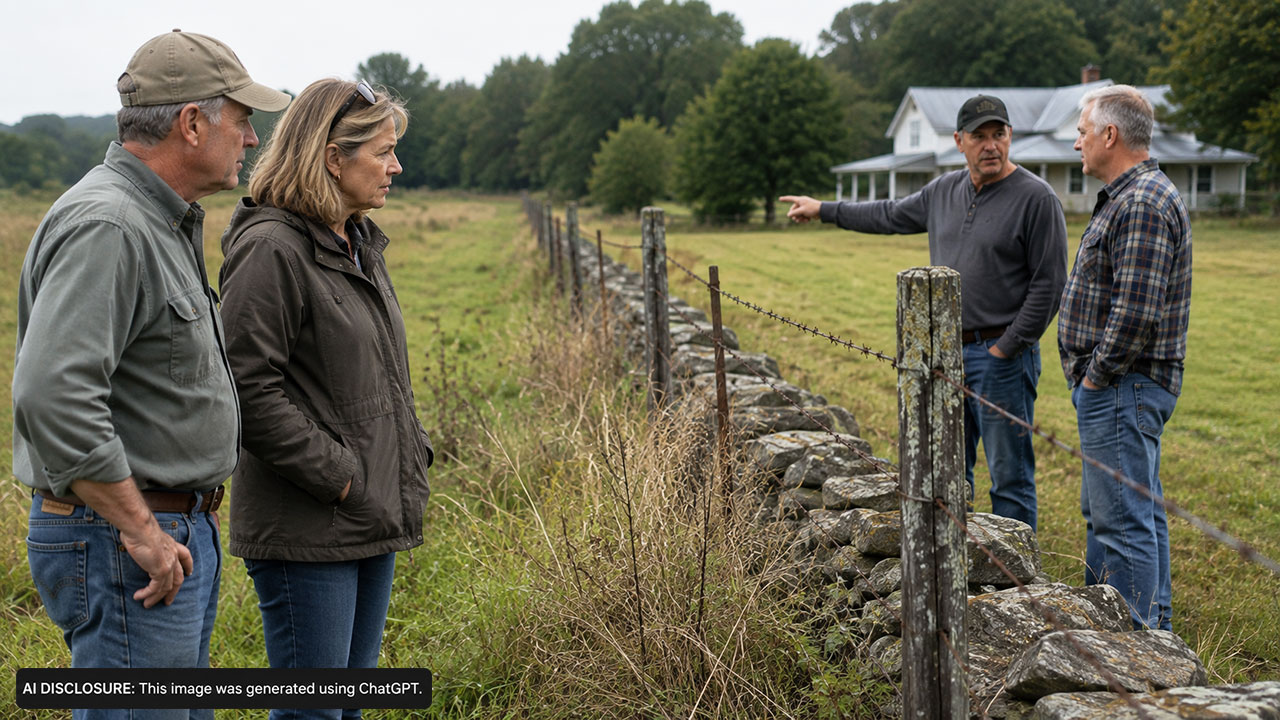
On rural property, a fence can feel like a fact of nature. It’s been there forever, the grass is grazed right up to it, and nobody questions it until the day someone does a survey and the “obvious” line suddenly isn’t so obvious.
That’s the kind of slow-burn neighbor mess that blew up in the source post out of Utah—where a longstanding fence looked like the boundary, one side claimed they’d used the land up to it for decades, and then everything hinged on whether they truly occupied it continuously and whether the neighbors were even “adjoining” owners for long enough.
The fence had always been “the line,” until it wasn’t
The Baadsgaard Family Trust and Robert and Suzanne Stevens owned adjoining property. For years, a fence sat there like the practical boundary, and the Trust treated the ground up to that fence as theirs—grazing cattle and raising hay right to it.
Then came the discovery that cracks a lot of neighbor relationships: the fence wasn’t on the true deed line. In other words, the Trust’s day-to-day use had reached onto land that, on paper, belonged to the Stevenses.
If you’ve lived out where property markers are old posts, faded corners, and whoever built the fence last, you can already hear the arguments starting. One side sees a harmless tradition. The other sees years of someone taking what wasn’t theirs.
They tried to “make it official” with a boundary-by-acquiescence claim
The Trust didn’t just shrug and move the fence. They sued to quiet title to the disputed strip using Utah’s boundary-by-acquiescence doctrine—basically arguing that the fence line had been treated as the boundary long enough that the law should recognize it.
To win, the Trust needed to prove the usual big-ticket items: long-term occupation up to the fence, mutual acquiescence in the fence as the boundary, and—this part matters later—that the parties were adjoining landowners for at least 20 years.
That “adjoining” element isn’t just vibes. It’s geography and time. The parcels have to be contiguous, and the required relationship and other elements have to exist continuously for the full period.
Mediation came with a hardcore “Honesty Provision”
Like a lot of property-line fights, it went to mediation. This is where people often try to stop the bleeding—legal fees, stress, and the awkward reality that you still have to live next to each other afterward.
But this mediation had an unusually explicit twist: an Honesty Provision. Both sides agreed to completely disclose all relevant information and documents, and the agreement even said that if either side failed to fully and honestly disclose relevant information, any settlement reached in mediation could be voided.
They did settle. The Stevenses agreed to deed part of the disputed land to the Trust. When they later didn’t perform, the Trust went to court and got an order enforcing the settlement.
So it looked “done.” On paper, at least.
The settlement unraveled because of one small parcel in the wrong place
After the enforcement order, the Stevenses learned something they said should have been disclosed before mediation: shortly before filing the lawsuit, the Trust had purchased another small tract—the East Parcel—located between parts of the Trust’s original property and the Stevenses’ land.
The Stevenses said they’d mistakenly believed the Trust owned that East Parcel all along. And that misunderstanding wasn’t a trivia detail—it went straight to the Trust’s story about how its cattle occupied the disputed area.
The Stevenses argued they thought the Trust’s cattle could have traveled west from land they assumed had always belonged to the Trust. But if the Trust only recently acquired that intervening parcel, it could undermine whether the Trust and Stevenses were actually adjoining owners for the required 20 years, and whether the Trust continuously occupied the disputed strip for that entire period.
So they went back to court and essentially said: we agreed to settle without knowing a material fact that the other side expressly promised to disclose.
The trial judge agreed, found the East Parcel ownership was material, and vacated the earlier order enforcing the settlement. In plain homeowner terms: the deal got pulled back off the table because the court believed the “full honesty” condition wasn’t met.
“You could’ve looked it up” didn’t work with a full-disclosure promise
The Trust argued the Stevenses could’ve discovered the East Parcel purchase through public property records. Recorded deeds can provide constructive notice, and in a lot of disputes, courts will look at whether someone could have found the information if they’d done their homework.
But the Utah Court of Appeals said that argument didn’t save the Trust here. The parties had voluntarily agreed to something stronger than the usual “it was recorded, so you’re deemed to know it” rule.
They promised to fully disclose relevant information and documents to each other and the mediator. The court’s message was blunt: you can’t sign an agreement to be fully transparent and then fall back on “well, you could have searched the county records.”
The appeals court also agreed the East Parcel mattered. Because it sat between portions of the properties, it could directly affect whether the “adjoining landowners” requirement was met continuously for 20 years, and whether the Trust’s cattle could actually have reached and occupied the disputed strip during the relevant period. The court said the East Parcel “absolutely should have been disclosed,” and it called the Trust’s complaint about an “impossible burden” to guess what matters to the other side “rather hyperbolic.”
There was even a side argument about mediation confidentiality. The Trust claimed the judge relied on confidential mediation discussions, but the appellate court said the ruling didn’t depend on confidential negotiations and noted the Stevenses’ own filed answer already showed why access and cattle movement mattered to their defense.
And the practical end of this wasn’t gentle: by the time of the appeal, the district court had dismissed the Trust’s claims with prejudice and ordered the fence removed so the Stevenses could take full possession of the disputed property.
The homeowner reaction: survey everything, document everything, and don’t treat mediation like small talk
This is the kind of case that makes property owners reach for the same three words: “Get. A. Survey.” Because a fence can be old and “everybody knows” it’s the line, right up until it’s not—and then you’re arguing about decades of use, animal access, and whether two properties really touched the way people assumed.
But the other big gut-check is about paperwork and disclosure. The settlement didn’t blow up because someone forgot a minor detail about a fence repair. It blew up because the parties agreed in writing to full disclosure of relevant information—and then one side didn’t disclose a recent purchase that went to the heart of the boundary claim.
If you’re a landowner, it’s also a reminder that mediation isn’t just a handshake with a nicer tone. When you sign an agreement with an honesty clause that says the deal can be voided, courts may take that seriously in a very literal way.
In the end, what started as a familiar country problem—an old fence that felt like the boundary—turned into a fight over maps, decades, and a newly purchased sliver of land that changed the story. And once trust is gone in a neighbor dispute, even a signed settlement can end up right back in court, with the fence coming down and the “real line” taking over.
Like Fix It Homestead’s content? Be sure to follow us.