New Homeowner Finds the Neighbor Paved Over a Ten-Foot Corner of the Land Without Asking — Then the Neighbor Says the Driveway Has to Stay Because It’s Already Poured
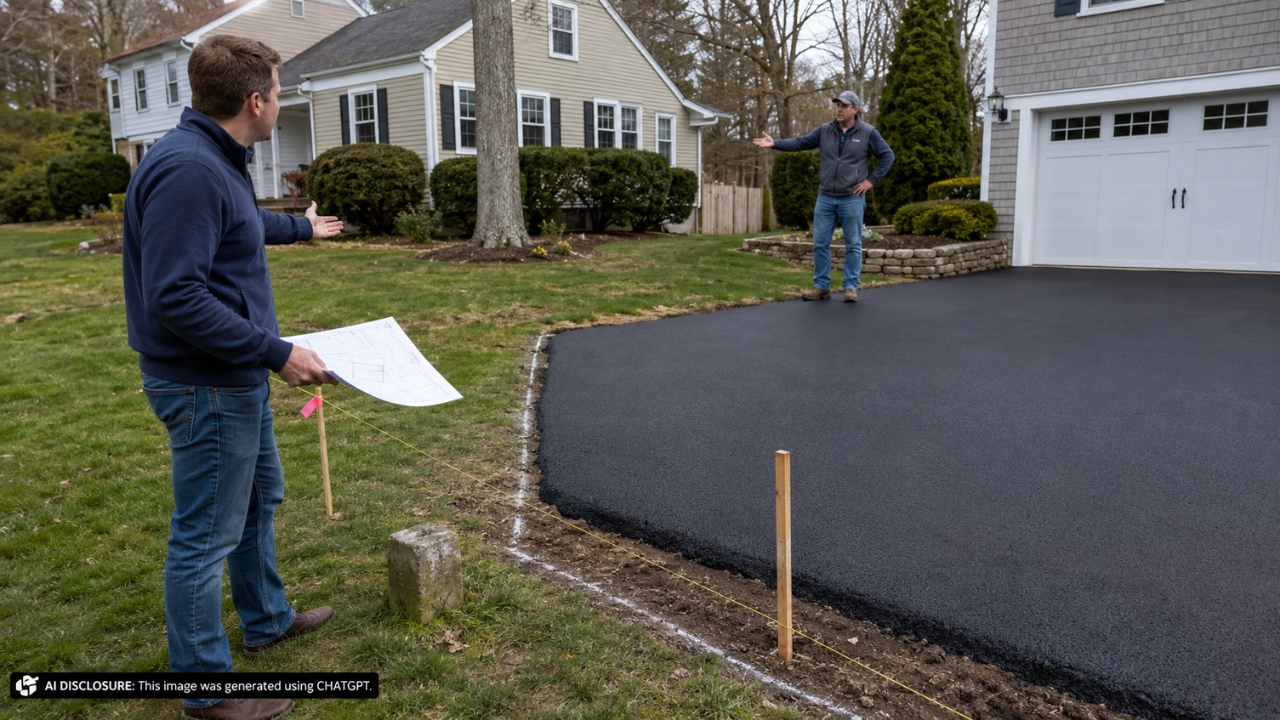
Photo credit: AI-generated image created using ChatGPT. Illustrative only.
It started with a driveway that looked a little wider than it used to. The kind of change you notice from the corner of your eye when you pull in after work, then forget about because you assume it’s still on the other person’s side.
But for one Massachusetts homeowner, that “little wider” detail turned into a full-blown property line fight after a survey showed the neighbor’s pavement didn’t just hug the edge—it crossed it. In the source post, the homeowner describes discovering that several feet of the neighbor’s repaved driveway sits on their land, then watching the neighbor double down by repaving again and covering the marker.
The first sign was a driveway that didn’t match the slope
The neighbors had moved in a few years earlier, and one of their first big projects was repaving their driveway. They didn’t just refresh the surface—they changed the shape at the end, making it larger so the climb up to their house would be less steep and less curved.
That’s the kind of “improvement” that can quietly shift a boundary. If a driveway flares out at the bottom, it can eat into a corner of the adjacent lot without anyone noticing until something forces the question.
Here, the homeowners had a nagging suspicion. They thought the expanded section might be on their land, so they did the responsible (and not cheap) thing: they hired a surveyor.
The survey confirmed what their eyes were already telling them
The survey results, according to the homeowner, matched their concern. The neighbor’s driveway was on their property “by several feet.” Not a disputed inch. Not a fence-post wobble. Actual paved driveway sitting where it didn’t belong.
They asked the neighbors to remove the portion that crossed the line. Then they waited. A year went by, and nothing changed.
Living next to someone who’s literally occupying part of your lot is one kind of stress. Living next to someone who won’t even acknowledge it is another.
It wasn’t just pavement—other boundary-crossing piled up
The driveway wasn’t the only thing the homeowner says drifted onto their side. They describe a string of problems that, stacked together, starts to feel less like neighborly friction and more like a pattern.
They say the neighbors drained their pool into the homeowner’s yard. They also say snow was blown off the neighbor’s driveway and onto the homeowner’s garage roof. Add “overall rude” to the list, and you can see why the driveway stopped feeling like a one-off misunderstanding.
Drainage and snow aren’t petty issues in Massachusetts. Water in the wrong place can wreck lawns, cause soggy spots, and push runoff toward foundations. Snow loads on a roof aren’t theoretical, either—especially when you’re dealing with repeated dumping in the same area.
The moment it escalated: the marker got covered again
Then came the day that pushed the dispute from simmering to active. The homeowners saw the neighbor had their driveway repaved again—fresh asphalt—covering up the land marker once more.
Whether it was intentional or just careless, the effect is the same: the visual proof on the ground is gone. And when you’re dealing with a boundary fight, visible markers matter because they keep the argument from turning into “your memory versus mine.”
The homeowners called the police. But the response they got wasn’t the one that resolves property disputes on the spot. According to the homeowner, the neighbors told police, “that’s how the driveway was when we got here, they can take us to court if they want.”
That line is doing a lot of work. It frames the pavement as pre-existing, shifts blame to prior owners, and dares the homeowner to spend the time and money to force the issue.
The tempting idea: just bring in a backhoe
After a year of waiting and now a second repaving, the homeowner’s question turned blunt: can they just use a backhoe and remove the neighbor’s driveway from their property, or do they need to go to court first?
On an emotional level, the backhoe idea makes sense. If it’s your land, why should you tolerate someone else’s pavement? Why should you have to pay lawyers to “get permission” to use your own property?
But in real-life homeowner disputes, self-help can be the trap. Even if the land is yours, tearing out someone else’s driveway can trigger claims of property damage, escalation, and retaliation. And if there’s any possibility of an easement, a past agreement, or a boundary nuance the homeowner hasn’t uncovered yet, acting first can put them on the defensive later.
The other problem is practical: removing a chunk of driveway is loud, messy, and immediate. It’s not like moving a fence panel back six inches. Once asphalt is broken up, you’ve created a new hazard zone along a shared edge—jagged pavement, crumbling base material, and runoff that suddenly changes direction.
Reactions leaned toward proof, paperwork, and keeping your hands clean
Even without seeing every reply, the typical homeowner-and-property-line playbook is pretty predictable, and it’s the one people tend to push in discussions like this: document everything, keep the survey information organized, and avoid being the person who “started the damage.”
When a neighbor claims, “it was like that when we got here,” that’s often a sign the next phase is going to be about records. Survey maps. Deeds. Any evidence of where the driveway used to end. Photos from old listings can matter more than people expect, because they timestamp what the driveway looked like before and after the neighbors arrived.
The homeowners already did a key step by hiring a surveyor. The next steps many people urge in these disputes are slower and less satisfying than a backhoe, but they’re designed to hold up when things get ugly: written demands, boundary notices, and professional advice before any physical action.
It also wouldn’t be surprising to see people suggest cameras, not to spy, but to protect against late-night “fixes” or more dumping—especially after the marker was covered again. Once you’ve had one boundary crossed, homeowners often start thinking about all the other ways a neighbor can make your life harder without stepping inside your house.
The frustrating part is that none of this instantly gives the homeowner their corner back. It just builds a trail that makes it harder for the neighbor to pretend nothing happened.
For now, the homeowners are stuck living with a piece of someone else’s driveway on their land, a covered marker, and a neighbor who’s effectively saying the burden is on them to force the issue. And that’s the real pressure point: not just the concrete and asphalt, but the feeling that if you don’t act the “right” way, you could end up paying twice—once to fix the property line, and again to clean up the fallout from trying to fix it yourself.