New Homeowner Finds the Neighbor’s Fence and Storage Shed Both Sitting Three Feet Onto Her Side of the Line — Then the Neighbor Says Only the Fence Needs to Move
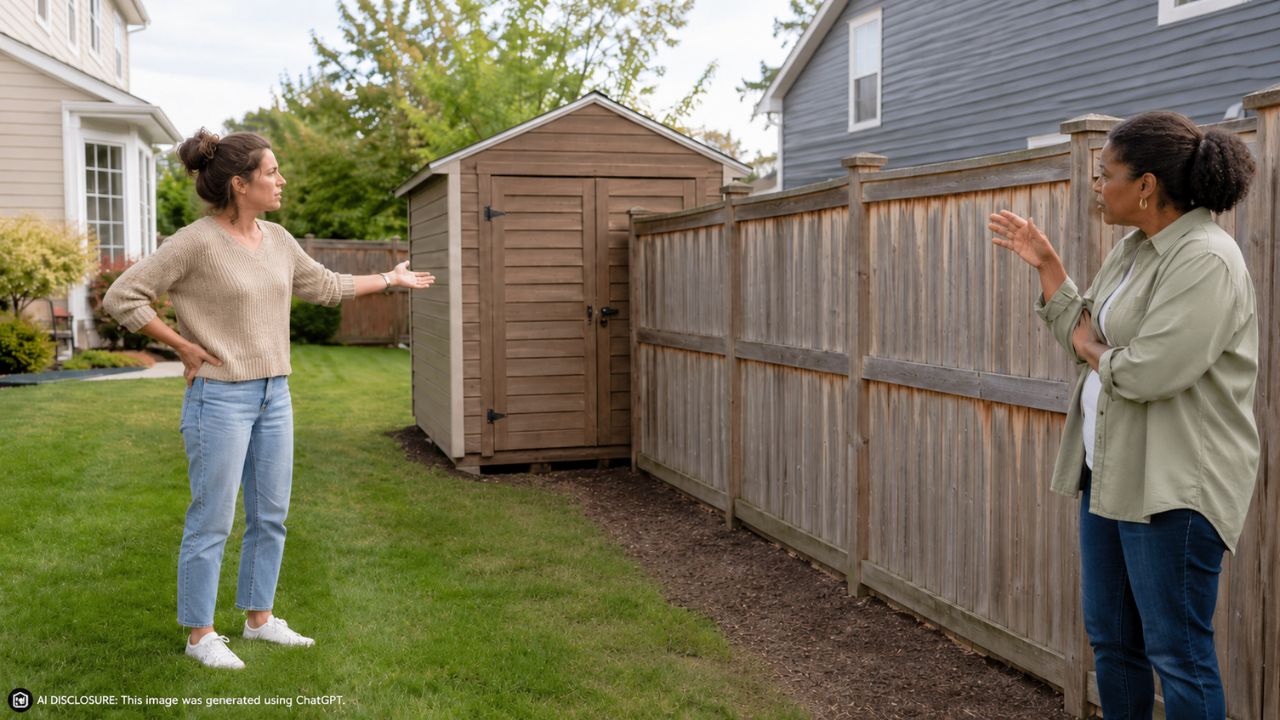
Photo credit: AI-generated image created using ChatGPT. Illustrative only.
It started the way a lot of property line problems start: a new homeowner looking down at the ground, spotting survey pins, and realizing the “neighbor’s side” doesn’t match what’s actually in the dirt.
In the original post, the homeowner said the neighbors built a fence about 1’8″ past the boundary. Then things escalated. A storage shed went up in a corner, and now part of that structure also sits over the line. On a small, cookie-cutter lot under a quarter acre, losing even a couple feet isn’t theoretical—it changes how you use your yard.
The pins were right there, and the math didn’t work
The homeowner wasn’t guessing. They said they found the survey pins in the ground and had a plat map showing where those pins should be. That’s the kind of detail most people don’t notice until something forces them to learn fast.
And once you see it, you can’t unsee it. A fence that’s nearly two feet over may not look dramatic from the street, but it quietly steals usable space. Add in a shed corner crossing the line, and it stops feeling like a “maybe” and starts feeling like someone is building on your land.
The lot size made it worse. In big rural properties, a foot or two can get shrugged off (even when it shouldn’t). In tightly spaced neighborhoods, those inches are your side gate, your mower path, your garden strip, your place to put a trash bin—real-life function, not just paper boundaries.
A fence is one thing. A shed makes it feel permanent.
Plenty of neighbor disputes start with fencing because it’s visible and it’s often installed quickly. But a shed changes the emotional temperature. It’s heavier, harder to move, and it signals long-term intent.
The homeowner described the shed as “partially on my side of the line,” placed in a corner of the neighbors’ yard. Corners are where people put permanent things: sheds, dog runs, compost bins, storage piles. It’s also where property line mistakes can sit for years because no one walks that strip every day.
Now the homeowner isn’t just looking at a crooked fence line; they’re looking at a structure that could affect drainage, access, and maintenance. Even if the shed isn’t causing damage today, it creates a new reality: someone else’s building is occupying space the homeowner believed they owned and could use.
The neighbor’s answer: nothing’s coming down
The homeowner did what most people try first—talk to the neighbors. The response was blunt: they said they’re not moving or taking down anything.
That’s the moment these problems stop being awkward and start being urgent. When a neighbor won’t even discuss a fix, the homeowner is left staring at a fence and shed that effectively redraw the yard. And the longer it sits there, the more the homeowner worries about being boxed into a corner later.
The headline version of this kind of dispute always sounds simple—“just move it”—but in the real world, moving a fence costs money, moving a shed costs more, and neither party wants to pay for a mistake. If the neighbor’s position is “only the fence needs to move” (or, in the homeowner’s case, “nothing moves”), that’s not a misunderstanding. That’s a standoff.
The money pressure: “Can’t afford an attorney”
The homeowner’s biggest problem wasn’t finding the pins. It was what came next. They said they can’t afford an attorney and asked if that means they’re out of luck.
That’s the part that makes these stories so relatable. Property lines are legal boundaries, but enforcing them can feel like a luxury product. You can have a plat map, you can have visible pins, you can even have the world’s most obvious encroachment, and still feel stuck if the only path forward seems to require a retainer you don’t have.
They also went looking for a government entity to help, only to hit a wall: the city’s code enforcement website specifically said it can’t help with property line disputes. That’s another gut punch. A lot of homeowners assume the city will step in when something is “wrong,” but property line encroachments often land in that frustrating gap between “obvious to the eye” and “not a code violation the city will arbitrate.”
Now they’re left with the kind of question that keeps people up at night: if nobody enforces it for you, do you just live with it?
What people pushed: documentation, proof, and not letting it drift
Even without a comment thread pasted in, the pressure points are easy to predict because homeowners have seen this movie before. When someone has pins and a plat map, the next step is usually to turn “I know exactly where the line is” into something that can’t be brushed off in a future argument.
In real neighborhoods, that often means creating a paper trail before emotions boil over. Photos of the pins. Photos showing the fence line relative to the pins. Measurements with clear reference points. Notes of dates—when the fence went up, when the shed appeared, when the conversation happened, and what was said (“they said they’re not moving or taking down anything”).
The other practical reaction tends to be: don’t rely on a handshake solution once the neighbor has refused. When a shed is involved, the homeowner is thinking about future resale, title questions, and whether a buyer’s inspector or survey could turn it into a last-minute deal problem. Even if the homeowner never plans to move, the property’s boundaries still matter when permits, additions, and landscaping plans come up.
The real-world stakes: access, maintenance, and the next project
On a small lot, three feet isn’t just “land.” It’s clearance for repairs, room to replace a fence panel, and space to get to the back corner without squeezing sideways. If a shed is sitting partly on the homeowner’s side, it can complicate basic upkeep—who trims behind it, who deals with rot, who handles pests if rodents nest under it, and who’s responsible if runoff starts cutting a groove along the line.
It also changes what the homeowner can do next. Want to plant a hedge? Add a gate? Run a French drain? Put in a patio edge? Suddenly every improvement involves negotiating around a structure that shouldn’t be there, and every conversation comes with the fear that the neighbor will treat that encroached area as “theirs” because it’s been that way for a while.
For now, the homeowner is stuck between what they can physically see—pins in the ground, a fence line that doesn’t match, a shed that crossed the boundary—and what they can realistically force without spending money they don’t have. It’s the kind of dispute that turns a brand-new home into a daily reminder that sometimes the hardest repairs aren’t in the walls. They’re right at the edge of the yard.
Like Fix It Homestead’s content? Be sure to follow us.