New Homeowner Finds a Fence Built Two Feet Inside Her Own Boundary — Then the Neighbor Says the Lost Strip of Yard Was “Never Really Yours to Begin With”
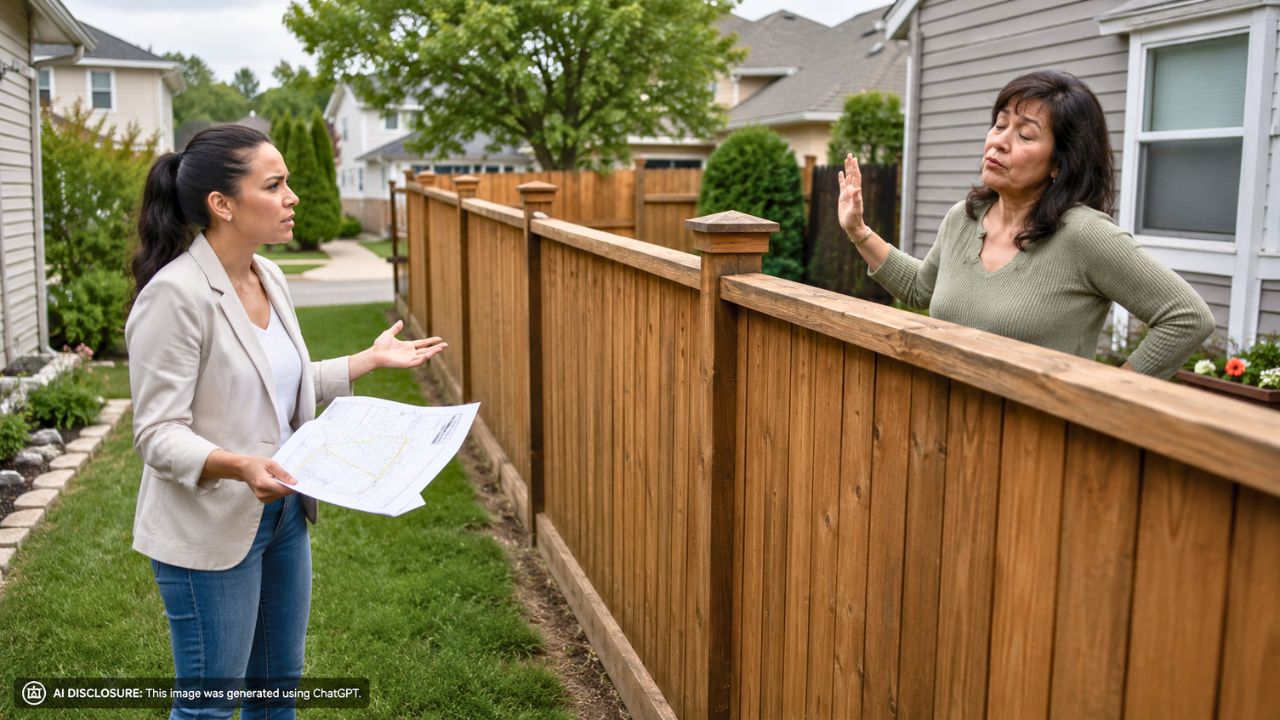
Photo credit: AI-generated image created using ChatGPT. Illustrative only.
Six months into owning her first home, a new homeowner watched her neighbor start setting fence posts along the side yard and figured it was a win-win: more privacy, cleaner boundary, done. Then she stepped back, looked at the line, and felt that stomach-drop moment when something just didn’t match what she remembered from closing paperwork.
In the original post, she explains that the new fence wasn’t landing on the property line at all. By her property plat from closing, it was sitting a full two feet inside her boundary for roughly 70 feet—enough to change how the yard functions, not just a “close enough” mistake.
The first sign was easy to brush off—until she measured it
At first, the build looked normal. A neighbor putting up a fence isn’t unusual, and a shared property edge is exactly where you expect it to go. But once she noticed it seemed “off,” she did what a lot of homeowners do when the ground truth doesn’t match the vibe: she went back to the documents.
Her closing paperwork included a property plat, and comparing that to where the posts were going made the problem hard to unsee. Two feet doesn’t sound like much until you stretch it out for 70 feet. Suddenly you’re not talking about inches—you’re talking about a strip of yard that could hold a garden bed, a path, a row of shrubs, or access space for maintenance.
And that’s exactly what made it feel personal fast: she’d planned to install raised garden beds in that area. A fence that far inside her line didn’t just shift a boundary. It wiped out a plan she had for her own property.
Then came the neighbor’s explanation: “It’s where the old fence was”
She didn’t go in swinging. She asked politely, giving the neighbor an opening to correct a simple mistake. Instead, she got a response that would make any new homeowner’s ears perk up: “It’s where the old fence was before. Been like that since forever, so it’s fine.”
This is where fence drama usually turns from awkward to serious. Because “it’s always been that way” isn’t just small talk. It’s a claim about history—about what’s normal, what’s accepted, and sometimes, what someone thinks they’re entitled to keep using.
But the homeowner did another quiet piece of due diligence: she contacted the previous owner. The previous owner told her there was no old fence. That didn’t prove where the line is all by itself, but it did undercut the neighbor’s story and made the new build feel less like an accident and more like a land grab dressed up as tradition.
Two feet doesn’t sound like much—until it starts changing how you live there
People who haven’t owned property will hear “two feet” and think this is a petty fight waiting to happen. Homeowners hear “two feet for 70 feet” and start doing the mental math on everything that lives in that zone.
That strip is where you run a mower without rubbing a fence. It’s where you step around to trim or paint. It’s where you might need access for drainage work, pest treatment, or future repairs. It’s where you put the raised garden bed you were excited about because the sun hits just right.
And there’s a bigger practical fear underneath it: once a fence goes in and sits there, it can quietly become the “new normal.” Even if nothing formal happens, time and habit can make it harder to challenge later, especially after landscaping grows in and everyone forgets what the yard looked like when you bought the place.
For a first-time homeowner still getting settled, it’s a brutal early lesson: property lines can feel theoretical until someone pours concrete and makes them physical.
The real problem wasn’t the fence—it was the pressure to let it slide
She’s not looking for a fight. That comes through clearly. Her question wasn’t “How do I destroy my neighbor in court?” It was basically: do I push this legally, or do I swallow it to keep the peace?
That’s the trap in these disputes. If you push back, you worry you’ll be labeled “that neighbor” for the next decade. If you don’t push back, you may be signing up for a permanent loss of space and a permanent reminder every time you look out the window.
It also changes the tone of every future interaction. Today it’s a fence. Next year it’s a shed “just a little over.” After that it’s a gate, a camera, a dog run, or landscaping that spills into the wrong side. Boundary issues don’t always stop at the first boundary issue.
For her, it wasn’t about winning. It was about not starting her homeownership story by watching a chunk of her yard get quietly erased.
Most people focused on one thing: proof before confrontation
Even without a play-by-play of replies included in the post, the direction of homeowner advice in these moments is usually consistent: don’t argue based on vibes, and don’t negotiate away your rights based on someone else’s “it’s always been like that.”
When a fence is involved, homeowners tend to zero in on documentation. A plat is a helpful start, but it isn’t the same as seeing the boundary marked on the ground. That’s why so many people urge getting the line clearly established before the fence becomes a finished, “locked in” structure that’s harder to undo.
Others tend to recommend putting things in writing early—politely, calmly, and with dates—because verbal conversations evaporate. If the neighbor is claiming an “old fence,” and the previous owner is saying there wasn’t one, having your own clear paper trail matters. It’s not about being dramatic; it’s about not being stuck later with a “he said, she said” argument after the boards are up and the dirt is packed down.
And there’s a practical reality: the neighbor is already building. Time favors the person holding the hammer.
She’s left choosing between peace and permanence
For now, her story sits in that tense middle space homeowners know too well. A fence line is being set in real time. The neighbor’s explanation doesn’t match what she’s been able to confirm. And the cost of doing nothing isn’t just losing two feet on paper—it’s losing use of that space in day-to-day life.
If she pushes back, she risks a chilly relationship with the person living a few yards away. If she doesn’t, she may spend years staring at a fence that reminds her she let the first big boundary test slide.
And that’s the hard truth about homeownership nobody puts in the listing photos: sometimes “welcome home” arrives as a dispute over two feet of dirt, and the next step you take—quietly, firmly, or not at all—can shape the whole neighborhood dynamic from there.
Like Fix It Homestead’s content? Be sure to follow us.