New Homeowner Finds Two Feet of Standing Water in the Yard After Every Storm — Then Learns the Neighbor’s Regraded Lawn Sends the Runoff Downhill Every Time
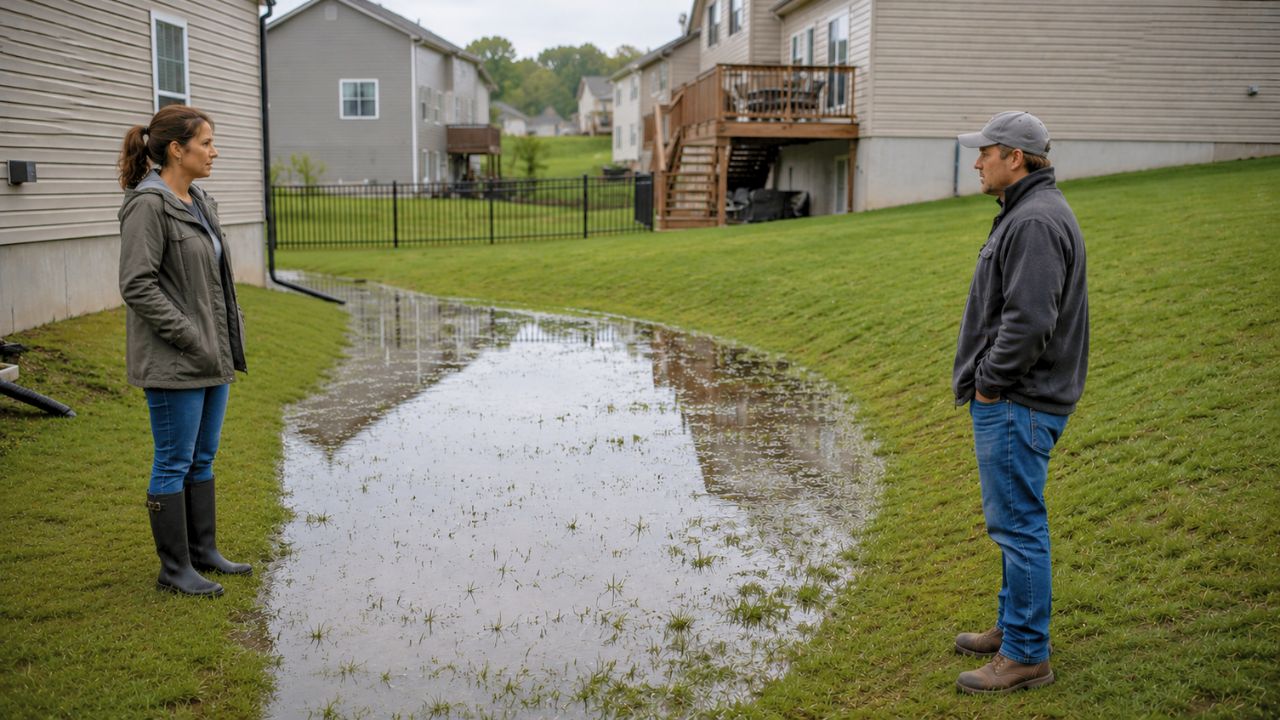
Photo credit: AI-generated image created using ChatGPT. Illustrative only.
The yard didn’t just get soggy after a storm—it turned into a pooling, churning mess that kept coming back. Water pushed across the ground hard enough to erode soil, and it wasn’t subtle. It was the kind of runoff you can see and hear, the kind that makes you wonder how long the yard can take it before the damage becomes permanent.
In the original post, a homeowner lays it out plainly: their neighbor’s roof water is running into their yard, causing flooding and erosion, and they want to know what steps to take. They even included a video, because sometimes describing water problems in words doesn’t do justice to how forceful and relentless they can be.
The water wasn’t “just drainage”—it was tearing the yard up
Most homeowners can handle a little runoff. A wet patch. A puddle that disappears by afternoon. But the complaint here wasn’t about a minor inconvenience—it was about flooding and erosion, the two red flags that say this isn’t going to fix itself.
When roof runoff lands in the wrong spot, it doesn’t behave like rain falling evenly across a lawn. It concentrates. It picks up speed. And if it’s coming off a roof line repeatedly during storms, it can carve out channels, wash away topsoil, and leave the lower yard taking all the punishment.
That’s what makes this kind of problem feel so personal so quickly. It’s not “bad weather.” It’s water being directed—intentionally or not—into someone else’s property, and the receiving yard becomes the sacrifice zone.
How this kind of issue sneaks up on new homeowners
Yard drainage problems have a way of hiding until you get the exact right storm. Walk a property on a sunny day and everything looks fine. Even during a light rain, the ground can absorb enough to mask a bigger flow pattern.
Then a heavy storm hits and the low spot reveals itself. If the runoff is coming from a neighbor’s roof, it can look like your yard is suddenly “failing,” when really it’s being asked to handle water it was never designed to take.
And once erosion starts, the yard can get worse with every storm. Soil washes away, the ground dips a little more, and that dip becomes the new collection bowl. The homeowner posting wasn’t just dealing with water—they were watching the property change shape.
When a neighbor’s roof water becomes your problem
Roof drainage is supposed to be managed on the property it falls on. Gutters, downspouts, and extensions exist for a reason: to move water away from foundations and keep it from turning into a hazard.
But if a downspout is aimed toward a property line, or if water is being discharged in a way that sends it downhill into the next yard, the result is predictable. The upper property sheds the water quickly, and the lower property gets a concentrated blast.
The homeowner’s wording was straightforward: the neighbor’s roof water is running into their yard, and it’s flooding and eroding it. That’s not a vague “we think it’s coming from over there.” It’s the kind of claim people make after watching the flow happen more than once.
The hard part is that even when the cause feels obvious, the fix can be touchy. Drainage changes can trigger neighbor defensiveness fast—especially if the neighbor believes they’re doing something normal, or if they’ve had their setup for years and don’t want to be told it’s a problem now.
The first “step” usually isn’t a shovel—it’s documentation
One reason the homeowner included video is that water disputes get weirdly slippery the moment you try to describe them later. What looks like a river in the moment can become “just a little runoff” when the ground dries out. Video makes it harder to hand-wave away.
Homeowners who end up in these disputes often learn that the most valuable thing early on is a clear record: dates of storms, pictures of pooling water, and clips that show the source and direction of flow. Not because everyone wants a fight, but because once you start talking about repairs—grading, drainage lines, gutter modifications—people ask, “How do you know it’s coming from me?”
And once erosion is involved, it’s not only about water. It’s about loss of soil, damaged landscaping, and the risk that the runoff will start undermining structures over time if it’s near a foundation, a fence line, or a patio area.
The homeowner’s question—“what are the steps that we need to take”—lands in that stressful space between wanting peace and realizing the yard can’t keep taking hits. There’s urgency, but also the sense that a wrong move could make living next door awkward for years.
People tend to split into two camps: “talk first” vs. “protect yourself first”
Even without a long back-and-forth included in the source material, the pattern around these posts is familiar: some folks push for a calm conversation with the neighbor, and others urge the homeowner to build a paper trail before any confrontation.
That split exists because both approaches can backfire. Talk first, and you risk getting brushed off—then the neighbor has a heads-up and may change things before you have proof of what was happening. Document first, and you can come off as hostile even if you’re simply trying to be careful.
But the reason documentation gets emphasized so often is simple: drainage problems can be expensive and complicated, and once you start correcting them, the “before” condition matters. If the homeowner ends up needing professional help, or if the neighbor denies anything is wrong, the video and photos become the common ground—something concrete to point to instead of a he-said-she-said argument over water.
There’s also a practical angle people bring up in these situations: sometimes the quickest, cheapest fix is on the neighbor’s side (adjusting a downspout or extending it), but the homeowner suffering the damage can’t just walk over and do it. That’s where the neighbor relationship matters, because access and permission become part of the repair.
The tension: it’s not just a wet lawn—it’s liability, repairs, and resentment
Water problems rarely stay in the yard. Flooding can create muddy walkways, slippery patches, and standing water that invites pests. Erosion can expose roots, destabilize fence posts, and chew away at the clean edges people work hard to maintain.
And once you feel like someone else’s property is causing damage to yours, it’s hard not to take it personally. Every storm becomes a reminder, and every new washed-out groove in the soil feels like proof that ignoring it is no longer an option.
The homeowner who posted is at that crossroads: they’ve identified the source as the neighbor’s roof runoff, they can see the damage, and they’re trying to figure out the next move. The video suggests they’re already thinking ahead—about showing what’s happening, not just complaining about it.
For now, the yard is still taking the hit every time the weather turns. The question isn’t whether water will come again. It’s whether the next storm will be the one that forces a bigger, more expensive fix—and whether the neighbor will be willing to help stop the flow before the erosion writes the next chapter.