New Homeowner Orders a Survey and Finds the Neighbor’s Fence Has Been on Their Property the Whole Time — Then the Neighbor Says the Survey Must Be Wrong
Photo credit: AI-generated image created using ChatGPT. Illustrative only.
It’s one thing to discover a squeaky stair or a sticking door after you buy a house. It’s another to walk the backyard and realize the boundary you thought you inherited doesn’t match what’s actually on paper.
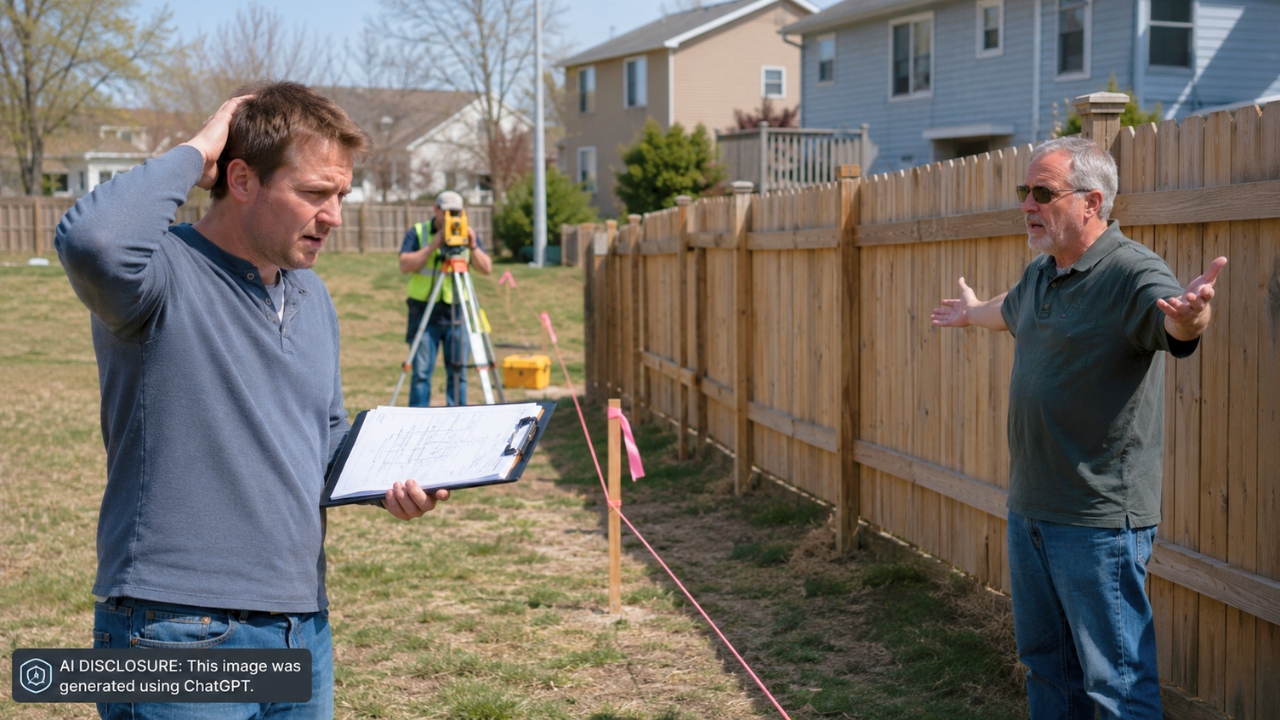
That’s the reality one new homeowner described in the original post: a freshly ordered survey came back with stakes in the ground, and those markers showed the neighbor’s back fence line wasn’t just close to the property line—it was on the new owner’s side.
The stakes in the ground changed the whole vibe
The homeowner had just purchased the place and did what cautious buyers do: they ordered a survey. When the survey results came in, the surveyor placed stakes that made the boundary visible in a way a map or legal description never really does.
With those stakes in, the homeowner went back to the property to physically check the yard. That’s when it clicked: the neighbor’s fence forms the back portion of a squared-off metal fence that encloses the neighbor’s backyard, and part of that enclosure appears to sit on the homeowner’s land.
This wasn’t a case of a few inches of landscaping spilling over. A fence is a statement. It defines where people think they can walk, mow, store things, and let pets roam. And once it’s been there “forever,” it starts to feel permanent—until someone pulls out a survey.
It wasn’t the lost land that bothered them—it was the risk
Here’s the twist: the homeowner didn’t sound angry about “losing” a strip of yard. They said they personally didn’t mind the fence’s placement because their yard slopes down toward the neighbor, and that section is basically unusable unless they take on a major leveling project.
That’s a very homestead-brain way to look at it: if the ground isn’t friendly and it’s not doing you any favors, it’s easy to shrug and say, “Not worth the fight.”
But the practical worry sneaks in fast. Even if the land is awkward, it’s still part of what they bought. And when a structure sits across a boundary, it can drag future problems with it—especially if the homeowner ever wants to sell, build, re-grade, add drainage work, or put up their own fence.
What felt like a small, ignorable detail becomes a paperwork problem. A title-and-transfer problem. A “why didn’t you address this when you found out?” problem.
Being neighborly doesn’t mean leaving it vague
The homeowner’s instinct was to handle it gently. They said they want to be a good neighbor and “do the neighborly thing,” and they mentioned their lawyer thinks that approach is best too.
That line matters, because it hints at the tightrope a lot of homeowners end up walking. You want to keep peace on the street. You don’t want every interaction to turn into a property-line standoff. And yet, property lines are one of those things that don’t get easier with time if they’re left fuzzy.
In a lot of neighborhoods, the most expensive part of a boundary problem isn’t the dirt itself—it’s the way confusion spreads. Who maintains it? Who’s liable if a section fails? If someone gets hurt on that slope, whose side is it really on? If the homeowner ever needs to rework the grade or improve drainage, does the fence block access?
And once you’re the one holding the survey, it can feel like the burden is on you to either enforce it or formally accept the status quo. Neither option is comfortable.
When the neighbor pushes back, the survey becomes the flashpoint
The headline version of this kind of story always has the same escalation: the new owner brings up the survey, and the neighbor insists the survey must be wrong.
That response is common because it’s emotionally simple. If the survey is “wrong,” then nothing has to change. No one has to admit a fence was placed in the wrong spot. No one has to pay to move metal posts or rebuild panels. No one has to confront the possibility that a decades-old assumption is about to get corrected.
But for the homeowner, that pushback can make things more urgent, not less. If a neighbor flatly rejects a professional survey out of hand, it turns a quiet discovery into a question of documentation and next steps. It’s not just “my fence is over here.” It’s “we don’t agree on reality.”
And that’s where a lot of neighbor disputes go from polite conversations to tense ones—because now every discussion is about whose evidence counts.
Commenters zeroed in on one theme: protect future-you
Even from the limited details, the reactions you typically see to this exact setup tend to follow a familiar pattern: people focus less on today’s slope and more on what happens when ownership changes or plans change.
The homeowner already sounded like they were thinking along those lines—wanting to “cover my bases” while staying cordial. That phrase is doing a lot of work. It usually means: I don’t want to start a war, but I also don’t want to create a mess that explodes when I refinance, sell, or start a backyard project.
In fence-on-my-property stories, the most practical commenters usually push for clarity in writing, not just a handshake understanding. The logic is simple: neighbors move. Memories fade. Friendly people can get replaced by new owners who aren’t friendly and don’t care what someone “always allowed.”
And if the fence placement is ever questioned during a sale, it’s far better to have a documented, intentional arrangement than to have a buyer’s inspector or surveyor discover it and let the uncertainty spook the deal.
The awkward part is that doing nothing is still a decision
This homeowner isn’t trying to reclaim a strip of grass to plant tomatoes tomorrow. They’re looking at a sloped, unusable portion of yard and thinking, “I can live with this.” And many people can—right up until they can’t.
Maybe the slope starts eroding and someone needs to re-grade. Maybe drainage becomes an issue and the fence line blocks equipment access. Maybe the homeowner decides to terrace the yard years later and realizes the fence is in the way. Or maybe they simply go to sell and get hit with buyer questions they can’t easily answer.
That’s why this kind of discovery feels so tense. It’s not dramatic in the moment. It’s a handful of stakes and a realization. But it sits there in the background, waiting for the first time the homeowner needs that boundary to be more than an idea.
For now, they’re stuck balancing two very normal desires: keeping the peace with the people next door, and making sure the property they bought stays as clean on paper as it is in their mind. In homeownership, that’s often where the real work begins—long before anyone picks up a shovel or moves a fence post.
Like Fix It Homestead’s content? Be sure to follow us.