New Homeowners Wake Up to Find a Chunk of Their Lawn Ripped Out and Bricks Staged for the Neighbor’s Driveway Extension — Then Learn the City Never Issued a Permit for It
Photo credit: AI-generated image created using ChatGPT. Illustrative only.
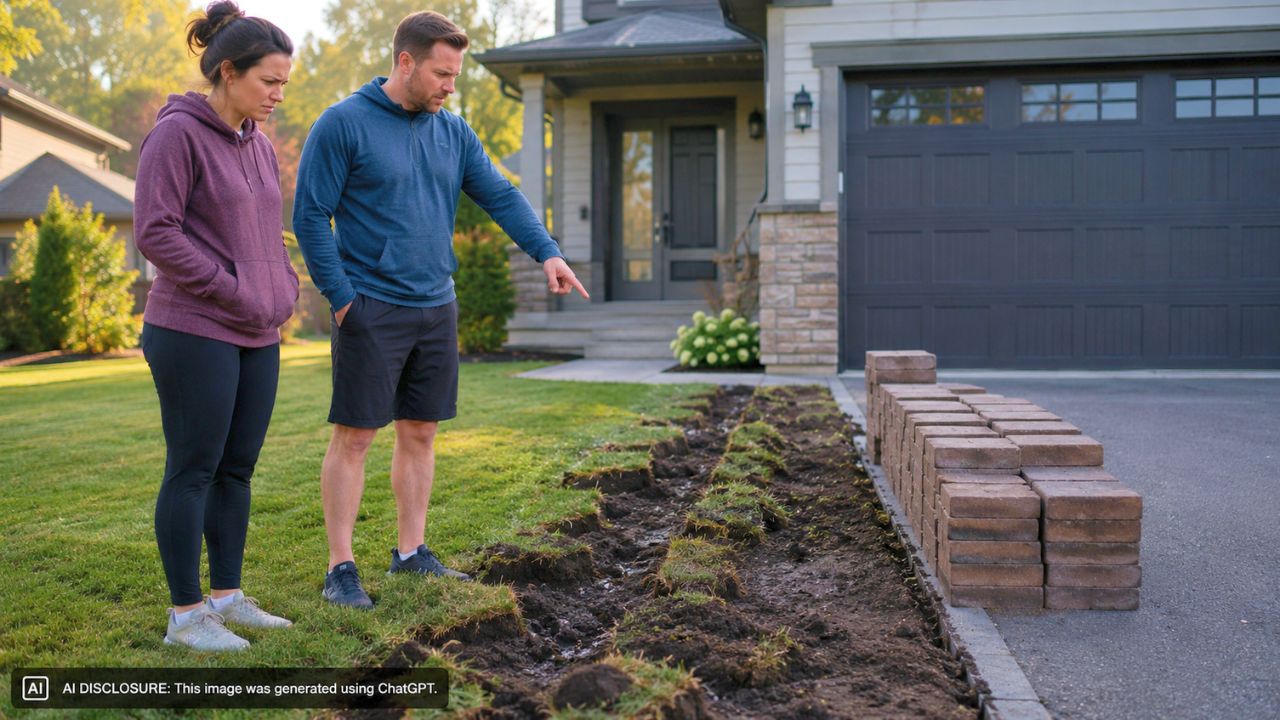
It’s one thing to wake up and notice a neighbor’s trash cans edging into your curb space again. It’s another thing entirely to step outside and see a literal chunk of your lawn missing—cleanly carved out—while a tidy stack of bricks sits nearby like someone’s already picked the “after” picture.
That’s what greeted a new homeowner who shared the blow-by-blow in the original post: a neighbor had removed part of their yard and appeared to be prepping the spot for a driveway extension. No heads-up. No knock on the door. Just missing grass and staged materials, like the property line was a suggestion.
A new house, a quiet street, and then a surprise excavation
The homeowner had only bought the place months earlier, back in November. They described themselves as young, and until this moment they’d filed the neighbors away as “nice, elderly” folks—maybe a little quirky, but harmless.
Then came the morning shock: the neighbor had taken out part of the lawn and set bricks aside, apparently planning to use the area as extra driveway space. The homeowner’s mind went straight to the practical stuff that hits hardest when you’ve just moved in: Does this reduce our lot size? Can they really just take that land? And even if it’s technically allowed, do we now have a car parked closer to our house forever?
The trespass didn’t feel like a one-off, either. The homeowner added that these neighbors regularly placed their trash cans in front of the homeowner’s house on pickup day. It was starting to feel less like “sweet older couple behavior” and more like testing boundaries to see what they could get away with.
The part nobody warns you about: property lines get real expensive
The homeowner’s first instinct was to verify what they owned and where the line actually was. That’s when the gut-punch number came in: they got a quote for a survey, and it was $2,000.
That’s the maddening part of yard disputes—your neighbor can make one casual decision with a shovel, and suddenly you’re looking at thousands of dollars just to say, confidently, “This is mine.” And until you have that survey in hand, every conversation feels slippery. You can point at the missing grass, but you can’t point at a legal boundary marker with the same certainty.
Meanwhile, the bricks sitting there weren’t just materials. They were momentum. Once pavers go down, people tend to treat the new footprint like it was always meant to be that way.
A quick call revealed the missing piece: there was no permit
Instead of waiting to confront the neighbor first, the homeowner called their local permit office. That one phone call changed the tone of the whole problem.
The neighbor didn’t have a permit.
That matters because a driveway extension isn’t just a personal preference—it can change drainage, affect setbacks, alter where vehicles sit, and even create new runoff or grading issues that spill into the next yard. Cities often require permits for exactly that reason, and when there isn’t one, it gives the impacted homeowner something more solid than a he-said-she-said argument over grass.
The homeowner hadn’t talked to the neighbors yet—they’d discovered the torn-up lawn right before rushing to work—but now they had a clearer path: the project wasn’t officially approved, and the city could get involved if needed.
Planning confirmed the bigger fear: parking would be too close
After the permit office, the homeowner reached out to the city’s planning department. This was the piece that addressed their biggest worry: the idea of a neighbor’s car being parked even closer to their house, day after day.
Planning told them the neighbor wouldn’t be allowed to use that extra driveway space for parking because it would be too close to the homeowner’s property line. The twist was that planning didn’t know exactly where that property line officially sat. Without a survey, even the city couldn’t point to the precise spot on the ground.
Still, the department checked what it could and verified the extension would be too close. The homeowner came away with something both reassuring and tense: if the neighbor parked too close to the house using the new paved area, the neighbor could be cited and forced to remove it. Those were the city planning department’s words, as relayed by the homeowner.
In other words, the lawn damage was already done—but the neighbor couldn’t just convert that patch into a permanent parking pad without consequences.
People urged proof first, feelings later
In responses, the theme was simple: don’t start with a fight, start with documentation. When a neighbor is already acting like the property line belongs to them, a friendly chat can turn into a fast, messy argument—especially if you can’t back up your claim with anything concrete.
The homeowner took the kind of steps that get recommended for these disputes: calling the permit office, talking to planning, and pricing out a survey even though it was painfully expensive. The goal wasn’t to “win” a neighbor feud. It was to stop the project from becoming irreversible and to keep the homeowner from getting steamrolled by momentum and misplaced confidence.
There was also a practical logic to not delaying. Once paving goes in and a car starts using it, the neighbor can fall into the habit of treating it like established driveway space. And it’s much harder to claw back a boundary once it looks permanent.
Now comes the hardest part: the conversation on the other side of the lawn
Armed with the city’s feedback, the homeowner planned to speak with the neighbor and make them aware of what planning said about setbacks and parking. It’s the kind of conversation that can go smoothly—“Oh, we didn’t realize”—or badly—“We’ve always done it this way”—depending on the personalities involved.
And it’s not just about lawn anymore. It’s about a pattern: the trash cans in front of the house, the assumption that “young new owners” won’t push back, and the sudden feeling that the property you just bought isn’t entirely under your control.
The homeowner hadn’t resolved the boundary question yet, and the survey cost still loomed. But the city’s confirmation—that the expanded area couldn’t be used for parking and could trigger citations and removal—put some weight back on the homeowner’s side of the fence line, even before the fence line was officially mapped.
For now, the bricks are still the quiet threat on the edge of the yard: a reminder that the first real homeownership surprise isn’t always in the attic or the basement. Sometimes it’s right out front, and it arrives with someone else’s driveway plans.
Like Fix It Homestead’s content? Be sure to follow us.