New Landowner Finds the Neighbor’s Six-Foot Retaining Wall Funneling Storm Water Straight Into the Yard — Then an Engineer Says the Wall Was Never Built to Code
Photo credit: AI-generated image created using ChatGPT. Illustrative only.
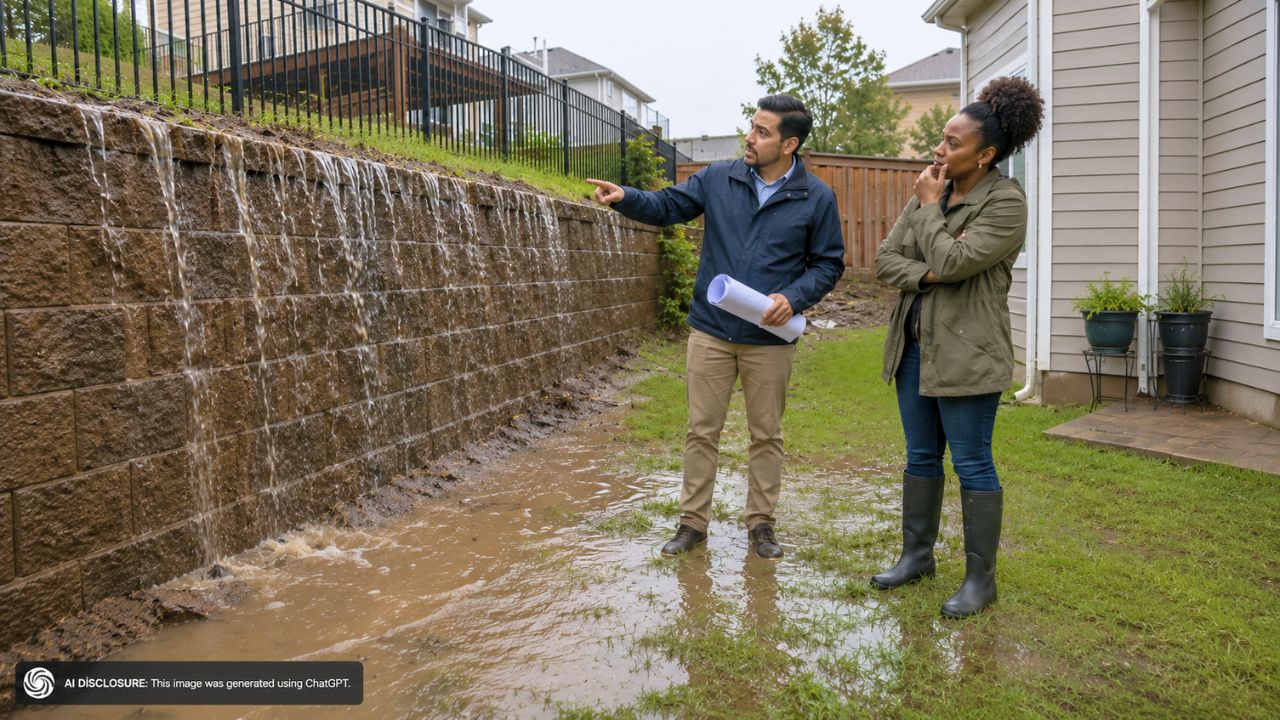
The first big storm after moving in is when it clicked: the yard wasn’t just “wet,” it was taking a direct hit like someone had aimed a downspout at it. Water was pushing hard along the property edge, collecting where it shouldn’t, and turning the lawn into a shallow pond.
In the discussion, the homeowner framed it around the neighbor’s retaining wall—six feet of stacked structure that seemed to be acting like a dam and a chute at the same time. They wanted to know what options exist when a neighboring build appears to be redirecting storm water straight into your yard, and an engineer later suggested the wall was never built to code.
The yard didn’t just get soggy — it got overwhelmed
Plenty of people have soft spots in the lawn after a rain. This wasn’t that. The volume in the short clip and the way the water moved made it look less like “poor drainage” and more like a defined flow path with real force behind it.
That’s the moment homeowners start thinking in worst-case terms: undermined soil, washed-out topsoil, standing water that kills grass, and a muddy mess that never fully dries out. And because it’s coming from the higher side of the property line, it’s easy to look uphill and blame the most obvious thing built up there—the wall.
A retaining wall changes the ground — even when it’s not the original cause
One of the most repeated points in the replies was blunt: the wall might not be the original reason the water wants to travel that way. With a major elevation difference, runoff is going to follow gravity regardless, and a wall can simply make the flow more visible, more concentrated, or more annoying.
A retaining wall is supposed to hold soil back and control erosion, not act like a stormwater system. If drainage behind it wasn’t designed correctly—or if it was slapped together without proper outlets—water can build up and then find the path of least resistance, which is sometimes around the end of the wall or through a low point that leads directly into the neighbor’s yard.
That’s where the “built to code” worry hits hard. If a wall wasn’t engineered or permitted correctly, it can mean the drainage behind it is wrong, the backfill is wrong, or there aren’t proper weep paths. For the downhill neighbor, the difference between “this is natural runoff” and “this wall is concentrating flow onto me” is the difference between an annoyance and a property-damage problem that keeps repeating.
Fixing the water without undermining the wall is the tightrope
The most practical responses boiled down to a few routes, and none of them were “easy button.” One commenter summarized the realistic paths: stop the water from flowing your way (hard, and requires cooperation), intercept it on the neighbor’s side with a ditch or French drain, or intercept it on your side and send it somewhere safe.
Another commenter pushed for the third option—handling it on the homeowner’s side—arguing that the wall isn’t necessarily what created the problem. The caution was important: if you dig too close to the base of a retaining wall, you risk undermining it. They suggested placing any French drain at least a couple feet away from the wall’s base to avoid destabilizing the structure.
And then came the reality check about volume. With flows like that, multiple people felt a French drain might not be enough, recommending an open channel swale (a shallow ditch meant to carry surface water). It’s not as tidy as a buried pipe, but it can move a lot more water when the storm really unloads.
The neighbor factor: cooperation is the cheapest fix, and the hardest to get
On paper, the cleanest solution is usually uphill: intercept runoff before it crosses the line, route it to a proper outlet, and keep both properties from turning into a seasonal mess. In real life, that means asking a neighbor to spend money, admit fault, or let someone dig on their side—three things people avoid even when they’re in the wrong.
That’s why this kind of dispute escalates. The downhill owner sees damage happening in real time. The uphill owner sees “water goes downhill” and assumes it’s not their problem. The wall becomes the symbol of it: a visible structure that looks like a deliberate change to the landscape, whether it actually caused the flooding or just changed how it shows up.
If an engineer has told the homeowner the wall wasn’t built to code, that adds pressure fast. “Not to code” can mean anything from a missing drainage detail to bigger structural issues—and the fear is that a wall that mishandles water today could fail tomorrow. Even if failure never happens, the suspicion alone is enough to sour neighbor relations, because now it’s not just water; it’s liability.
Commenters didn’t argue about feelings — they argued about flow
What stood out in the replies was how quickly people moved past blame and into physics. Several commenters essentially said: with that elevation difference, you had runoff long before the wall, and you’re probably only seeing part of what’s moving through there.
They also nudged the homeowner away from the “quick fix” fantasy. A small French drain sounds neat until you realize storms don’t care about neat. When the flow is heavy, an open swale with a clear outlet is often the only thing that keeps water from backing up and spilling into the yard again.
At the same time, nobody treated digging as harmless. Too close to the wall and you can create a new problem—destabilizing a structure that’s already suspected to be poorly built. That’s how a drainage complaint turns into a safety fight, because once a wall starts moving, everyone’s property gets dragged into it.
Now the homeowner is stuck between “manage it” and “prove it”
The hard part about water problems is that they don’t leave a receipt. A flooded yard can look like a temporary inconvenience to anyone who doesn’t live with it, especially if it only happens during storms. But the homeowner is the one watching soil wash away and wondering what’s happening under the surface.
Managing it yourself—swale, drain, regrading—can bring relief, but it can also feel unfair if the flow is being concentrated by a neighbor’s structure. Proving it, on the other hand, tends to mean time, paperwork, and the uncomfortable step of involving engineers, permits, or whoever enforces local building rules.
For now, the most grounded advice from the thread points toward controlling the water in a way that won’t destabilize the wall: plan for bigger flow than you think you have, keep excavation a safe distance from the wall’s base, and prioritize a reliable outlet so you’re not just moving the puddle from one spot to another.
Because once your yard becomes the neighborhood’s low point, every storm feels personal. And it only takes one more heavy rain to turn “annoying runoff” into damage you can’t ignore.