Ohio Homeowner Comes Home From Walking the Dog to Find New Fence Posts So Close They’d Block Access to the Side of the House — Then a City Building Inspector Shows Up and Issues a Stop-Work Order
Photo credit: AI-generated image created using ChatGPT. Illustrative only.
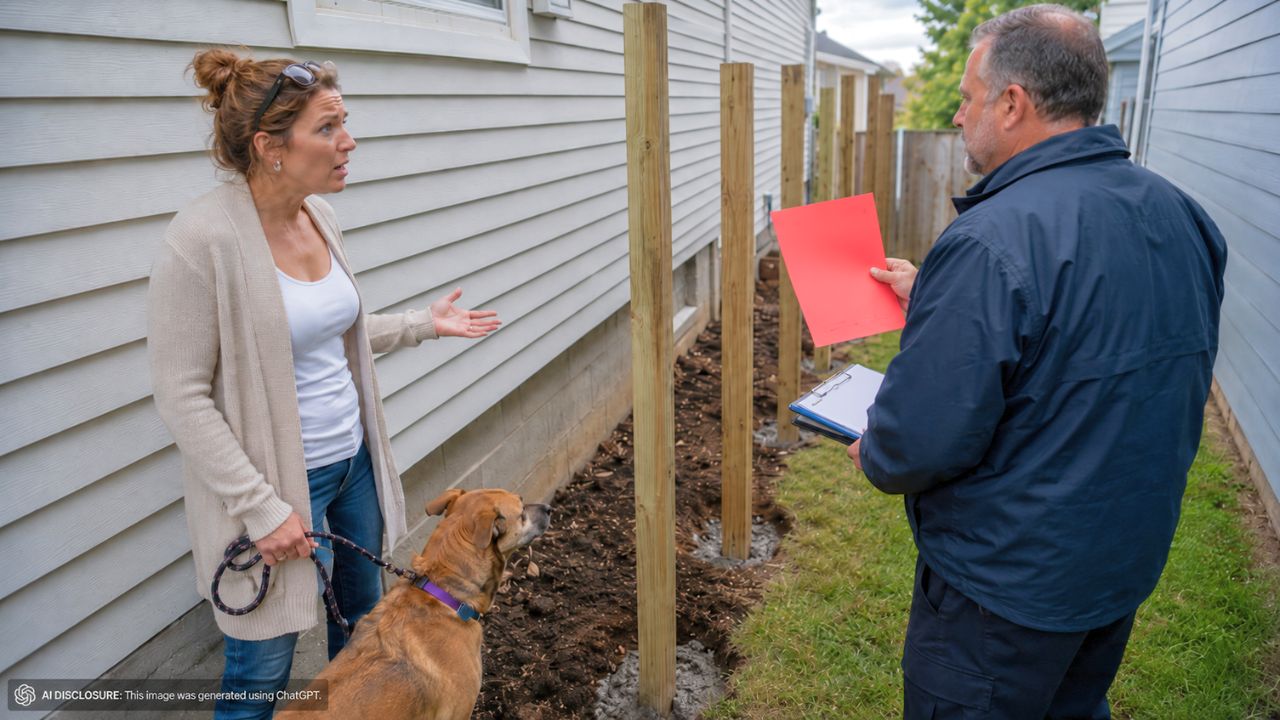
One Ohio homeowner stepped out for a routine dog walk and came back to a surprise: fresh fence posts lined up so close to the side of their white house that it looked like the only way to reach that side yard would be by opening someone else’s gate and stepping onto someone else’s property. The posts weren’t theirs, and they hadn’t been asked about it.
With no recent survey in hand but a strong belief the grassy strip belonged to them, the homeowner turned to outside advice and documentation, sharing photos and details in the original post. The immediate fear wasn’t just “who owns what.” It was practical: blocked access to their own house, and the possibility that a contractor was drilling post holes into ground that wasn’t theirs.
A fence line that didn’t leave room to live
This wasn’t a case of a fence drifting a foot over the line at the back of the yard where no one goes. The homeowner described posts placed close enough to interfere with basic access along the side of the house. Anyone who has ever had to get to their meters, hose bibs, siding, or foundation knows how quickly “a few inches” stops being small.
Even if the fence were technically on the neighbor’s side, it raised a real-world question: how is a homeowner supposed to maintain that side of the structure if the neighbor can close it off? The homeowner’s first instinct was that it couldn’t possibly be allowed, especially if it forced them to open a neighbor’s fence just to reach their own exterior wall.
But the sticking point was proof. The homeowner admitted they’d never had a survey done, even though they’d “always been led to believe” the entire grass area belonged to them. That’s the trap a lot of people fall into—years of assumptions meet one new project and suddenly everything gets measured.
The fastest escalation wasn’t an argument—it was a phone call
Instead of confronting the neighbors or the fencing crew in a heated moment, the homeowner planned to call the city building inspector the next morning. That choice mattered, because fence disputes can turn into long-running neighbor wars if the first move is accusations across a property line.
In this case, the city got involved quickly. A building inspector came out and posted a Stop Work order on the fencing company. It wasn’t a vague “let’s all calm down” request. It was a hard pause, triggered by what the inspector saw on site.
According to the homeowner, the inspector agreed there were issues. Two of them stood out: the fence posts hadn’t been inspected, and the inspector didn’t believe a survey had been done to verify the property lines. In other words, the city wasn’t comfortable letting the job continue when the basics—verification and inspection—didn’t seem to be in place.
When the paperwork showed up, the story changed
After the stop-work order, a representative from the company that owns the neighboring property came out. This wasn’t described as an owner-occupant next door. The homeowner said the neighboring house is owned by a company that buys and rents out houses like it for use as group homes for developmentally challenged people.
That detail is important for one reason: it often means multiple layers between the work crew and whoever is actually responsible for the property. Contractors may be acting on a work order without anyone double-checking boundaries on the ground.
The representative reportedly confirmed the fence was encroaching—based on the company’s own documentation—because their property “only goes to the edge of their driveway.” The homeowner said the rep didn’t know what the fencers were thinking, and planned to raise it with their boss once back in the office.
It’s one of those rare twists that can instantly lower the temperature: the neighbor-side decision-maker wasn’t doubling down. They were effectively saying, “Yes, that’s not our land.”
The hidden worry: holes near a foundation
Even with the work stopped, the homeowner still had to look at the physical reality: post holes had already been dug. Fence contractors don’t dig for fun, and they don’t stop neatly at a chalk line if they’ve been told the line is somewhere else.
The homeowner noted the holes were likely excavated with a two-person auger, and believed there shouldn’t have been damage to the house or foundation. That’s reassuring, but it also shows where a homeowner’s mind goes in these moments. It’s not just “my grass.” It’s “did someone disturb soil right next to my structure, and am I going to find out the hard way later?”
When crews dig close to a house, you worry about more than concrete. You think about shifting soil, buried utilities, and what happens the next time it rains. You also worry about the mess left behind if the posts have to be pulled and the holes filled—because “we’ll fix it” can be a different standard depending on who is paying.
Commenters pushed the same theme: proof beats assumptions
The homeowner’s plan to involve the building inspector matched the most common practical advice people give in fence-line fights: stop the work before it becomes “already built,” and get the line verified before anyone spends more money.
Even without a blow-by-blow of the comment section, the thread’s direction was clear from the homeowner’s edits: survey, documentation, inspections. Those aren’t dramatic steps, but they’re the steps that matter when a contractor is acting like a few inches of yard is free real estate.
This is also the kind of dispute where people tend to recommend keeping everything in writing—who authorized the work, what documentation was used, what the city inspector flagged—because if a fence company argues later, “We were told that was the line,” the homeowner needs more than memory.
Now comes the slow part: removal, repairs, and boundaries
The likely next step, according to the homeowner, is that all the fence posts will be removed. The idea being floated was to attach the fence to the cement driveway instead of setting posts into the grass—because the grass appears to be on the homeowner’s side.
But even with a cooperative property representative, there’s still tension in what comes next. The homeowner mentioned one possible compromise: allowing roughly six inches near the back of the house. They were clear that they didn’t want anything that blocks the side of the house, and they didn’t sound eager to give away space unless there was some concession in return.
That’s where these disputes get sticky, even after everyone agrees the original work was wrong. Once you “allow” something on your land, you start wondering what you’ve just agreed to long-term—access, maintenance, resale headaches, and whether the next contractor treats your kindness as a new boundary line.
For now, the fence is paused, the city has stepped in, and the neighbor’s representative has acknowledged the encroachment. The homeowner is left watching to see how quickly the posts come out, how cleanly the ground is restored, and whether the next version of the project respects what most homeowners want in the first place: the ability to walk along their own house without needing permission.
Like Fix It Homestead’s content? Be sure to follow us.