Ohio Landowner Shares a Thirteen-Acre Wetland With a Neighbor Who Falsely Accuses Him of Trespassing — Then Admits by Message He’s Been Draining Their Shared Water on Purpose
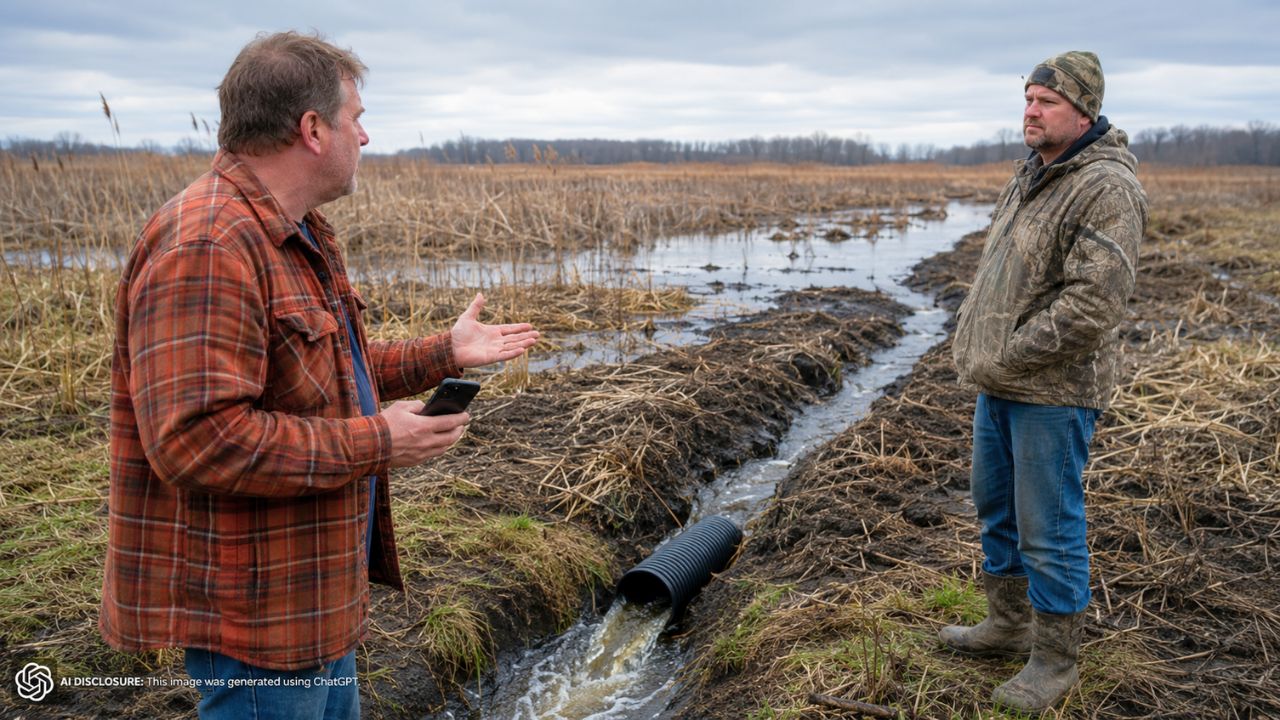
Photo credit: AI-generated image created using ChatGPT. Illustrative only.
It started as the kind of slow change you might blame on weather: a wetland that had been steady for years suddenly looking a little lower on one side. But for one Ohio landowner, the receding waterline wasn’t just an inconvenience—it was a sign that someone nearby might be messing with the very thing that made the property usable.
In the original post, the landowner describes a 35-acre wetland that formed naturally about eight years ago when beavers dammed a creek. Roughly 13 acres of that wetland sits on his land, with the rest on a neighbor’s property. Both neighbors had been benefiting from it, especially for waterfowl hunting, until the relationship between them soured and the water started disappearing.
The wetland wasn’t built—beavers built it
This isn’t a stocked pond or a man-made impoundment with a clear owner and a valve on a pipe. The wetland exists because beavers backed up a creek, creating standing water that spread across both properties. For eight years, it held, becoming part of the landscape and part of how both landowners used their land.
The poster says both sides “take advantage of the waterfowl hunting this wetland offers,” which is where the tension seems to live. Rural neighbor disputes often start with something small—noise, trespass accusations, a gate left open—but here the shared resource is the water itself. When one person can affect it, the other person can lose it.
The first sign was water receding on only one side
The landowner noticed the water on his side “has been receding.” That detail matters because wetlands don’t always drain evenly. If the beaver dams and the creek control point are on the neighbor’s parcel, the neighbor’s decisions about that structure could change everything downstream.
He suspected manipulation of the beaver dams. Not a storm. Not a drought. Not “beavers moved on.” He thought the water level was being deliberately changed, and because his acreage sits farther from the dam area, he believed his portion would drain first.
That’s a brutal kind of helplessness in the country: you can stand on your own land and watch it change, knowing the lever might be on someone else’s side of the line.
The message that turned suspicion into something else
Trying to handle it directly, the landowner messaged the neighbor on Facebook. The approach was measured—asking if there was an issue with the “damn” (he meant dam) and asking permission to walk the neighbor’s property to see what was going on.
Instead of a normal back-and-forth, he says the neighbor’s response made two things “clear”: first, the neighbor didn’t want him stepping foot on the property; and second, the neighbor was manipulating the water level so the poster “would not have a wetland to hunt.”
That’s the kind of statement that shifts a rural disagreement into a property-impact dispute. A wetland isn’t just scenery. It’s habitat. It’s drainage. It can affect the value and usability of land, not to mention the practical day-to-day things—where you can drive, where you can plant, what you can hunt, and what you can’t.
When “my property” and “your property” share the same water
The poster’s core question is one a lot of landowners eventually run into: even if the beaver dams are on the neighbor’s land, does that give the neighbor the right to change water levels in a way that harms the wetland on the other side?
He also raises what makes this feel bigger than a personal feud: “I know wetlands are protected and you have to obtain a permit to drain one.” He wonders if a permit—if one even exists—could allow a neighbor to effectively drain a shared wetland and strand the other landowner with dried-out ground.
And then there’s the paper trail. The neighbor didn’t just deny access or complain about boundaries. The landowner says the neighbor effectively admitted by message that the drainage was intentional and targeted.
In real-life property fights, intent is often the hardest thing to prove. People blame erosion, broken culverts, “act of God,” or a mystery leak. Here, the landowner believes he has words in writing showing purpose: lowering water so only one side gets to enjoy the wetland.
The stakes aren’t just hunting—they’re drainage, habitat, and escalation
It’s easy for outsiders to hear “waterfowl hunting” and assume this is just a sportsman argument. But water is structural on rural land. Wetlands affect groundwater, flooding patterns, and the way a property behaves during heavy rain.
If one side starts draining faster than it should, it can change soil conditions, expose soft ground that was previously submerged, and alter how runoff moves across fields and woods. It can also stir up a new set of conflicts: if the wetland shrinks, do animals shift? Do beavers move and dam somewhere else? Does the creek cut a new path?
The landowner is also thinking about consequences for the neighbor if this crosses a regulatory line. He mentions contacting the USDA and EPA, and he’s trying to decide whether to warn the neighbor first and “work it out” before calling an agency. That’s the tightrope many rural owners walk: you want the behavior to stop, but you don’t want the next five years to be open warfare at the property line.
He even asks whether this could qualify as “hunter harassment.” That detail underscores how personal the conflict has become. When someone believes the other party is intentionally spoiling access to land use—especially by altering the land itself—it no longer feels like trash-talk or ugly looks. It feels like sabotage.
What people fixate on in disputes like this: proof and boundaries
Even without seeing the replies, the pattern in land-and-water fights is predictable: everything turns on documentation and lines. If there’s a message where the neighbor admits manipulating the water level, that’s the kind of evidence people tend to protect—screenshots, downloads, saved copies—because people delete messages when they realize what they’ve said.
And then there’s the physical proof. Water levels, photos over time, marked shorelines, dates, and any signs of added structures on the dam—anything that suggests a deliberate “way to manipulate the water level,” as the landowner suspects.
Finally, boundaries matter. The neighbor has already accused the poster of trespassing “which has never happened,” and also ordered him not to step foot on the neighbor’s land. That means any attempt to investigate in person could instantly become a new flashpoint. It’s the classic trap: you need to know what’s changing, but the easiest viewpoint might be from the other side of the line.
For now, the wetland is still there, just shrinking on one side. The landowner is left watching water slip away and weighing his next move—whether to try one more round of reason with someone who “hates” him, or to escalate to the agencies that take wetlands seriously. Either way, the message exchange changed the tone: this isn’t a misunderstanding about a beaver dam anymore. It’s a neighbor deciding who gets to keep the water.
Like Fix It Homestead’s content? Be sure to follow us.