Rural Illinois Woman in Her 80s Watches a Neighbor Bulldoze Her Fence and Twenty Old-Growth Trees to Claim Half an Acre — Then He Offers to Fix the Damage but Refuses to Pay Her a Cent
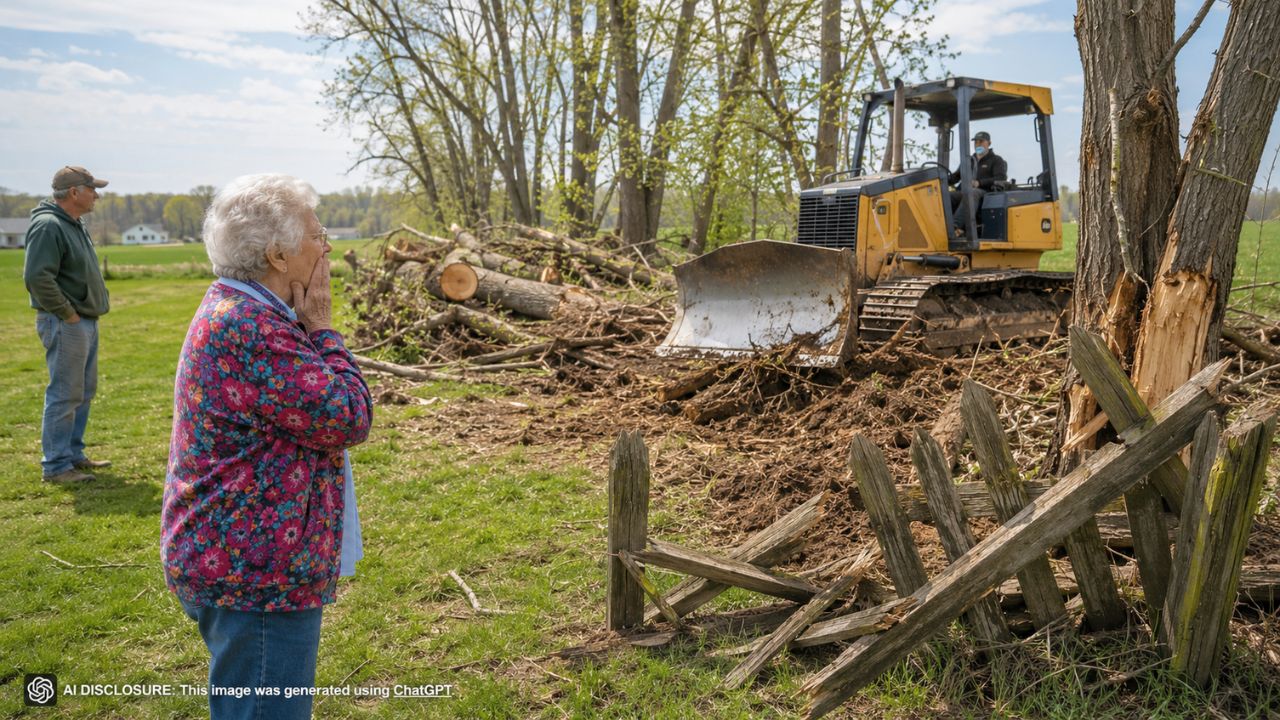
Photo credit: AI-generated image created using ChatGPT. Illustrative only.
Out in rural Illinois, where property lines are often marked by old woven wire and trees that have stood longer than anyone can remember, one family says they watched a boundary get erased in a day. A woman in her 80s, living alone on 10 acres, noticed bulldozing in the northwest corner of her land—work she didn’t order and wasn’t prepared for.
When her child went to look, the scale of it hit hard. The fence that had run north-south and east-west to separate her 10 acres from the surrounding 80-acre farm ground was flattened, along with what they estimate could be around 20 old-growth trees. The account was shared in the original post, where the family asked what options exist when a neighbor not only destroys a boundary but seems to “take” land in the process.
The land wasn’t just “open”—it was marked
This wasn’t a suburban spat over a few inches of grass. The mother’s parcel is a 10-acre island inside a much larger 80-acre property owned by a neighbor who doesn’t live there and rents the tillable ground out for farming.
In places like that, a fence isn’t decorative. It’s history, it’s a line of understanding, it’s where you stop mowing and where the other guy starts planting. And when it’s old woven wire—stuff that’s been stapled to posts for decades—it’s usually there for one reason: to show where the property ends.
That’s why the family’s description feels so jarring. They didn’t describe a fence that “needed replacing” or a corner that “looked messy.” They described a deliberate knockdown of a boundary that had been doing its job.
Then the bulldozer took more than the fence
The fence removal was only the first punch. According to the family, the work also wiped out as many as 20 old-growth trees along that line. In a rural setting, those trees aren’t just aesthetics—those can be windbreak, shade, habitat, erosion control, and a privacy buffer all in one.
The bigger gut-check was the apparent land grab. The family believes the neighbor “assumed” roughly a third to half an acre of her land into his field. That’s not a rounding error. On 10 acres, losing half an acre is losing a noticeable piece of the property.
And once the physical markers are gone, everything gets harder. If you grew up around farms, you know how quickly “we’ve always farmed it to here” becomes a story people tell like it’s proof.
A drainage change can quietly become the long-term damage
Along with bulldozing, the family says a field drainage system was installed. The part that raised alarms wasn’t just that it exists—it’s where it discharges. They wrote that it empties roughly 50 feet inside their mother’s property into a creek.
Drainage is one of those rural problems that doesn’t always show up as a dramatic “flood.” It can show up as a soggy strip that never dries, a creek bank that starts slumping, a new gully after hard rain, or sediment that wasn’t there before. Once the land is reshaped and water is redirected, you can end up dealing with years of knock-on effects.
The neighbor, for his part, offered to build a “dry dam” on his side to slow water coming off his field into the creek. That offer suggests even he recognizes the water piece could become a real issue—not just a cosmetic one.
He offered to “fix it,” but not to compensate her
After several conversations, the neighbor reportedly offered a package of repairs: rebuild the fence, clean up the tree mess, reseed the damaged area, and address runoff with that dry dam concept.
But he drew a bright line at paying compensation. No money for the destroyed trees, no payment for the taken use of land, and nothing for what the family called the “damage and stress.” That’s the kind of stance that can make an already bad neighbor dispute feel personal, even if the neighbor insists it’s just business.
It also leaves the homeowner in a bind. Taking the “fix” might restore some function, but it can also feel like accepting the new normal—especially if the fence goes back in the wrong place or the reseeding is treated like it erases the loss of mature trees.
Most reactions centered on proof, boundaries, and not letting time pass
Even without a full comment section included, the way people typically respond to a property-line bulldozing story is predictable for a reason: once you’re arguing from memory, you’re already losing. The practical focus tends to land on documentation—photos of the damage, any older photos that show the fence line and trees, and anything that establishes where the boundary actually is.
In rural areas, the next word people bring up is usually “survey.” Not because a survey magically solves conflict, but because it gives a clean reference point when the physical markers have been removed. When someone has already moved dirt, installed drainage, and erased a fence, it’s no longer a handshake disagreement. It’s a measured-lines disagreement.
Another common reaction in these disputes is to get repair estimates anyway, even if the neighbor is offering to fix things. Rebuilding fence, removing debris, and reseeding isn’t the same as replacing old-growth trees. And drainage work, done wrong, can become a permanent headache that costs far more than the initial “free fix.”
The tension isn’t just the money—it’s what happens next season
This happened in March 2026, which matters because the farm calendar doesn’t wait. Once planting starts, once the rented ground is being worked, and once crops go in, the incentive to keep that newly claimed strip becomes stronger. A half acre “borrowed” during bulldozing can turn into a half acre “used” all year, and then it starts to feel entrenched.
For the family, the stakes sound immediate and practical. They want their mother’s property line respected. They want the fence back where it belongs, not where it’s convenient. They want the drainage ending where it should. And they want acknowledgement that you don’t get to bulldoze someone’s trees and boundary markers and call it even with a bag of grass seed.
The neighbor’s offers might repair the visible scars, but the bigger question is whether those repairs come with a real reset—putting everything back on the correct line, in writing, and in a way that doesn’t invite the same “mistake” the next time someone brings equipment onto the property. For a homeowner in her 80s, that’s not a theoretical worry. It’s the difference between feeling secure on your own land and feeling like you’re waiting for the next machine to show up.
Like Fix It Homestead’s content? Be sure to follow us.