Rural Landowner Finds the Neighbor Has Been Planting Crops Across Twenty Feet of the Property for Five Growing Seasons — Then the Neighbor Says the Old Fence Line Was Always the Real Boundary and the New Survey Must Be Wrong
Photo credit: AI-generated image created using ChatGPT. Illustrative only.
It started the way a lot of rural property headaches start: with a “huh, that looks a little off” moment that’s easy to ignore when you’ve got a hundred other chores waiting. A landowner noticed the neighbor’s rows seemed to be creeping past the usual line—just a strip, nothing dramatic—until the pattern repeated year after year.
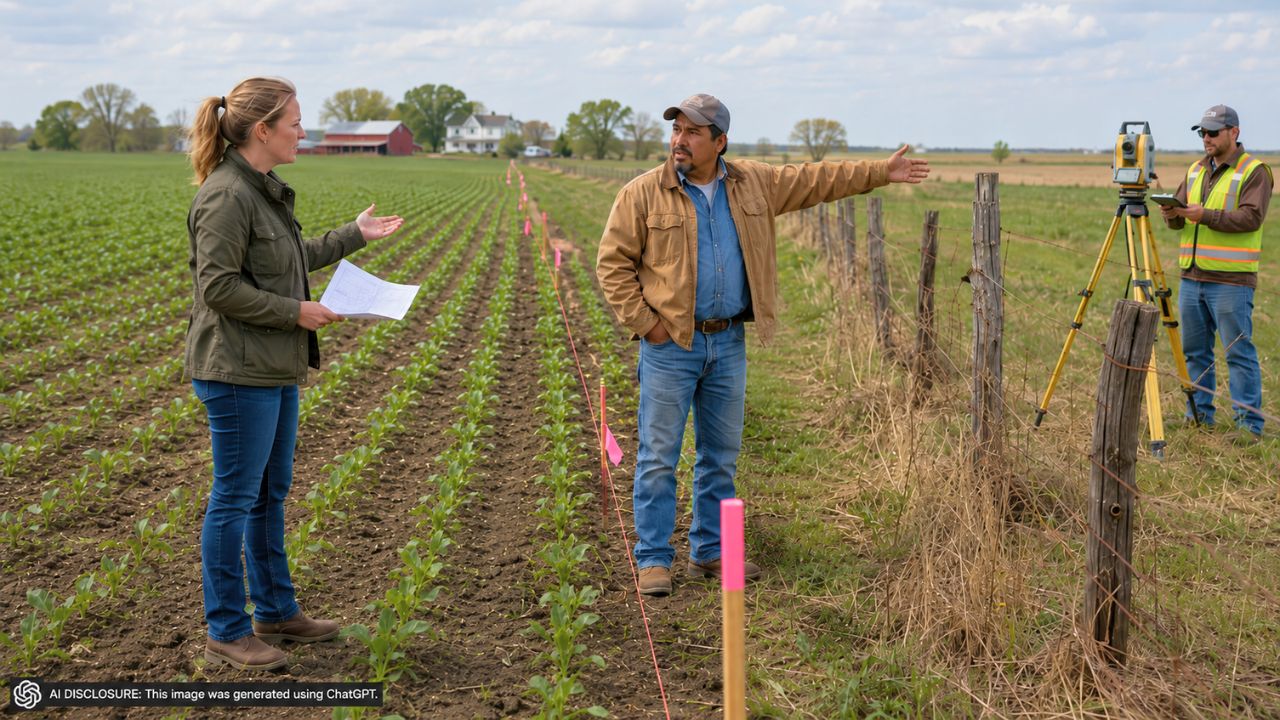
By the fifth growing season, that “strip” added up to a real bite of ground. When the landowner finally brought it up, the neighbor didn’t apologize or offer to move the planting back. Instead, they pointed to an old fence line and basically said, that was always the true boundary, and any new survey showing otherwise has to be wrong. The playbook for what happens next—proof, paperwork, and a clock that may be ticking—is laid out in the original post discussing farm boundary disputes and land encroachment.
The first sign was easy to brush off
In the country, boundaries can be more “understood” than measured. Old hedgerows, a tired fence, a ditch that’s been there forever—those become the mental map. And when planting starts a few feet over, it’s tempting to chalk it up to a crooked pass with the equipment or a simple mistake.
But crops don’t plant themselves. If a neighbor has been using a slice of your field for multiple seasons, it stops looking like an accident and starts looking like a routine. That’s when people begin quietly walking the edge more often, noticing what’s changed, and realizing they might be watching a small problem turn into a big one.
“The fence was always the line” vs. what the documents say
The neighbor’s argument is common because it feels intuitive: the old fence must mean something. Sometimes it does. Longstanding physical features—walls, fences, hedgerows—can help show where ownership begins and ends, especially if they’ve been treated as the line for years.
The problem is that fences move. They get rebuilt after storms. They get nudged to make room for equipment. They get installed for livestock convenience instead of legal accuracy. The source material notes that the best starting point is usually the deed or first transfer document to establish where the boundary actually is, because physical markers can blur over time.
This is where rural disputes get personal fast. One side feels like they’re defending what they paid for. The other side feels accused of stealing land they “always used.” And neither side wants to be the one who backs down, because backing down can feel like admitting the other person is right.
The part that makes landowners nervous: adverse possession
Once you suspect someone is occupying your land without permission, the risk isn’t just losing a few rows of crops this year. The bigger fear is letting that use harden into a claim.
The source explains adverse possession as a way someone can acquire title to land they don’t legally own by physically possessing it for the required period. To succeed, a claim needs factual possession, an intention to possess, and possession without the owner’s consent.
That “without consent” piece is why neighbors who are trying to keep the peace can accidentally make things worse. If you shrug and say nothing for years, you’re not just being neighborly—you may be creating a trail of silence that’s hard to undo later.
Time matters here, too. The source notes different time periods depending on whether land is registered or unregistered—typically 10 years for registered land and 12 years for unregistered. It also highlights a Supreme Court ruling: for registered land, an applicant needs only a “reasonable belief” that the land belonged to them for any 10-year period before applying. For a landowner watching a neighbor push into their property, that’s the line that makes the stomach drop.
Paper beats shouting: what people scramble to collect
Once the neighbor starts insisting the “real” boundary is wherever the old fence sits, the argument stops being about vibes and starts being about evidence. And in a rural boundary dispute, evidence is rarely one clean document that settles everything in a single glance.
The source recommends building up a legal defense by gathering the earliest historical evidence available: deeds and transfer documents, reports and surveys, Ordnance Survey mapping, and photographs showing the boundary and extent of the land over time. People dig through file cabinets, call relatives who kept records, and scroll through old phone photos looking for that one shot that happens to include the fence line in the background.
Many landowners also take the step of getting a high-quality boundary survey from a specialist chartered land surveyor. Not because they love spending money on paperwork, but because a good surveyor can assess what’s on the ground and help interpret where the boundary is supposed to be—not just where everyone’s gotten used to seeing it.
And while all that is happening, the land still needs tending. That’s the rural twist. You can’t pause the season while adults argue about where a line should be.
Reactions from the peanut gallery: document everything, stay calm, get it in writing
Whenever stories like this get shared, the practical voices tend to come out first. People don’t just say “fight it.” They say to keep inspecting the property and watch for signs of occupation, use, or attempts to create boundary features such as fences—exactly the kind of slow-motion “making it official” behavior that can creep in while you’re busy.
There’s also a strong chorus for “no handshake deals.” If you decide to allow a neighbor to use your land—even temporarily—the source stresses giving permission in writing so it’s clear they aren’t using it adversely and both sides acknowledge who owns it. In other words: if you’re trying to be kind, be kind on paper.
And for the folks who dread confrontation, the advice tends to be: don’t start with threats. Start polite, but don’t be vague. Ask them to stop or remove the encroachment. If they refuse, the source notes that a formal notice to vacate or a “Letter Before Action” might be appropriate. That’s usually the moment people realize this isn’t just a neighbor chat anymore; it’s a process.
The hardest part is fixing the line without making the war permanent
Even if the documents are solid and the survey is clear, there’s still the real-world problem of what’s sitting on that twenty-foot strip right now. Crops, tire tracks, maybe even a re-staked fence corner—things that don’t move themselves. And once someone has used land for five seasons, they often feel entitled to keep using it, even if they’re wrong.
The source emphasizes acting swiftly where there is potential occupation without permission, and formally documenting any resolution. That last part matters because rural properties outlast people. Owners change, tenants rotate, memories fade, and the “we agreed it was fine” story turns into “it’s always been this way.”
For the landowner, the next steps aren’t glamorous: gather records, get a proper boundary survey, keep inspecting the edge, and put any permissions or agreements in writing. Because in the country, the quiet disputes are the ones that linger the longest—and the most expensive part is often not the land itself, but the years of assumptions that piled up on top of it.