Rural Property Owner Finds the Only Access Road Blocked by a Neighbor’s Parked Cars for Two Weeks Straight — Then the Neighbor Says the Road “Was Always Just a Courtesy”
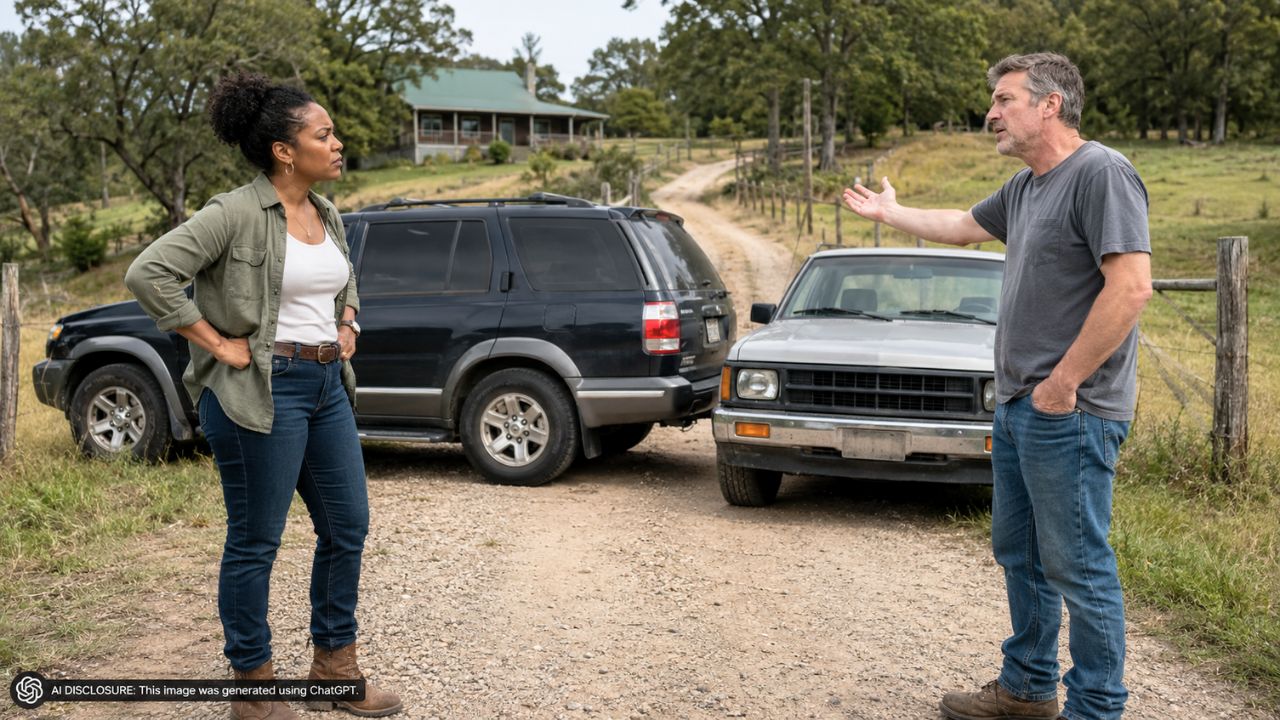
Photo credit: AI-generated image created using ChatGPT. Illustrative only.
When you live off an access road that functions like your driveway’s lifeline, a blocked gate isn’t just annoying—it shuts down your whole day. That’s what one rural UK homeowner says has been happening over and over, with a neighbor treating the only way in and out like extra parking.
In the original post, the property owner explains that the access road is legally part of their land all the way to the street. The neighbor has an easement to use it, but the deeds also say the road can’t be blocked. The problem is that “can’t” and “doesn’t” are two different things when someone keeps leaving vehicles in the way.
A shared access road that isn’t actually shared ownership
The layout is one of those odd rural setups: a private access road runs from the public street to the homes. The homeowner owns the road itself, while the neighbor has a legal right of way (an easement) to travel along it.
On paper, that should mean everyone treats the lane like what it is: a necessary corridor, not storage space. In practice, the homeowner says the neighbor has been using the access road as overflow parking, sometimes leaving cars right in front of the homeowner’s gate—fully blocking access.
The homeowner isn’t describing a quiet house with occasional traffic. Four people live there. Two of them currently have cars and a third will soon. Friends visit. Deliveries show up. Vehicles are “constantly in and out every day,” which means even a short-term blockage turns into a constant hassle.
The neighbor’s driveway is bigger—yet somehow unusable
What makes the story more frustrating is that the neighbor’s driveway is actually larger than the homeowner’s. But it’s also clogged with what sounds like a long-term accumulation: a partly built garage that’s “falling down,” a storage container, a caravan, piles of garden waste, and a flatbed truck.
So instead of clearing space on their own property, the neighbor uses the access road as their pressure valve. Sometimes the cars are “off to the side,” which still isn’t harmless. The homeowner maintains bushes and a flowerbed running along that side, and passing drivers trying to squeeze by end up drifting into the landscaping.
Even when the gate isn’t completely blocked, the setup is still forcing strangers, delivery drivers, and visitors into a narrow slalom between parked vehicles and a flowerbed the homeowner is responsible for. The neighbor’s convenience becomes the homeowner’s property damage risk.
It stopped being a nuisance once other people started paying for it
The homeowner shared a few moments that show how quickly “parking drama” turns into real-world fallout. One day, two friends were arriving. Just before the first friend pulled up, the neighbor parked directly in front of the gate.
The timing made it extra tense. The friend had to reverse out to let the neighbor clear the space, then drive back in. Then the neighbor moved the car “off to the side” on the access road, and friend number two squeezed past—scratching his car on the bushes.
Another time, the lodger’s girlfriend had a breakdown situation with her car, waited four hours for a tow truck, and arrived only to find the recovery vehicle couldn’t get in because of the neighbor’s parking. The homeowner says they ended up banging on the neighbor’s door at 11 p.m. to get them to move the vehicle.
What stuck with the homeowner was the neighbor’s response: he asked where he was supposed to park it. The homeowner’s answer was blunt and practical—his driveway or the street.
Blocking emergency access raised the stakes overnight
Most people can tolerate a bit of inconvenience until it crosses a line that feels unsafe. For this homeowner, that line was emergency access.
They say the neighbor has blocked emergency access at least three times: once when an ambulance was trying to reach their lodger during a severe asthma attack, and twice when emergency trades had to get in—an emergency plumber and an emergency electrician.
There’s an immediate safety issue when medical help can’t get close. But there’s also a very real money issue when contractors bill by the hour while everyone plays vehicle shuffle just to get a van through the gate.
Add in the flatbed truck the neighbor leaves at the bottom of the access road, and the homeowner says exiting onto the street feels dangerous because visibility is limited until you’re already pulling out. They’d been told this might violate the truck operator’s license, and noted the truck has no MOT—another detail that adds to the sense that this is a pattern, not a one-off.
Polite apologies, same behavior, and a camera log starts growing
The homeowner says they’ve tried the civil route. The neighbor has acted apologetic, even approaching the homeowner’s lodger at one point and asking him to apologize to everyone in the house for the parking.
But the actual behavior doesn’t change. Friends keep arriving to a blocked gate. The homeowner keeps knocking to get cars moved. The homeowner notes their friends are getting angrier and have started honking when blocked, with some wanting to go yell directly.
That’s the moment where “keeping the peace” starts to look less like maturity and more like enabling. The homeowner has started using CCTV footage to log each time the access road is blocked. Their next step, they say, is to write a letter with photos, asking the neighbor to stop and reminding them the deeds prohibit blocking the access road.
They also made it clear they’re trying to avoid a neighbor war. But the slow drumbeat of disruptions—especially the emergency access episodes—makes “avoid escalation” hard to reconcile with “protect the household.”
Readers pushed documentation first, because memories get fuzzy fast
While the homeowner’s post is a request for advice, the shape of the problem almost forces the same first move: proof before confrontation. They’re already doing the most practical thing in a shared-access dispute—documenting patterns instead of relying on “he always does this” arguments that go nowhere.
A written letter with dates and photos is the next logical rung on that ladder, not because it’s dramatic, but because it creates a clean timeline. It also gives the neighbor a clear off-ramp: stop blocking the road, stop damaging relationships, and stop risking an emergency turning into a tragedy.
What makes this kind of rural access dispute so combustible is how small the physical space is, and how big the consequences become. One parked car can trap residents, block deliveries, delay trades, and turn every visitor into a potential witness—or a new person who feels personally wronged.
For now, the homeowner is still trying to keep it civil: cameras on, patience thinning, letter drafted in their head. But when the only way to your front door keeps getting treated like “overflow,” even a polite household eventually runs out of room to maneuver.
Like Fix It Homestead’s content? Be sure to follow us.
- Man Says He Found Out the Fence He Paid For Wasn’t Actually on His Property
- Woman Says Her Neighbor Started Taking Mulch From Her Delivery Pile Before She Could Even Spread It
- I made Joanna Gaines’s Friendsgiving casserole and here is what I would keep
- What Caliber Works Best for Groundhogs, Armadillos, and Other Digging Pests?