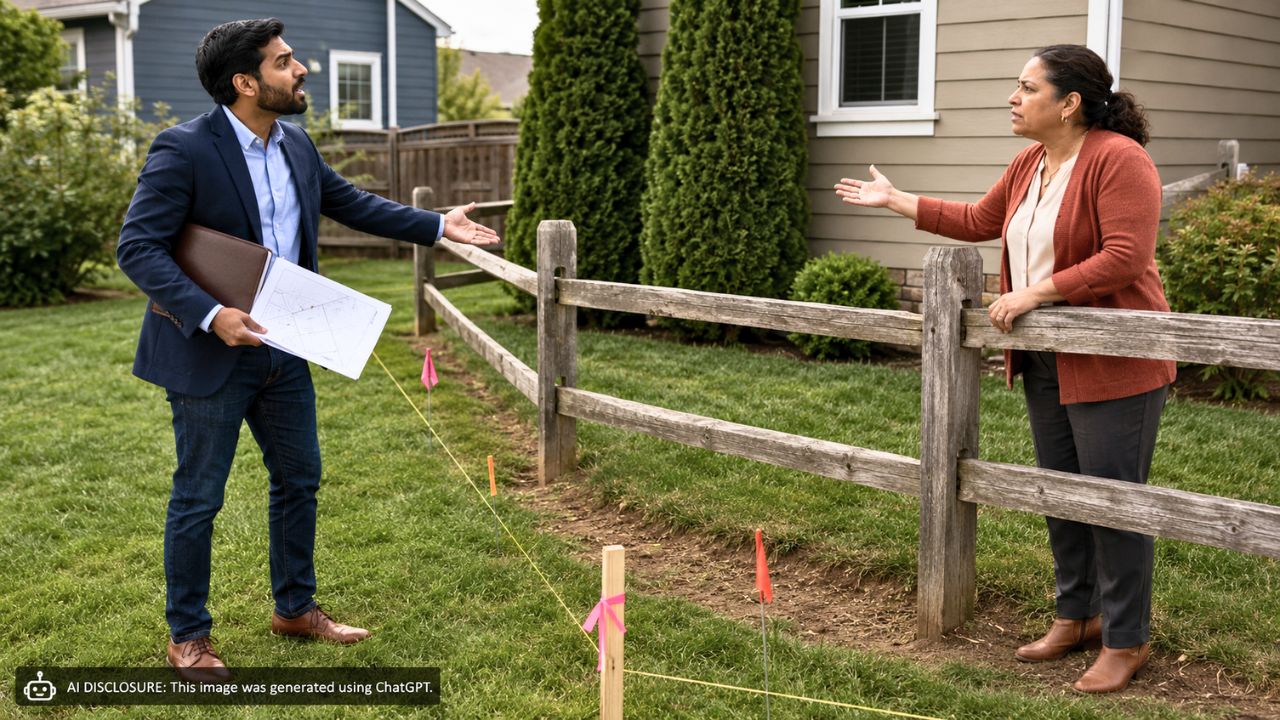
Buyer Finds Out at Closing That the Neighbor’s Split-Rail Fence Has Enclosed a Corner Strip of the Property — Then the Neighbor Says a Handshake Deal With the Previous Owner Made That Strip Theirs
Photo credit: AI-generated image created using ChatGPT. Illustrative only.
It’s the kind of surprise that doesn’t show up in the listing photos: you think you’re buying one clean rectangle of land, and then the paperwork comes back and says a neighbor’s fence is sitting inside it. Not by inches, either, but enough to create a little “bonus” corner the neighbor has been treating like theirs.
That’s the anxiety driving a Florida buyer’s question in the discussion: if an updated boundary survey shows a neighbor’s fence over the line, what do you actually do next—and if the neighbor refuses, can you remove it yourself?
The closing surprise: the line on paper doesn’t match the line on the ground
Boundary problems have a way of hiding in plain sight. A split-rail fence looks “country nice,” like it’s been there forever. Everyone mows and trims to it, and after a few seasons, your brain starts treating it like the official border.
Then comes the updated boundary survey, the one lenders and cautious buyers like to see before they finalize everything. Suddenly there’s a crisp, professional drawing saying the fence is inside your boundary. And what you thought was a harmless rustic divider becomes an encroachment—real, measurable, and sitting on land you’re paying for.
In the Florida question, the person wasn’t even in a full-blown fight yet. They were doing research because they were “getting a new survey done,” and wanted to know what happens if the results show the neighbor’s fence crossing the line.
When the neighbor says “we shook on it,” things get personal fast
This is where these disputes usually turn from technical to tense. A survey feels official; a fence feels emotional. And neighbors often respond with the kind of story that doesn’t fit neatly into a closing folder: a handshake deal with the previous owner, a long-ago understanding, a “they told us it was fine.”
It’s easy to see how that would happen. Someone years back wanted the fence straightened out, or the corner was awkward to mow, or they were trying to keep animals contained without spending money to regrade. Two people talked, agreed casually, and moved on—no paperwork, no boundary line agreement recorded, nothing that follows the property cleanly to the next owner.
But for the new buyer standing there with a survey in hand, that story lands like a trap door. The neighbor is acting like the fence location is settled history. The documents you’re signing say otherwise.
The first real “step” is getting your proof as clean as possible
The question in the source material is blunt: if the survey shows the fence is inside your boundary, what steps must you take to have it removed? The person asking framed it hypothetically, but it’s the same first move homeowners make in real life: confirm the line before you confront anyone.
An “updated boundary survey” is the starting point because it turns a gut feeling into something you can point to. Without that, every conversation is just two people gesturing at grass and saying, “I think it’s about here.”
From there, the next step most people expect is some kind of formal notice—something that signals you’re not just complaining, you’re asserting where the boundary is according to the survey. Even if you’re trying to stay friendly, the goal is to stop the quiet drift where the fence stays put long enough that everyone forgets it was ever questioned.
And that’s the tricky part: doing it early enough that you’re not accused of “letting it go,” but calmly enough that it doesn’t turn into a daily cold war across the rails.
The big temptation: “Can I just remove it?”
The second part of the Florida question is the one that keeps people up at night: if the neighbor doesn’t remove the fence, can the owner of the property remove it themselves?
On paper, it’s your land. On the ground, it’s someone else’s structure—possibly tied into posts, gates, or landscaping that could get damaged. Even if you’re convinced you’re right, physically touching it is the moment the dispute stops being theoretical and starts generating consequences: accusations of property damage, arguments about who paid for materials, and that awful possibility that the neighbor escalates by putting the fence right back up, stronger and uglier.
That’s why people tend to seek advice before taking a tool to it. Not because they’re unsure about where the line is, but because they’re unsure about how fast a fence fight can turn into a legal one.
What people in the comments usually push: document first, talk second, act last
Even when a post is short, the pattern around these disputes is consistent. Homeowners who’ve lived through boundary drama tend to focus on proof and paper trails before confrontation.
The person in the source material made clear they hadn’t “consulted a Florida lawyer,” and were just gathering information. That alone hints at how common this is: people want to know the playbook before they knock on a neighbor’s door and effectively say, “That’s on my side.”
In similar fence-line conflicts, the practical crowd tends to emphasize keeping everything boring and defensible. Surveys, photos, notes about dates, and copies of anything exchanged. If the neighbor’s entire claim is “the previous owner said it was fine,” the new owner’s best counter usually isn’t a louder argument—it’s clean documentation and a consistent process.
And if the fence is actually being used—containing animals, marking a maintained yard, blocking access—people also tend to suggest thinking about the real-world impact before moving anything. Fixing the boundary can be straightforward; dealing with the fallout can be the expensive part.
The homestead-level consequences: access, mowing, drainage, and future projects
A “corner strip” doesn’t sound like much until you imagine what you might need that space for. Maybe it’s where you planned to run a driveway, widen a gate, plant a windbreak, install a shed, or bring in equipment. A fence that’s a few feet inside the line can quietly steal your workable layout.
Then there’s maintenance. If you start mowing to the survey line but the fence stays where it is, you can end up with a no-man’s-land of weeds and pests. If you keep mowing to the fence line, you’re effectively treating the neighbor’s claim like it’s real, even if you don’t intend to.
And if you’re buying the property right now, there’s the added pressure of timing. This is exactly the kind of thing that can sour the early “new neighbor” period. You’re still learning where the shutoffs are, still figuring out the soil and the shade, and suddenly you’re stuck in a dispute about inches and memories.
The frustrating part is that the fix—moving a fence—sounds simple until you have to decide who moves it, who pays, and what happens if the neighbor flatly refuses. That’s why people start asking these questions before the survey even comes back. They’re trying to avoid waking up after closing to find out that the land they bought and the land they can peacefully use are not the same thing.
In the end, this kind of boundary headache doesn’t begin with shouting. It begins with a clean drawing from a surveyor and a fence that suddenly looks less like charm and more like a problem someone left for the next owner to solve.