Rural Landowner Finds a Septic Tank Buried Twelve Feet Onto the Property That Belongs to the Neighbor — Then the Neighbor Says Digging It Up Would Be “Overkill”
Photo credit: AI-generated image created using ChatGPT. Illustrative only.
Buying a rural lot is supposed to feel like a clean slate. For one landowner in a small Nebraska town, it turned into a buried surprise: a neighbor’s brand-new septic work appearing to creep onto the property—without anyone asking, and without the owner even living in-state to catch it in real time. The account was shared in the original post, and the timing couldn’t have been worse.
The land had been purchased about six months earlier, with plans to start building a home in roughly two months. The couple still lived in another state, so the lot sat mostly unattended—exactly the kind of gap where heavy equipment can roll in, dirt can get moved, and nobody feels watched.
A quiet lot, a busy neighbor, and a fresh pile of dirt
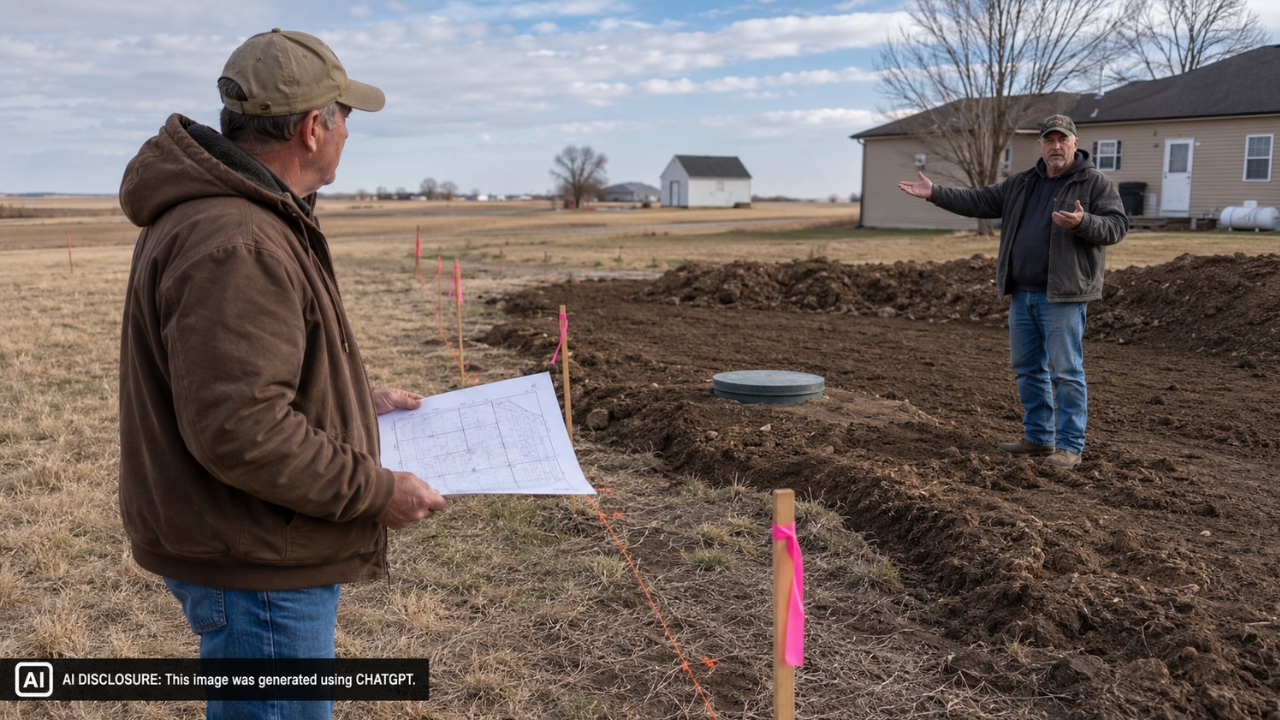
The first red flag wasn’t a cracked foundation or a knocked-down fence. It was the footprint of excavation: disturbed soil starting about 25 feet from the property line, where the neighbor had recently replaced a failing septic system.
The landowner didn’t even catch it the day it happened. By the time they came by to talk to their own contractor, the neighbor said the work had been finished for more than a month. That detail matters, because once a tank is in the ground and hooked up, “undoing it” stops being a simple backfill job and turns into a major disruption—with permits, inspections, and the risk of damaging a system that’s already in use.
Adding to the stress: the owner didn’t know the exact tank location, only where the digging began. In country properties, 25 feet can be “basically next door” or “definitely not yours,” depending on the lot shape and where the line actually runs.
Property markers don’t care about anyone’s assumptions
When the owner confronted the neighbor, the neighbor looked genuinely surprised and insisted the property line was farther out. The landowner responded the way a lot of rural buyers do when things get real: they went to the markers.
They showed the neighbor the marker locations from a survey done only six months earlier by what they described as a reputable company. That’s not a casual guess or an old fence line someone eyeballed back in the ’80s. It’s a professional stake in the ground, and it’s the kind of thing lenders and builders tend to take seriously.
Still, the neighbor wanted another survey—this time “by his own guy”—to confirm. That survey was supposedly coming the next week, and until it happened, the landowner was stuck in that maddening limbo where you can see dirt moved but can’t yet point to a document and say, “Here is exactly what crossed the line.”
Then came the pitch: buy the system, sell an easement, or sell the land
Instead of opening with, “If it’s on your land, I’ll make it right,” the neighbor jumped to what he called the “only viable solution.” He suggested the landowner buy the septic system from him.
The neighbor said it cost $9,000 and offered it for $7,000, framing it like a deal. The problem was obvious: the landowner wasn’t planning to use septic at all. They intended to hook the future house up to the town system. In other words, the neighbor wasn’t offering a useful upgrade—he was asking the new owner to pay to keep a mistake in place.
If the septic purchase wasn’t acceptable, the neighbor floated two more options: buying an easement for that portion of the property, or buying that portion outright. Those can be normal solutions in rural areas where wells, driveways, and utility lines cross lines—but they usually come after both sides agree on the facts, and after the person who caused the encroachment acknowledges responsibility.
The landowner’s preference was simple: reverse everything that was done and restore the land. The neighbor’s response was blunt—he said that wasn’t possible because he didn’t have the money, and that the landowner would have to pay for it themselves.
Why this hits harder when you’re about to build
A buried tank isn’t just “something over there.” A septic system comes with required setbacks and clearance rules, and it can complicate where a new home, driveway, garage, or even a future addition can go. Even if the owner never planned to use septic, having one on their lot can still affect construction plans, site grading, and utility runs.
There’s also the ugly practical side: if a tank and lines are on your land and something goes wrong later—leaks, collapses, odors, contamination—who gets the angry phone calls? Who gets pressured to allow access for repairs? Even the simplest maintenance can turn into a “permission” discussion if the system is physically sitting on land it doesn’t legally belong to.
And timing matters. The owner had two months until construction was supposed to start. Builders like predictability: clear lines, clear access, and no surprises that force redesigns. A disputed property line and a fresh underground installation are the opposite of predictability.
What people pushed: prove it, document it, and don’t let it become “normal”
The landowner came in asking what to expect and what options existed. While the post itself focuses on the facts and the neighbor’s demands, the common practical reaction in these kinds of disputes is less about yelling across the property line and more about getting your paperwork tight.
That usually means sticking to written communication, keeping copies of your survey, photographing the disturbed area, and coordinating through professionals instead of relying on handshake negotiations. If the neighbor is ordering a second survey, that’s one more reason to keep everything dated and documented—because once another map shows up, the argument often shifts from “Where is the line?” to “What do we do about what’s already installed?”
People also tend to warn against treating an easement like a small favor. An easement can be permanent, transferable, and limiting. If you plan to build, the wrong easement in the wrong spot can haunt every future improvement, and it can be hard to unwind later.
The pressure point: someone wants the mistake to become your problem
What makes this kind of property drama so explosive isn’t just the dirt being moved. It’s the attempt to normalize the encroachment by converting it into a quick sale: “Just buy the system,” or “Just sell me that strip,” or “Just grant an easement.”
For the landowner, it wasn’t just about the money. It was the principle of paying thousands to accept a system they didn’t want, installed without their knowledge, on land they had owned for only half a year. It also raised a bigger fear that rural owners know well: if you don’t push back early, you can end up living next to a “that’s how we’ve always done it” neighbor arrangement that slowly eats away at your ability to use your own property.
At the time of the post, the immediate next step was the neighbor’s survey scheduled for the following week. Until that survey confirmed (or challenged) the boundary markers, the landowner was stuck watching the calendar creep toward their construction date, with a brand-new underground system potentially sitting where it never should have been in the first place.
And in small towns, where everyone knows everyone, that’s the tightrope: you want peace with your neighbors, but you also can’t build a future home on a compromise that starts with someone else’s septic tank ending up on your side of the line.