New Homeowner Inherits a Property and Finds the Garage Was Built Over the Property Line — Then the Neighbor Demands It Be Torn Down
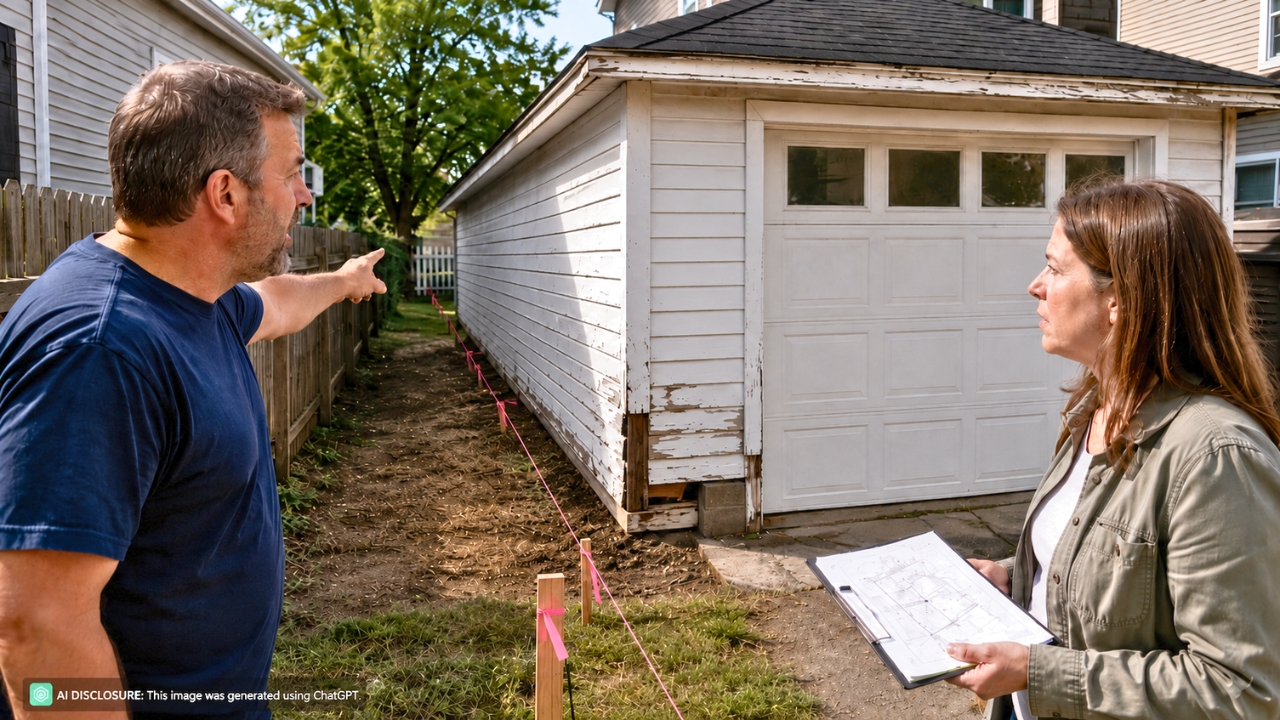
Photo credit: AI-generated image created using ChatGPT. Illustrative only.
It’s one thing to inherit a house with old carpets or a roof that’s near the end of its life. It’s another to realize a “permanent” outbuilding is sitting where it legally shouldn’t be—because someone built it without checking where the land actually ends.
That’s the bind one family described in the original post: an external garage built by the poster’s dad crosses the property line by roughly three feet onto the grandmother’s adjacent lot. For years, it sounds like nobody treated that as an emergency. Now, with the grandmother’s health failing, unpaid property taxes looming, and a home sale needed to fund care, the “small” mistake has become a big, expensive question.
A garage that made sense—until it didn’t
The setup is painfully familiar in families who’ve lived on the same land for decades. The house and property were originally tied to the poster’s mom’s mom, and the land had been “given to us almost 30 years ago,” the poster wrote, with the home and property now in both parents’ names.
At some point, the dad built a garage and didn’t pay attention to the boundary. It wasn’t just close. It’s over the line by a few feet, into the grandmother’s parcel. In a family context—where “grandma’s land” still feels like “our land”—that kind of thing can get shrugged off for years.
But land doesn’t care about family history. It cares about deeds, parcel maps, and who is legally on title. And once you start talking about selling, it stops being a quirky oversight and turns into a disclosure problem with teeth.
The neighbor problem no one wants to meet: a new owner
In the headline version of this nightmare, a neighbor demands the structure be torn down. In real life, that neighbor may not even be a person you know yet—it could be whoever ends up with the grandmother’s lot if taxes aren’t paid.
The poster is worried the grandmother could lose the property because she’s behind not just on taxes, but on “all of her other bills.” The family was told she can’t sell or gift the property if taxes are owed, and they say they can’t afford to pay them off. The amount they later found on a state tax site was $5,439.64—enough to be out of reach when money is already tight, but also enough to be the difference between “we can solve this” and “we’re about to meet a stranger holding a tax deed.”
If that lot changes hands, the handshake agreement disappears. The new owner could see an encroachment as leverage, a liability, or an opportunity—especially if they want to build, fence, or sell. That’s when the demand comes: move it, remove it, or pay up.
Trying to sell a house with an encroachment hanging off it
The poster’s questions jump quickly from “is this a problem?” to “can we just sell as-is and make it the next owner’s problem?” That’s the exact moment many sellers hit the wall. You can sell a house “as-is,” but you generally can’t sell it as “not my problem” if there’s a known boundary issue tied to the improvements on the property.
Even without getting into legal jargon, the practical reality is simple: buyers, lenders, and title companies hate surprises. A garage that crosses onto another parcel is the kind of surprise that can blow up a deal late, when everyone is already emotionally and financially committed.
And it’s not just the building. The poster points out there’s a big concrete slab under it. That means even if the structure itself could be removed, the footprint is still there, and the fix isn’t as simple as “take down a shed.” Concrete becomes its own project: demolition, hauling, disposal, grading—real money.
Underneath all of it is the family pressure. The poster says they’re going to have to put their dad into a full-time care home soon, and selling may be required either to help pay for his care or because the household can’t afford the mortgage without his Social Security checks. That turns a property-line issue into a ticking clock.
“After it’s sold, how much time do we have to get out?”
This is where the story feels less like a technical property question and more like a family bracing for a forced move. The poster isn’t just worried about the garage. They’re worried about timing, cash flow, and what happens between accepting an offer and actually leaving.
They ask whether proceeds from the sale could be used to hire someone to tear the garage down, which hints at a common trap: if the problem needs to be corrected before closing, you might not get access to the sale money until after the closing. That can create a financing gap—especially if you don’t have savings or credit to float the work upfront.
And if the buyer discovers the encroachment during inspections or title work, they may want it resolved before they close at all. That’s where sellers suddenly find themselves needing estimates, a plan, and possibly agreements with the neighboring parcel owner—fast.
The poster’s concrete question—how do you break it up, how do you get rid of it—shows how quickly a paper issue becomes a demolition-and-dumpster issue. Encroachments aren’t solved by paperwork alone when there’s literal tonnage involved.
What people zeroed in on: parcels, taxes, and proof
Even in the limited snapshot provided, you can see what homeowners tend to do first when this kind of thing surfaces: start hunting for parcel numbers and tax records. The poster found a parcel number for the lot and located a state tax website that shows what’s been paid and what’s owed.
Next came the obvious follow-up question: what is the lot worth? They wanted to know whether they could look it up like a home value, even asking if they could put the address into Zillow for an empty lot. That’s a practical instinct, because the value of that adjacent parcel—and the ability to control it—could change everything.
If the family could somehow keep the neighboring lot in the family (or buy it back if it’s headed to a tax sale), the garage being three feet over might become a paperwork fix instead of a demolition fix. But if the lot is worth far more than the tax debt, that’s also exactly why someone else might be willing to pay the back taxes and take the land.
In homeowner circles, this is also where people tend to push for hard documentation—surveys, boundary markings, recorded plats—because “about three feet” and “a few feet” can turn into very different outcomes once lines are staked.
The tension sitting under the concrete
The messy part of this story isn’t that a garage is over a line. It’s that the family is trying to solve three emergencies at once: an aging relative’s failing health, a looming care-home need, and a home sale that may be the only financial lever they have.
A three-foot encroachment might sound minor until it’s attached to a separate parcel with unpaid taxes. Then it becomes a question of who will own that land next—and how cooperative they’ll be once they realize part of your garage is on it.
For now, the garage is still standing and the family is still trying to figure out the lot’s value, the tax status, and whether they can sell without having to jackhammer their way out of the problem. But the longer the neighboring parcel stays uncertain, the more the garage stops being storage space and starts being a countdown clock.
Like Fix It Homestead’s content? Be sure to follow us.