Buyer Considering Two Acres in Louisiana Finds the Neighbor’s Electrical Service Line Running Down the Middle of the Entire Property — Then Learns Moving the Poles Could Be Prohibitively Expensive
Photo credit: AI-generated image created using ChatGPT. Illustrative only.
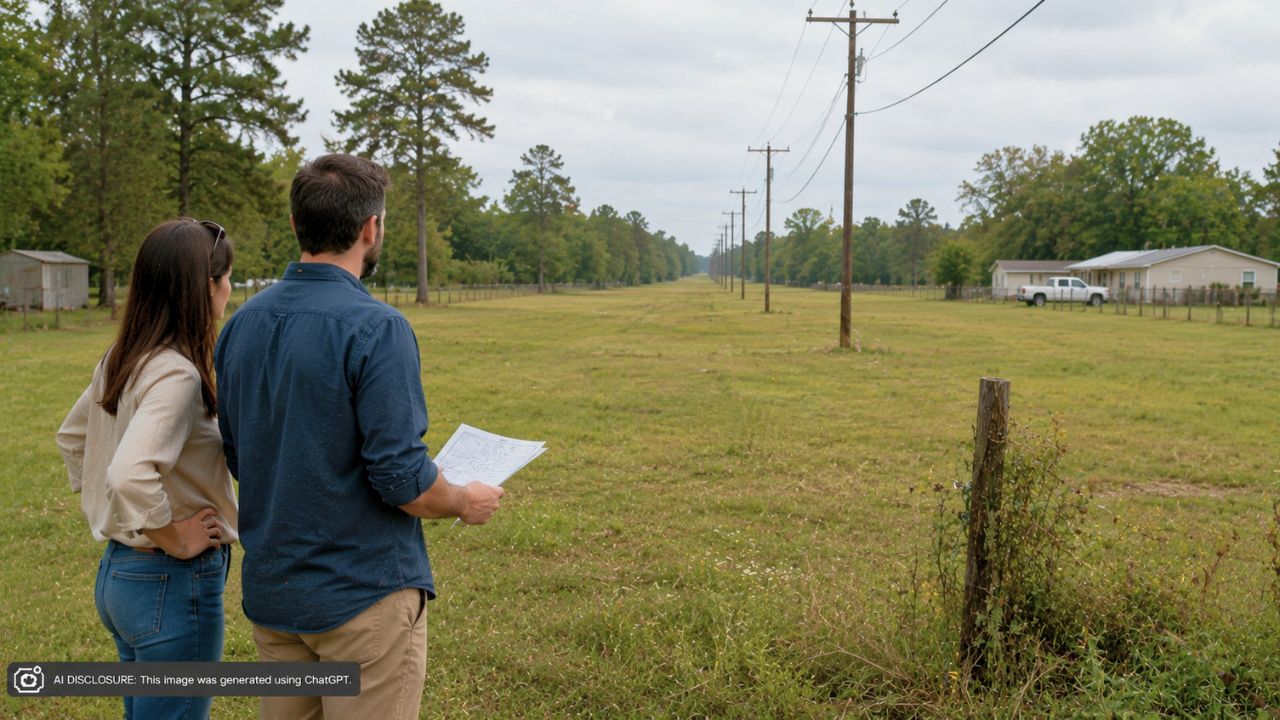
Two acres can feel like a blank canvas—until you notice the one thing you can’t unsee. A prospective buyer in Louisiana thought they were looking at a straightforward piece of land, then realized the neighbor’s electrical service line doesn’t just clip a corner or cross a back edge. It runs straight down the middle of the entire property for the full stretch.
In the original post, the buyer described a service line serving a home behind the parcel, with poles carrying the line “smack dab” through the center—about 380 feet of it. The discovery immediately turned a peaceful land purchase into a mess of questions about cost, buildability, and whether the easiest option is simply walking away.
The “nice piece of land” came with a line through its heart
At first glance, it’s easy to miss what a power line really means when you’re standing on raw acreage. You might see the poles and think, “That’s just utility stuff,” the same way you’d glance at a drainage ditch or a fence line. But this wasn’t along a boundary where it can be planned around.
The buyer said the line runs the entire length of the property, directly through the middle. On a two-acre tract that’s roughly 380 feet long, that’s not a small inconvenience—it can dictate where you can put a driveway, where you can place a house, and even how you can use the land day-to-day.
And because the line serves a neighbor behind the lot, it’s not the buyer’s service line to adjust like a personal upgrade. It’s someone else’s lifeline to their home, physically occupying space the buyer thought they were purchasing.
The first question was simple: “Can I move it?”
The buyer’s first instinct was the one most people have: push it to the edge. If the poles and line were relocated to a boundary, the middle opens back up. The land becomes buildable in the way buyers imagine when they picture a house site, a shop, a pasture, maybe a future fence line.
But moving power infrastructure isn’t like moving a mailbox. There are permissions, safety rules, and usually an easement—an established legal right for the utility line to be where it is. If that easement exists, the land can still be sold, but the new owner inherits the burden: that corridor effectively becomes “don’t build here” space whether you like it or not.
The buyer asked the money question, too: if moving is possible, what kind of cost are we talking? That’s where these situations often turn from annoying to deal-breaking. Even when relocation can be done, it tends to be priced like a construction project, not a minor service call.
The second question hit harder: “Can I build at all?”
Once the reality set in, the buyer jumped to the bigger fear—maybe the whole property is functionally unbuildable. They said they’d been searching online and “google is telling me no,” which is the kind of spiral that happens when you’re trying to make a decision on a ticking clock, with a seller waiting and financing possibly lined up.
At the same time, the buyer noticed something that made the decision even more confusing: on Google Earth, they could see other homes nearby with service lines that appear to run over houses. That contrast—online warnings versus what looks normal in the neighborhood—creates a dangerous gray zone where people start rationalizing. “If everyone else did it, maybe it’s fine.”
But there’s a big difference between a line that visually appears to cross near a roofline and a line with an actual required clearance or recorded easement that restricts structures underneath. And there’s also a difference between what already exists (sometimes grandfathered in) and what you’ll be allowed to build new today.
Why the cost can explode even before the first pole moves
Here’s the part that makes buyers feel trapped: the real cost isn’t always the physical moving of poles. It’s everything that comes before it—the paperwork and authority. If the line is in an easement, the utility may not be motivated to change it. They already have legal access and a functioning route.
If the buyer wants it relocated for their own convenience, that can place the entire price tag on the buyer. In many areas, that’s when you start hearing numbers that feel wildly out of proportion to “just shifting a line to the side,” because the work may require new poles, re-tensioning, new spans, potential permits, and coordination with the neighbor’s service.
And there’s a practical risk that makes it worse: even if you’re willing to pay, the utility still has to agree. A new route might cross someone else’s land, require a new easement from another neighbor, or run into clearance requirements that aren’t obvious until an engineer looks at it. What felt like a simple lateral move can turn into “we can’t do that,” or “we can, but only if you also do this other expensive thing.”
Reactions focused on one thing: rights on paper beat lines on maps
Even from just the buyer’s description, the shape of the advice is predictable—because these property-line utility surprises tend to end the same way when people skip the boring steps. When a line runs “smack dab” through the middle of a parcel, the first question isn’t really “Can I move it?” It’s “What legal right allows it to be there?”
People in these threads typically push for documentation over assumptions: a survey that shows exactly where the line and poles sit, and a title search that reveals recorded easements. A satellite view can be misleading, and “it looks like it runs over their house” doesn’t tell you whether it meets clearance rules or whether it was installed decades ago under different standards.
They also tend to caution against building plans based on hope. Even if you can build somewhere else on the lot, the utility corridor can carve up the most desirable portion of the land—especially if the best homesite is right where the poles are.
The land still might be usable, but it won’t be the land you imagined
A line down the middle doesn’t automatically mean you can’t buy the property. It means you’re buying a property with a built-in limitation. You may be able to place a home outside the restricted area, but that can affect everything: septic placement, well placement, driveway approach, future barns, and where you can safely run tall equipment.
It also means living with ongoing access. Utility companies typically retain the right to maintain their lines. That can mean trucks crossing the property, trimming trees, and working in that corridor when needed. On rural acreage, that reality can feel especially intrusive because you’re buying land for space and privacy—and then discovering there’s a permanent shared-use strip right through the center.
For the buyer, the tension is immediate and practical. Two acres is enough to build dreams on. It’s also small enough that one straight line through the middle can reshape the entire plan. The next move isn’t guesswork—it’s getting the facts in writing, because on land like this, one easement can be the difference between a bargain and a long, expensive regret.
Like Fix It Homestead’s content? Be sure to follow us.