Homeowner Hires a Surveyor Who Finds the Neighbor’s Fence and Deck Cutting a Wedge Out of the Property Line — Then the Neighbor Says He Only Built Against the Previous Owner’s Old Fence
Photo credit: AI-generated image created using ChatGPT. Illustrative only.
It started the way a lot of boundary fights do: with a nagging feeling that something about the fence line wasn’t quite right, and the realization that guessing doesn’t protect your biggest investment. So the homeowner did what people always say to do—stop eyeballing it and pay for a real survey.
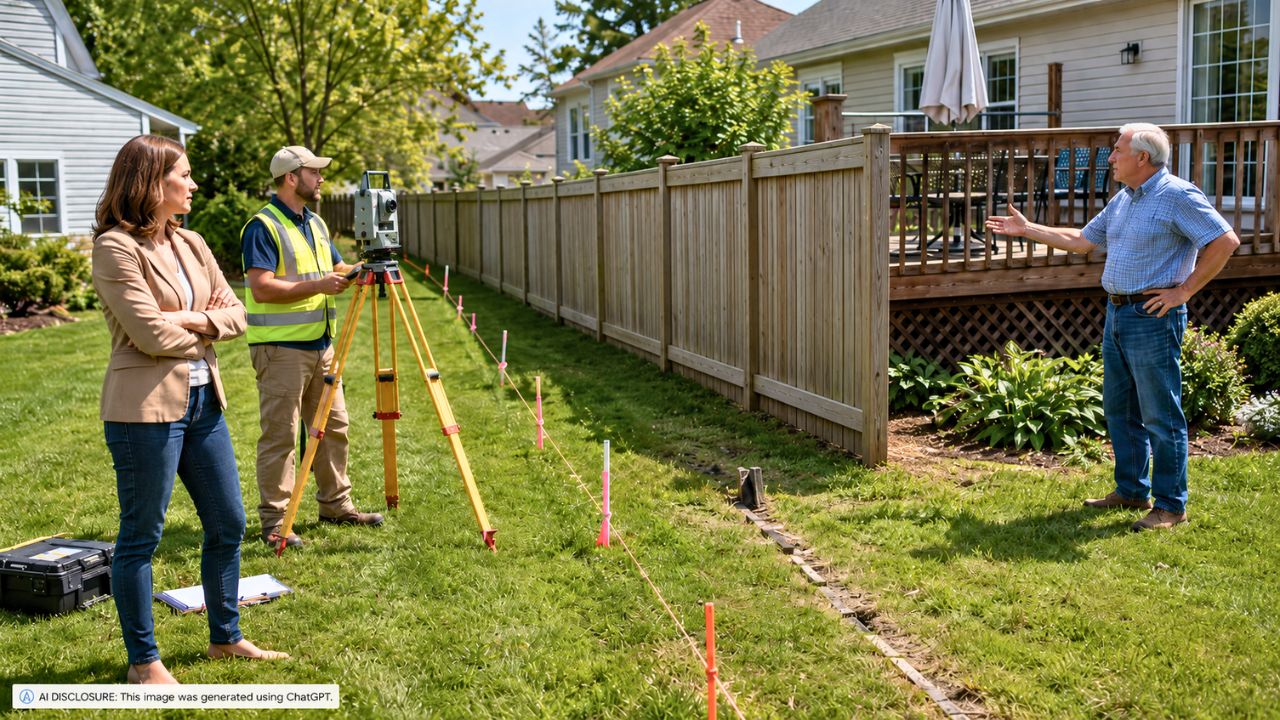
When the surveyor came out, the answer wasn’t “it’s close enough.” It was that the neighbor’s fence and deck were over the line “by a fair bit,” cutting a wedge-shaped bite out of the lot because the lots are slightly skewed. The homeowner laid it out in the source post, including a photo showing just how tight and awkward the space looks between the homes.
The survey turned a vague worry into a measured problem
The homeowner didn’t come back from the survey with a fuzzy “maybe.” The surveyor pointed to rebar in the ground that “looks like the original stake,” and said his assessment was actually about three inches to the left of what the homeowner initially understood from the picture.
Even that small detail matters, because property disputes don’t live in the world of “close.” They live in inches, drawings, and whether the permanent markers match recorded plats. The surveyor planned to reassess and finish later, but the preliminary read was already enough to confirm the bigger issue: the neighbor’s structures weren’t simply near the line—they were across it.
And because the lots angle instead of running perfectly square, the encroachment isn’t a clean rectangle you can shrug off. It’s a wedge—meaning the farther you go, the worse it gets, and the more it can affect how the yard functions and how the property is described in the future.
The neighbor’s defense: “I built to the old fence”
With the surveyor’s flags and measurements in mind, the homeowner did the normal human thing: they talked to the neighbor. The neighbor’s response wasn’t hostile in the way of shouting or threats—at least not from what was shared—but it carried a familiar message.
He said his fence was built against the previous owner’s fence, and that’s how they “determined property lines back then.” In other words: if there was already a fence there, he treated it like the boundary, and built to it.
Then came the heavier hint. The neighbor said the fence had been up for over 20 years, and the homeowner read it as a nudge toward adverse possession arguments under Illinois rules. It’s the kind of statement that changes the temperature immediately, because it suggests the neighbor isn’t thinking about moving anything—he’s thinking about time, precedent, and making the current layout permanent.
No permits on file, and that changed the homeowner’s options
The homeowner didn’t stop at the survey. They called the local permit department to see what paper trail existed for the fence and deck, and were told there were no permits on file for either of them.
The only permit record they found was for concrete, which the neighbor reportedly used for a patio in the front yard. That missing paperwork doesn’t magically fix an encroachment, but it adds a second pressure point: if something was built without permits, there may be code enforcement angles that don’t require the homeowner to personally negotiate every inch.
Still, the homeowner was realistic about the downside. Even if code enforcement shows up and agrees there’s a problem, “either way, he will still be over my line.” A citation doesn’t redraw a boundary. And if the neighbor digs in, you can end up with an uglier standoff—one that affects daily life, not just paperwork.
The real-life trap: you can’t just “sell the strip” and move on
One of the most practical details in the post wasn’t the rebar or the permit search. It was the financing. The homeowner said they can’t sell land without the bank because they have an FHA mortgage, and they don’t want to sell it anyway.
That’s the part people outside homeownership miss. Even when a “simple fix” exists in theory—sell the sliver, grant an easement, sign a boundary line agreement—in real life you may need a lender’s approval. You may also be risking your future resale if the lot line becomes a “special arrangement” that every buyer’s inspector and title company has to parse.
Meanwhile, the wedge-shaped bite isn’t just an abstract shape on a plat. It’s yard you might want to use, a side access path you might need, and space around the house that matters for maintenance—fence repairs, drainage, even just getting a wheelbarrow through.
How the crowd read it: proof first, then pressure
The homeowner came looking for options “besides lawyer,” which is where these posts usually get blunt. The general tone in exchanges like this tends to be: you already did the right first thing by getting a surveyor, now make sure the documentation is finished and official before you make your next move.
In practical terms, that means waiting for the final drawing and reassessment the surveyor mentioned, because a neighbor can wave away a conversation, but it’s harder to wave away a stamped survey map that shows the line and the encroachment clearly.
From there, people usually push a few common-sense moves: keep everything in writing, don’t agree to “temporary” arrangements you don’t understand, and avoid getting dragged into a he-said/she-said about where the previous owner’s fence sat. The neighbor’s entire defense is based on that old fence being treated as the boundary; the homeowner’s leverage is based on recorded lines and measurable markers.
And yes, code enforcement came up in the homeowner’s own thinking—calling them after the final drawing is in hand. It’s a way to move the dispute out of backyard arguments and into a process, even if it doesn’t guarantee the fence and deck come down quickly.
Where it left off: a finished survey, a wedge of yard, and a neighbor who won’t budge
Right now, the homeowner is stuck in the uncomfortable in-between: enough information to know the fence/deck is over the line, but not yet at the clean end of the story where there’s a signed agreement or a moved fence.
The neighbor is leaning on the idea that he built along what was already there and that time is on his side. The homeowner is leaning on the surveyor’s assessment, the rebar marker, and the absence of permits. Those are two very different versions of “what counts.”
For anyone watching from the sidelines, it’s a reminder that boundary problems don’t stay theoretical for long. Once a fence line turns into a deck line, and a deck line turns into a wedge of lost yard, the question stops being “who’s right?” and becomes “what happens next—and how much will it cost in time, stress, and neighbor peace to make the property match the paperwork again?”
Like Fix It Homestead’s content? Be sure to follow us.