Homeowner Comes Home From Work to Find the Neighbor Cut Down Their Fence-Line Tree Without Asking — Then Learns She Already Cost Them $600 in Fines Over a County Complaint About Ladders
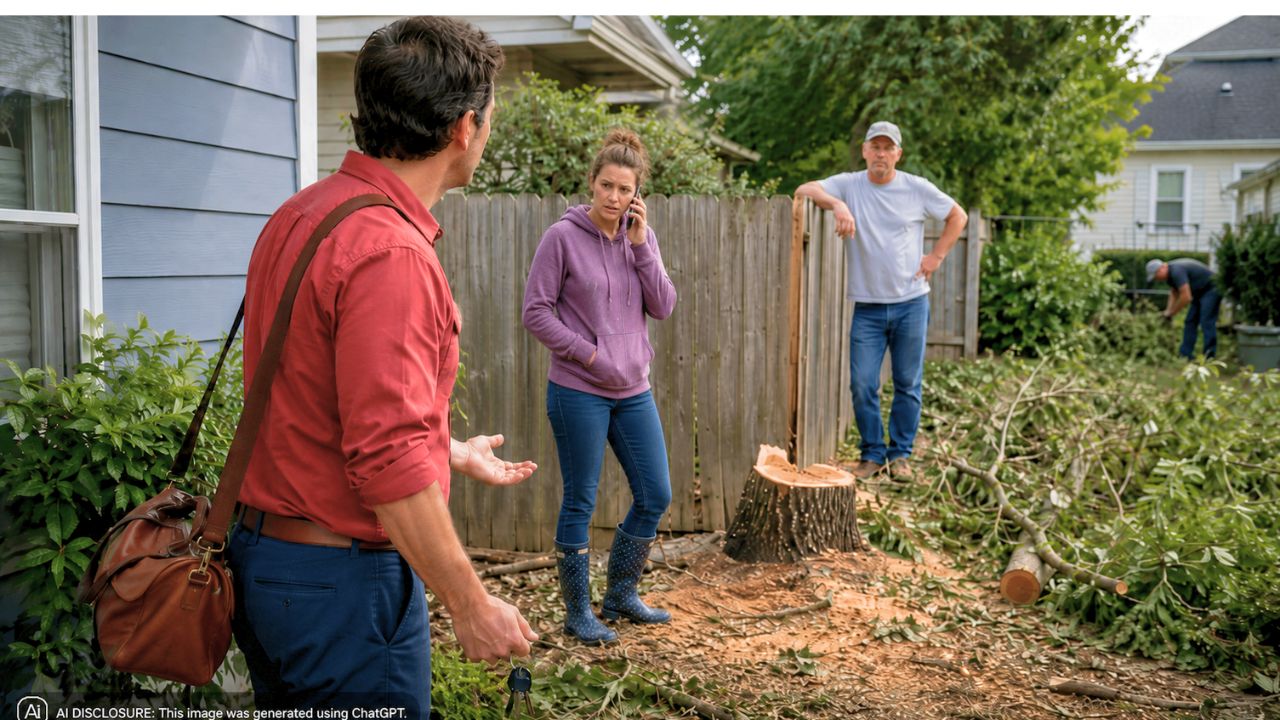
Photo credit: AI-generated image created using ChatGPT. Illustrative only.
They left for work expecting a normal day and came home to a backyard that had been changed without their permission. A tree that had been sitting on their side of the fence line was simply gone—cut down while no one was home.
In the original post, the homeowner described a long-simmering neighbor dispute that suddenly turned physical. The neighbor didn’t ask. Didn’t wait. Just took it on herself to remove a fence-line tree the homeowner says was on their property, leaving them staring at a stump and wondering what, exactly, they’re supposed to do next.
Coming home to a missing tree on your own property
Fence-line trees are one of those things people argue about for years without ever touching a saw. They’re close enough to “feel” shared, but they’re not—property lines are property lines, and a tree’s location matters.
That’s why the homeowner’s description hits so hard: the neighbor cut down the backyard tree while the family was away at work. No knock on the door, no note, no heads-up. Just a decision made next door, carried out across a boundary that, for most homeowners, is supposed to mean something.
It also creates a nasty kind of shock. A tree isn’t a trash can you can replace on the next store run. It’s shade, privacy, bird habitat, and in a lot of yards, a key part of how the fence line feels—like a buffer between two households that don’t necessarily want to be in each other’s business.
This wasn’t the first time the neighbor reached for “official” pressure
What makes the tree removal feel less like a one-off and more like a pattern is what happened before. The homeowner said they’ve already had issues with these neighbors filing a complaint to the county—specifically about ladders being kept in their backyard.
That complaint didn’t end with a warning or a polite suggestion. According to the post, the homeowner’s father was fined over $600 and had to move all the ladders to a storage unit.
That detail changes the temperature of the whole story. Once a neighbor has shown they’ll involve county enforcement over something as basic as ladders on private property, it’s hard not to view the missing tree through that same lens: not a misunderstanding, but a neighbor who keeps pushing until something gives.
Now, the homeowner isn’t just annoyed. They’re trying to stop a cycle where the next-door line keeps getting crossed—sometimes with paperwork, sometimes with a chainsaw.
The fence line is where small disputes turn into expensive ones
A tree on the fence line sounds simple until it isn’t. People argue about overhang, leaves in gutters, roots that lift pavers, and branches that scrape roofs during storms. Some neighbors treat anything that drops into their yard as “theirs” to remove.
But even if a tree is close to the boundary, taking it down without permission is a different level of escalation. It’s the kind of thing that can set off a chain reaction: questions about where the property line actually runs, whether the fence was placed correctly, and what else the neighbor feels entitled to “fix” while the homeowner is away.
And there’s the practical side that homeowners immediately understand. A tree removal changes your yard. It can expose a fence to wind. It can remove privacy from windows and patios. It can alter drainage and sun exposure, drying out one strip of yard while turning another into a muddy mess.
Even if the neighbor believed the tree was a problem, the way it was handled left the homeowner with all the uncertainty and none of the control.
“Who do I call?” becomes the whole question
The homeowner’s main ask was straightforward: they want the neighbor to stop messing with them and their property, and they want to know who to call.
That question is more loaded than it sounds. When something happens on the edge of two properties, homeowners tend to bounce between options—local code enforcement, county offices, police non-emergency lines, or even civil routes—because it’s not always clear which agency treats it as their lane.
And because the neighbor already brought the county into it once, there’s also a sense of uneven power. The ladders complaint already cost the family real money and real hassle, forcing them to rent storage space just to keep their own equipment. Now the homeowner is looking at a neighbor who not only complains, but acts.
It’s the kind of moment where people start thinking about documentation and boundaries in a new way, because they can’t rely on courtesy. They’re already past that.
Reactions centered on proof, property lines, and paper trails
Even without a long comment thread included, the place this was posted—and the way the homeowner framed it—signals what most experienced homeowners tend to focus on first: proof. Fence-line disputes don’t resolve on vibes. They resolve on records.
When a neighbor removes something from your yard, the first scramble is usually for the basics: photos of what was there before, any camera footage (doorbell cams, backyard cameras, even a neighbor across the street), and any documentation that shows where the line is supposed to be.
And because trees can be a major asset—not just landscaping but sometimes a meaningful portion of a property’s value—people also tend to think in terms of replacement costs and professional estimates. Not because everyone is itching for a courtroom fight, but because once something is gone, you can’t un-cut it. The only thing you can do is get organized and decide what you’re willing to pursue.
Another practical reaction that comes up in these stories is the idea of preventing a repeat. When someone is willing to enter the gray zone once—especially when you’re not home—homeowners start thinking about locks on gates, posted signage, and cameras that cover the fence line clearly enough to remove any doubt the next time.
A backyard dispute that’s no longer just about yard work
The homeowner’s frustration isn’t hard to understand. First, a complaint about ladders led to a $600+ fine and the added cost and inconvenience of a storage unit. Then, a tree on their property disappears while they’re at work. That doesn’t feel like neighborhood friction anymore; it feels targeted.
And the hardest part is the lingering tension. A fence line is something you look at every day. You take the trash out, you let the dog into the yard, you mow, you garden. If the person on the other side is unpredictable, every normal chore starts to feel like a new opportunity for conflict.
For now, the homeowner is stuck in that awful in-between: the damage is done, the neighbor has a track record of escalating, and the only clear next step is figuring out which authority will take it seriously—and what kind of proof they’ll need. Until then, the empty spot where the tree stood is more than a landscaping change. It’s a reminder that the boundary isn’t being respected.
Like Fix It Homestead’s content? Be sure to follow us.