Homeowner Climbs Through a Window to Reach Her Own Wall Because the Neighbor’s Gate Is Bolted to the House — Then She’s Told to Produce Permits Before They’ll Detach It
Photo credit: AI-generated image created using ChatGPT. Illustrative only.
Exterior remodels are supposed to be loud, dusty, and inconvenient. They’re not supposed to require climbing through a window just to reach your own wall.
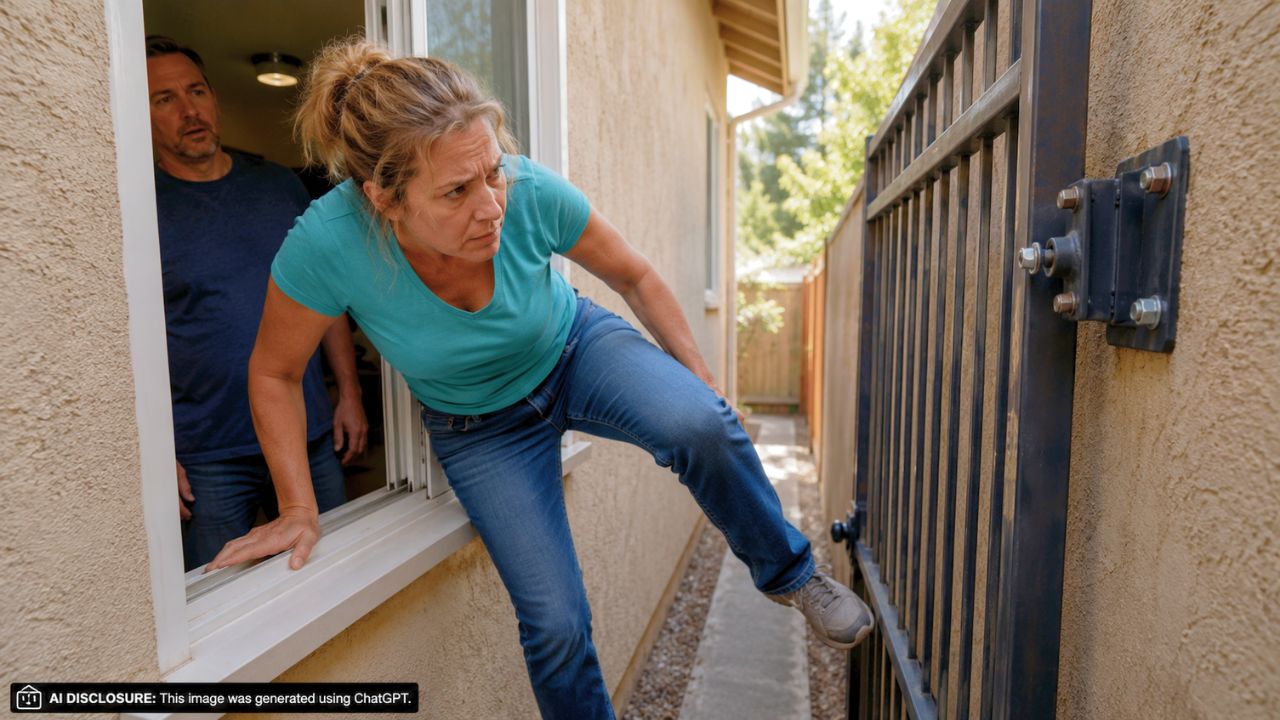
That’s where one Long Beach homeowner says she landed after realizing her neighbor’s gate and fence were bolted directly to her house, blocking access to the side yard area she needed for construction. In the original post, she describes a standoff that escalated fast: she asked for the attachment to be removed, and the neighbor responded by demanding permits before they’d detach anything.
The side of the house that became unreachable
The gate attachment wasn’t new. The homeowner says it’s been connected to her house “for years,” long enough that it likely faded into the background as one of those odd property-line realities people accept when nothing breaks.
Then came exterior remodeling. Suddenly, the part of the home that had been physically blocked off mattered—because contractors and materials need access, and schedules don’t pause while two neighbors sort out a decades-old boundary habit.
At one point, she says the blockage was so complete she had to climb through a window she’s replacing just to get to that side of her house. Not because it was dramatic, but because it was the only way to do what the remodel demanded without waiting for the neighbor to be home.
A request that turned into a paperwork dare
When she approached the neighbor, the ask was straightforward: remove the portion of the gate or fence that’s attached to her house so it won’t keep interfering with work now—or any future repairs.
The response she got wasn’t a flat “no.” Instead, it was a kind of procedural roadblock: the neighbor claimed she needed permits and had to show them before they could detach the gate from her house.
To the homeowner, that didn’t pass the smell test. Her understanding was that permits are typically required to build or modify a fence, not to remove something that’s improperly anchored to someone else’s structure. In her mind, this wasn’t a permit conversation at all. It was an encroachment problem hiding behind red tape.
Why this feels personal in the way only neighbors can make it
The gate isn’t happening in a vacuum. The homeowner describes the neighbor as consistently unfriendly, someone who doesn’t acknowledge them, with interactions mostly limited to complaints.
She mentions one prior flashpoint: the neighbor complained about a family member’s car parked on the street in front of the neighbor’s house. It’s the kind of everyday friction that doesn’t seem connected to a fence—until you’re asking that same person to undo something they’ve gotten used to having their way.
Then there’s the lingering suspicion that raises the temperature even more. The homeowner says she doesn’t have proof, but believes the neighbor killed a tree in front of her house, tying that belief to how the neighbor previously got the city to remove two dead trees of her own. Even without evidence, that suspicion colors everything: it’s hard to negotiate access to your home when you already feel like the other side plays hardball.
The real cost is time, access, and the risk of damage
When a fence blocks the side of your house, it’s not just annoying. It affects maintenance, emergency access, inspections, painting, termite treatment, stucco repair—anything that requires a human being to stand next to the wall and work.
During a remodel, those issues multiply. Crews have limited time. Materials show up on deliveries. Weather windows matter. When one neighbor’s hardware turns your side yard into a locked hallway, your project starts paying a tax in delays.
There’s also a quieter risk: when something is attached to your home, it can create damage points. Bolts, brackets, and repeated gate movement can pull at siding, stucco, or framing over time, or create small gaps where water intrusion starts. The homeowner didn’t describe visible damage in her post, but the access problem alone was already enough to force unsafe workarounds—like climbing through a window opening mid-project.
And then there’s liability anxiety. If contractors need access and can’t get it, everyone starts improvising. Improvisation around ladders, windows, and tight spaces is how small projects turn into injuries or expensive mistakes.
What people pushed: document first, then escalate
The homeowner asked what the “correct way” to handle it is if the neighbor refuses to remove the gate from her house. She floated a few options herself: code enforcement, a written notice, or another route.
Even without a full comment thread included in the source material, the direction of this kind of homeowner dispute tends to follow a predictable path once permits get weaponized in conversation. People push for documentation and clarity before another face-to-face argument spirals—photos of the attachment points, a record of requests made, and a dated paper trail showing that access was being blocked during permitted work on the home.
The other common practical impulse is to stop negotiating “in the driveway” and move the issue into formal channels that don’t rely on goodwill—especially when the relationship already feels hostile. When someone tells you to “show permits” before they’ll detach something from your property, they’re often signaling that a friendly request isn’t going to be enough.
That leaves homeowners juggling two pressures at once: keep the remodel moving, and avoid doing anything that could be framed as tampering with the neighbor’s property—even if the neighbor’s gate is physically attached to your structure.
A standoff built from screws and stubbornness
The strange part about fence battles is how small they look from the street. A hinge. A bracket. A few bolts into stucco or wood. But for the person living it, it’s access to their own home, on their own timeline, with their own money on the line.
This homeowner isn’t describing a theoretical disagreement about property rights. She’s describing a day when she couldn’t reach part of her house during active construction and climbed through a window opening because waiting wasn’t an option.
For now, the gate remains the choke point, and the neighbor’s demand for permits hangs over the conversation like a challenge: prove you’re allowed to ask for your own wall back. Whether this ends with a simple detachment or a more formal enforcement route, the remodel already exposed the core problem—when someone else’s hardware is anchored to your home, you don’t really control your own exterior until it’s gone.
Like Fix It Homestead’s content? Be sure to follow us.