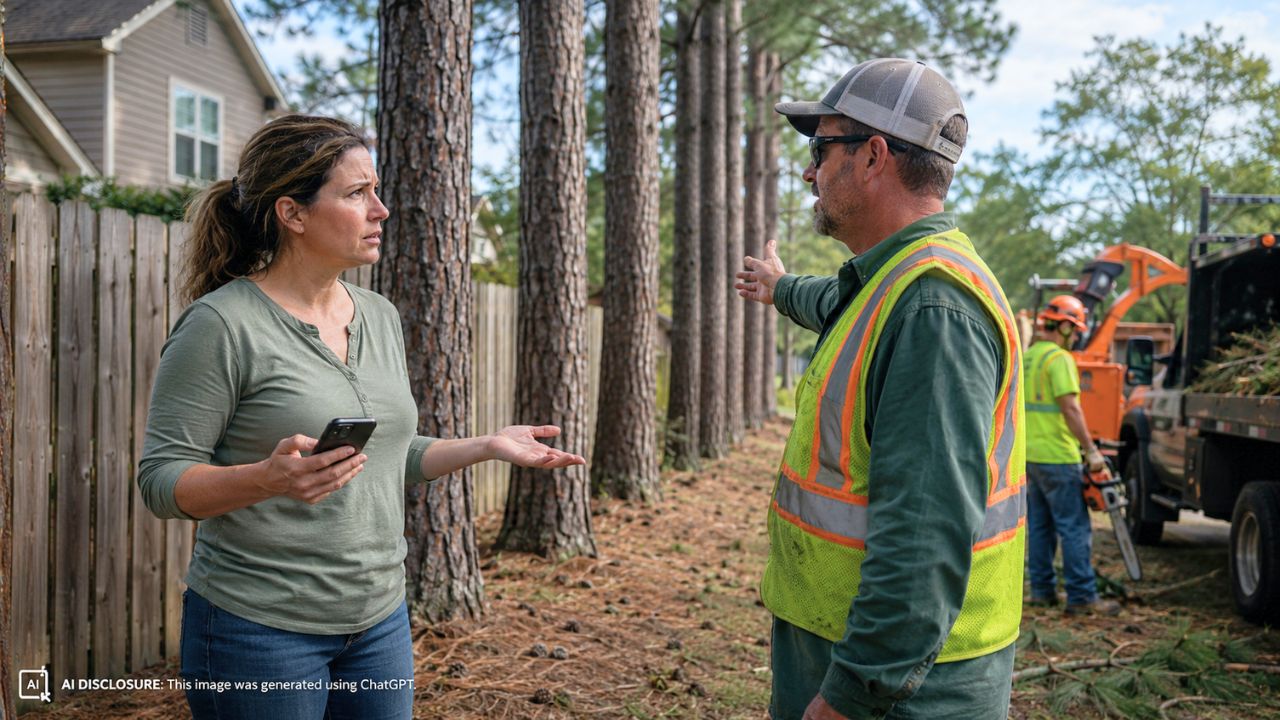
Homeowner Finds a Voicemail Announcing a Tree Crew Will Cut Property-Line Pines the Next Morning — Then the Crew Boss Says ‘The Neighbor Wants It Cut’
Photo credit: AI-generated image created using ChatGPT. Illustrative only.
It started with a voicemail that sounded more like a courtesy notice than a question: the neighbor said a tree service would be cutting down “one or two” of the pine trees along the property line the next morning, and they were “just letting us know.” No request. No pause for approval. Just a heads-up that a saw was coming.
The homeowner in Pennsylvania laid out the play-by-play in the original post, describing six tall pines—roughly 50 to 70 feet—standing in a row where the two properties meet. By the time they tried to get the name of the company and slow things down, the neighbor went quiet. The crew showed up anyway.
The voicemail wasn’t a request, and that changed everything
After hearing the message, the homeowners texted back asking to speak with the tree company first and requesting the company’s name. They didn’t authorize any work, and they say they never got a response.
In a lot of neighbor disputes, the fight starts with a fence panel or a few feet of mulch creeping over. Here, it was mature pines—big enough to matter for privacy, wind buffering, shade, and the feel of a backyard. A “we’re doing it tomorrow” message doesn’t leave room for any of that.
And once a tree is down, there’s no easy undo button. That’s part of what made the voicemail feel so loaded: it wasn’t just about trimming; it was about removal.
By morning, the crew was already cutting
The next day, the tree service arrived and started work without checking in first. When the homeowner confronted the crew boss, they were told, “the neighbor wants it cut so we’re cutting it.” The homeowner asked if the tree was sick or dead, and says the boss didn’t claim it was.
The homeowner also told the crew the trees were on shared property. Still, in the moment, they made a call many people make under pressure: they agreed to let that first tree come down, assuming it would be the only one. They also set a boundary—come to them before touching the second tree or any trees farther in.
That boundary didn’t hold. The homeowners say the crew cut branches from the second tree without asking.
Then the neighbor said the quiet part out loud
What pushed this from “miscommunication” into “brace yourself” territory happened next. The homeowner was in the backyard and heard the neighbor approach the crew. The conversation was loud enough to carry, and the neighbor referenced how the homeowners “tried to shut them down.”
According to the homeowner, the neighbor’s response was blunt: “too bad for them. We’re cutting down all of these trees.”
At that point, it wasn’t about one tree anymore. It was a plan to remove the whole line—five more tall pines—whether the other property owner agreed or not. When the homeowners went back out front to stop additional work, they were told the company would return and “just cut the tree from their property,” brushing off concerns that the trunks might be partially owned or on the line.
That’s where the real homeowner nightmare kicks in: a contractor in your yard insisting they’ll follow whoever paid them, while the people next door are acting like the property line is a suggestion.
A shouting match at the property line
When the neighbors came over, the homeowners brought up the missing consent. That’s when the conversation turned aggressive. The homeowner says the neighbors raised their voices, cursed, and insisted the homeowners didn’t have a choice about the rest coming down.
The neighbors also claimed the trees were theirs, but wouldn’t show proof when asked. The homeowner recorded the exchange on their phone, which tells you how quickly this felt like something they might need to document.
From there, the questions got urgent and practical. Who has to prove where the line is? Do the homeowners need to pay for a survey? If the tree service shows up again, what can you do in real time—especially if the crew is willing to work first and sort it out later?
The plan: township records, a lawyer, and a hard pause
The homeowners’ next steps were less about winning an argument and more about stopping the next cut. First: go to the township to see what property line information is available and whether the town can offer guidance.
Second: meet with a lawyer to draft a cease-and-desist letter. The goal is to freeze the situation until ownership is clear, because a row of mature pines can represent a lot more than landscaping. It’s privacy from windows, a visual boundary, sound buffering, and the kind of tree line that makes a yard feel like a yard.
They also left the door open to compromise—but only with structure. If the trees are jointly owned, they’d consider letting the neighbor pay for removal, but only if the neighbor can show the trees are in poor health or hazardous, and only if the work is done by a reputable, insured service.
In other words: no more “we’re cutting tomorrow” voicemails. No more surprises. No more chainsaws without paperwork.
What people told them: document everything and don’t let contractors freestyle your boundary
Even without a long comment thread included in the source, the themes are the ones homeowners return to in these disputes: get everything in writing, document every interaction, and stop treating a property-line tree like a casual yard project.
A tree crew showing up ready to cut is a reminder that contractors often take direction from whoever hired them, not from whoever might be affected. That doesn’t make it right, but it does make it predictable. Once a crew is mobilized, the incentive is to finish the job, get paid, and move on.
Homeowners who’ve been through similar standoffs tend to focus on a few practical moves: keep communications in text or email when possible, keep video or audio records of confrontations (as this homeowner did), and push for clear boundary proof before any more work happens. If the neighbor is certain the trees are theirs, the fastest path to “prove it” is usually records and a surveyed line—not a shouting match.
The unsettling part is how quickly a normal suburban or rural boundary can turn into a worksite. One voicemail later, a long-standing tree line is suddenly being negotiated in real time with strangers holding saws.
For this homeowner, the next morning isn’t the scary part anymore—the scary part is the next crew visit. Five more pines are still standing, and until someone can show exactly where those trunks sit, the line between “their trees” and “our trees” is more than a map problem. It’s a pressure test for how well neighbors can share space when money, privacy, and control are all on the table.
Like Fix It Homestead’s content? Be sure to follow us.