Homeowner Asks Three Times for the Neighbor to Fix a Sagging Telephone Wire Drooping Four Feet Over the Yard — Then the Phone Company Says It Can’t Help Since the Wire Isn’t Connected to Her House
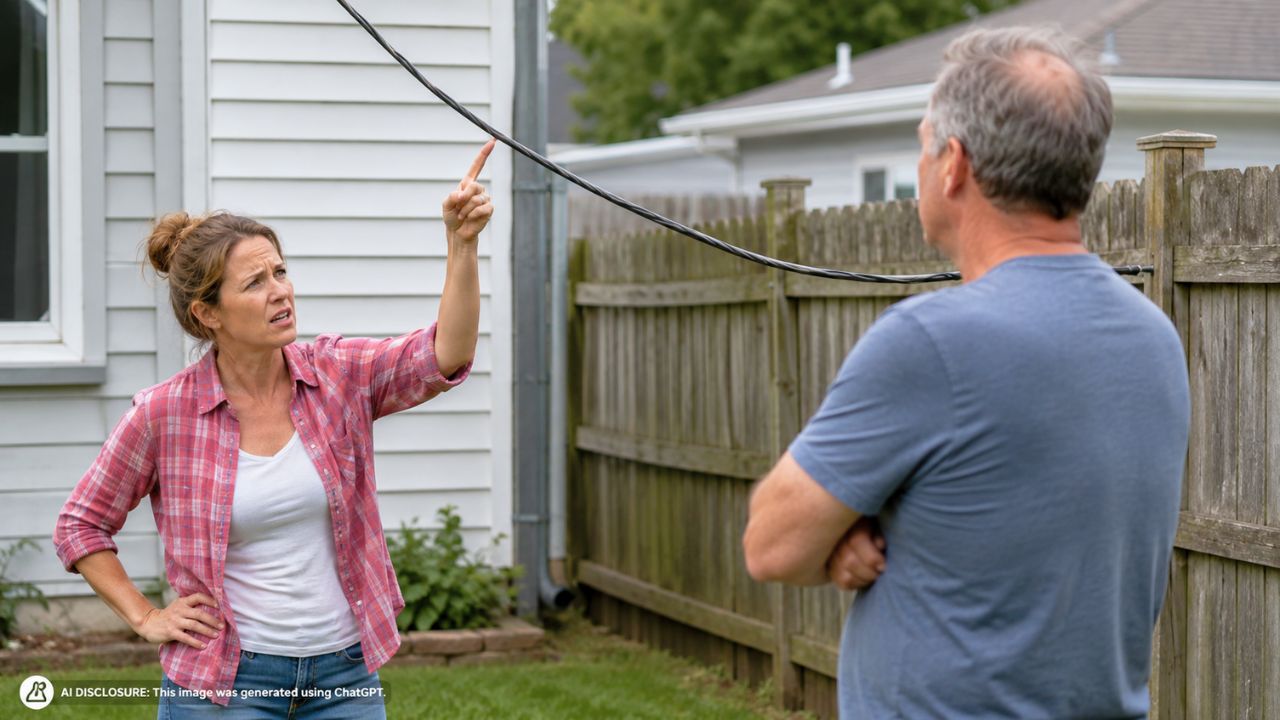
Photo credit: AI-generated image created using ChatGPT. Illustrative only.
The cable didn’t look like a big deal at first—just one more line coming off the utility pole in the backyard. But then it loosened where it attaches to the neighbor’s house and started hanging low over the grass, turning a normal yard into something you have to duck under.
In the original post, the homeowner described a giant telephone pole sitting in their backyard with wires that cross their property and connect to the neighbor’s home. One of those lines is now sagging about four feet off the ground—low enough that kids running, playing, or carrying something could easily catch it without realizing what it is.
A backyard utility pole turned into a daily headache
The setup is the kind many homeowners inherit without thinking much about it: a big pole, a few overhead lines, and a general assumption that the utility companies and neighbors have it handled. The wires run across the yard but aren’t feeding the homeowner’s house—they’re serving the property next door.
That detail matters more than most people expect. When the line drooped, it didn’t just look messy. It changed how the homeowner could use their yard, because a wire hanging at chest height isn’t something you ignore when you’ve got kids outside.
The drop got low enough to feel unsafe
This wasn’t a minor sag where the cable is still overhead and out of reach. The homeowner put the height at around four feet above the ground, meaning it’s right in the zone where someone could brush it, clothesline themselves on it, or get tangled if they’re moving fast.
Even if it’s “only” a copper telecom line, it’s still a line under tension that’s supposed to be up high, away from people. The homeowner’s worry wasn’t abstract. Kids don’t treat the yard like an obstacle course with utility hazards—they sprint, they chase, they cut across corners, and they grab whatever is in front of them.
And once a wire is drooping that low, it’s hard not to start imagining all the ways it could get worse: a lawn mower getting too close, someone tugging it by accident, a storm adding weight, or the attachment point failing further and dropping it even lower.
Three requests to the neighbor, and nothing changed
The homeowner tried the direct route first: talk to the neighbor whose house the wire connects to. They asked three separate times for the neighbor to fix it.
Nothing happened. The homeowner described the neighbor as “so lazy,” which gives you the vibe—this wasn’t one polite reminder and then a scheduled repair. It was repeated asking, watching the problem remain, and feeling like the yard was being treated as someone else’s dumping ground for an unresolved maintenance issue.
That’s the part that makes these disputes so draining. A sagging wire isn’t something you can quietly fix from your side without crossing a line—literally and figuratively. It ties into another person’s house, another person’s service, and equipment most homeowners aren’t comfortable touching.
Then the phone company hit them with a dead end
Next came the “fine, I’ll call someone who has to deal with this” phase. The homeowner reached out to both the energy company and the telecommunications company that owns the copper cable.
But the telecom company’s response was blunt: they said they couldn’t do anything because the wire isn’t connected to the homeowner’s house. In other words, because the service doesn’t belong to the person calling, they weren’t treating it as their issue to resolve.
It’s the kind of answer that leaves a homeowner staring at the line like it’s mocking them. The cable crosses their yard. The pole is in their backyard. The safety risk is on their property. Yet the responsibility, at least in the way customer service framed it, lands somewhere else.
This is where these problems get sticky fast: the homeowner isn’t asking for a new installation or a service upgrade. They’re asking for a low-hanging wire to be put back where it belongs. But once companies start sorting requests by account holder instead of by hazard, the person who’s impacted can get pushed to the side.
Why it feels like nobody “owns” the problem
From the homeowner’s perspective, it’s simple. A line is drooping into their usable yard space, and it needs to be tightened or reattached properly at the neighbor’s home.
From the neighbor’s likely perspective, the wire still “works” or doesn’t feel urgent, so it gets bumped down the list. It’s not in their way, and if they’re not the one tripping over it, the motivation disappears.
And from the company perspective—at least as relayed by the homeowner—the wire is part of a service drop to another property. That means the homeowner can’t easily report it as a repair for their own account, even though the physical hazard is sitting in their yard.
The result is a classic homestead-style frustration: you’re the one living with the mess, but you’re not the one with the official power to order the fix. Meanwhile, the wire keeps hanging there like a low ceiling over your own grass.
Readers leaned toward documentation and pressure, not DIY heroics
Even without a long comment thread included in the source material, this kind of problem tends to pull practical advice from other homeowners: document the height and location, take clear photos, and keep a record of when you asked the neighbor to address it.
That paper trail matters because it shifts the story from “annoyance” to “safety hazard on my property that I have been trying to resolve.” It also gives you something concrete if you need to escalate beyond a basic customer service call.
People also tend to warn against trying to “just move it” yourself. Even if it looks like a harmless copper line, it’s still part of a utility system attached to another house, and messing with it can create new problems—damage to the neighbor’s connection, an argument that turns personal, or a bigger repair bill that lands in your lap.
When a wire is that low, the goal isn’t to become your own line crew. It’s to get the right party to treat it like the priority it should be.
For now, the homeowner is stuck in the most frustrating phase: the danger is visible, the requests have been made, the companies have been called, and the yard is still living under a drooping line. And every time the kids run out back, it’s one more reminder that sometimes the hardest home repairs aren’t the ones you can do yourself—they’re the ones you can’t get anyone else to claim.
Like Fix It Homestead’s content? Be sure to follow us.