Missouri Homeowners Mow the Same Eighty Square Feet of a Neighbor’s Yard for 20 Years — Then She Vows Never to Give Their Land Back
Photo credit: AI-generated image created using ChatGPT. Illustrative only.
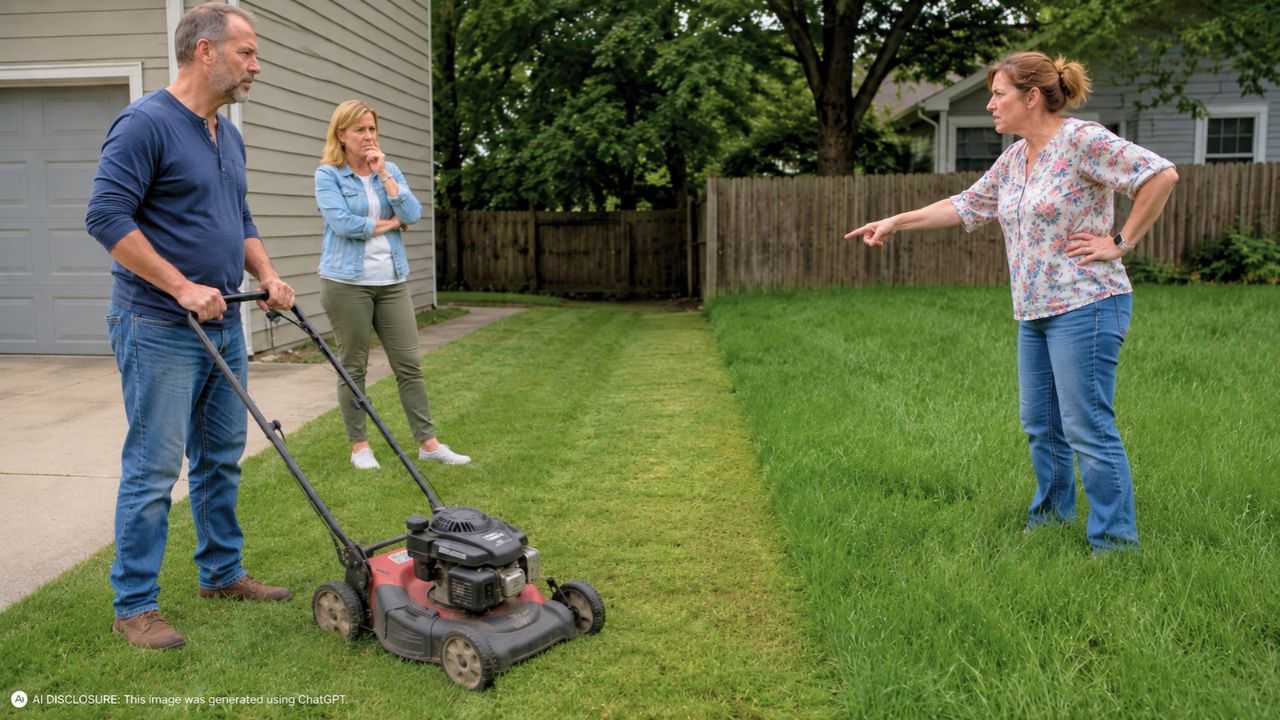
It started as one of those quiet, petty compromises neighbors make to keep the peace: an extra strip of grass gets mowed, a planting bed creeps over a line, everyone shrugs and moves on. In this Missouri yard dispute, the homeowners say they’ve been cutting about 80 square feet of their neighbor’s front-yard grass for roughly 20 years—because, in their telling, the neighbor planted on about the same amount of land in the homeowners’ backyard without permission.
Then the relationship blew up. After the homeowners reported what they described as verbal and mental abuse of the neighbor’s husband, who has Alzheimer’s, they say the neighbor retaliated in the most suburban way possible: by declaring they were no longer allowed to mow “her” grass, and by insisting there was “no way” she would give back the portion of backyard she’d planted. The question they took online—laid out in the source post—was simple and loaded: if you’ve maintained someone else’s yard for two decades, does it become yours?
Twenty years of mowing, one backyard grudge
The homeowners framed it like a long-running trade. They cut a small rectangle—about 80 square feet—in the neighbor’s front yard, and in exchange (or at least in uneasy balance) the neighbor had plants sitting on about 80 square feet of the homeowners’ backyard.
Nothing about that kind of arrangement is unusual in real life. Property lines can be weird, fences get placed “close enough,” and people get tired of arguing over a strip that’s basically the width of a push mower pass or two.
But the key detail is that it wasn’t a clean, written swap. It was just years of habit: they mowed; she planted; nobody went to the courthouse to redraw anything.
The moment it stopped being about grass
What changed wasn’t the landscaping—it was the relationship. The homeowners said they reported the neighbor for verbally and mentally abusing her husband. After that, the neighbor allegedly turned the boundary issue into leverage.
Instead of treating the mowing as a harmless routine, she reportedly told them they “better not cut her grass anymore” and that she wasn’t restoring the homeowners’ backyard area “to us.” That’s the kind of statement that makes a long, fuzzy arrangement suddenly feel like a trap.
Because once someone is mad, every shared driveway, every overhanging branch, every inch of “we’ve always done it this way” becomes a potential fight.
Can mowing turn into ownership in Missouri?
The homeowners’ main hope was a legal concept a lot of people have heard of but few fully understand: adverse possession. It’s the idea that if you openly treat someone else’s property as your own long enough, you can sometimes gain legal ownership.
In the attorney response posted, Michael R. Nack explained why this particular mowing history doesn’t automatically create ownership. He pointed to a core requirement: the possession has to be “open, notorious, hostile and under a claim of right.” In plain terms, you have to act like it’s yours, even against the actual owner.
Here’s the part that undercuts the homeowners’ argument: the attorney said that if both sides acknowledge the strip belongs to the neighbor, that acknowledgment defeats an adverse possession claim. In other words, “we’ve been mowing it with permission” (or with mutual understanding) is basically the opposite of “we took it and claimed it as ours.”
The mowing might be long-term. It might be routine. But it isn’t necessarily “hostile,” and that’s the word that matters in this doctrine.
Why this kind of yard dispute gets expensive fast
Eighty square feet doesn’t sound like much until you picture it as a permanent bruise on your property. In the front yard, it’s curb appeal and resale photos. In the backyard, it’s where you put a garden, a shed, or a fence—until you can’t, because someone else has already planted there.
The bigger risk is that these tiny boundary squabbles don’t stay tiny. When people stop speaking, you don’t coordinate mowing schedules or ask before moving landscaping stones. One party might put in edging. The other might “accidentally” scalp the lawn. Plants die, or get removed, and suddenly someone’s claiming damages.
And if a vulnerable adult is involved—as the homeowners described with the neighbor’s husband—emotions tend to run hotter and logic goes out the window faster.
Reactions focused on proof, not payback
Even in a short legal Q&A thread, the practical takeaway in the attorney’s response is clear: the law cares less about how long you’ve been doing yard work and more about what you were claiming while you did it.
The response also hinted at what usually comes next in real life: statutes, case law, and paperwork. The attorney noted that a more specific answer would require researching Missouri law and that the online response shouldn’t be treated as legal advice. He offered a paid opinion letter and a free phone consult, which is often where these “it’s just a strip of grass” arguments end up—because people want certainty before they move a fence, rip out plantings, or escalate the dispute.
If you’ve ever watched neighbors spiral over property lines, you know the rhythm: first comes the measuring tape, then the old survey, then the new survey, and then the certified letters.
When “permission” is the detail you can’t outrun
The homeowners asked if cutting the area “with permission” for 20 years made it theirs. That word—permission—may be the anchor around their ankle. Permission suggests the neighbor was still the owner, and they were allowed to use it, not that they seized it as their own.
At the same time, the backyard issue cuts the other direction. If the neighbor planted in the homeowners’ backyard “without permission,” that may be the part that feels like an actual taking to them. But even then, feelings aren’t deeds.
Now they’re stuck with the worst kind of homeownership stress: a boundary that’s physically visible every day, tied to a personal feud, with the added weight of a serious allegation involving an ill spouse. Grass grows back. Bad blood doesn’t.
And unless someone is willing to sort out the line on paper—calmly, and probably with professional help—this won’t stay at 80 square feet for long. It’ll spread into every decision about the yard, the fence, and what “neighbor” even means on that street.
Like Fix It Homestead’s content? Be sure to follow us.