Rural Landowner Finds a Neighbor Excavating the Property Without Permission — Then a Water Main Breaks During the Dig
Photo credit: AI-generated image created using ChatGPT. Illustrative only.
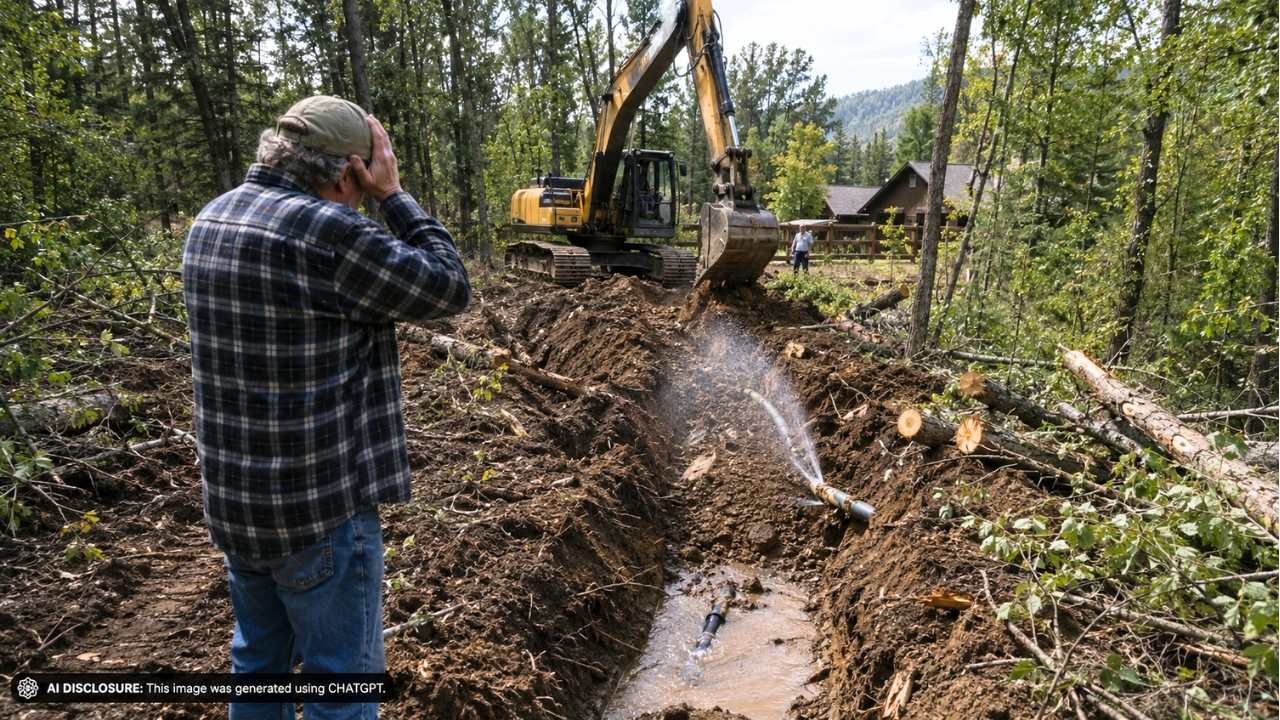
On a quiet private lane in Utah, a rural landowner walked out to what used to be a dense, wooded lot and found it cut open like a jobsite. A neighbor’s water line had broken, and instead of a knock on the door or a quick conversation at the fence, a full-size excavator had gone straight through the middle of the property, leveling trees and underbrush in its path.
The landowner described the damage and the neighbor’s justification in the original post: a new trench ran north-to-south through what had been a thick yard. The neighbor insisted he had the right to do it anyway, citing “prescriptive easement” and “easement by necessity,” even though the landowner said their title report showed no recorded easement allowing that route.
It started with a broken water line and a rushed “fix”
This wasn’t a random dig for landscaping or a casual boundary scuffle over where to park. The landowner said a water main and four lateral water lines lie on their property, with a utility easement recorded along the south line running east-to-west. One of those lateral lines served the neighbor to the north/east.
When that neighbor’s line broke, the response wasn’t a careful repair along the original path. The landowner says the neighbor ran equipment right through the center of the lot, turning a wooded area into a trench corridor to install a new line.
And in rural living, that kind of “emergency repair” can be the moment everything escalates—because once dirt is moved and pipe is placed, the physical evidence becomes the new argument: the line is there now, so it must be allowed now.
The real damage wasn’t just the trench—it was what got flattened
The landowner wasn’t describing a couple of broken shrubs. They said about 30 trees were leveled, plus thick underbrush that “can’t be replaced” in any meaningful way, at least not quickly. A wooded lot isn’t a lawn you reseed in spring; it’s privacy, windbreak, habitat, shade, and the feel of the property itself.
What hit hardest was how permanent it felt. The homeowner described feeling “completely violated” and “devastated,” not only because the land was altered, but because it was altered without any permission—no conversation, no handshake, no agreement about where equipment could travel, and no plan to restore what was destroyed.
Even worse, they believed the new line was installed where it was most convenient for the neighbor, not where the old line had been when the houses were built in the late 1970s. That detail matters because it raises an obvious question: was this truly a repair, or a relocation?
When easements are real, they’re usually written down
The homeowner’s paperwork showed a recorded utility easement along the south property line. That’s the type of easement most owners can live with—annoying sometimes, but defined. It explains where utilities can run and where access might be needed.
The neighbor’s claimed right was different. According to the landowner, there was “no recorded easement for him to do what he did,” and nothing in the title report documenting permission for a trench cut right through the lot.
That’s when the neighbor switched from asking to asserting. The landowner said the neighbor claimed he had the right because of a prescriptive easement and an easement by necessity—two phrases that can sound official enough to shut down a normal person in their own driveway. But to a homeowner staring at downed trees and exposed soil, it reads like this: “I did it, and I’m daring you to stop me.”
Then the dig turns into a bigger risk: water, access, and future fights
Once an excavator has made a “highway” through a wooded lot, the property changes in ways that aren’t obvious until later. The trench becomes a path for runoff. The cleared strip becomes a new access route. If the soil is disturbed, erosion and settling can follow, especially around buried lines.
And when a water line breaks in the first place, it’s rarely neat. Saturated soil can undermine nearby areas. A rushed trench can nick other lines, crush roots, or change grading just enough to push water toward the wrong place during storms.
The landowner also pointed out something that tends to haunt these disputes: the water main and multiple laterals already lie on the property. That means future repairs are almost guaranteed. If the neighbor has effectively established a new route—and feels entitled to use it—what happens the next time there’s a leak?
Even if the immediate break is “fixed,” the long-term problem is that the neighbor now has a precedent, a physical installation, and an argument that the land was used this way before. The homeowner is left trying to reverse a change that’s already in the ground.
People fixated on one thing first: proof
In the comments and general reactions to stories like this, the practical advice tends to cluster around documentation, because the land itself has already been altered. When trees are gone and trenches are filled, the easiest story to sell becomes: “This is how it’s always been.”
The homeowner already had one key piece of proof: a title report that didn’t show an easement supporting what the neighbor did. But paper and dirt don’t always match, and that’s why readers often push for more—photos of the damage, dates of when it occurred, the exact location of recorded easements, and any evidence showing where the original line ran versus where the new line was placed.
There’s also the unspoken reality that rural neighbor disputes can turn into years of low-grade stress. People want the owner to lock down their version of the timeline before the neighbor has a chance to rewrite it.
Living next to someone who won’t restore what they destroyed
The most deflating detail in the landowner’s account wasn’t the broken line or even the excavation itself. It was that the neighbor wasn’t willing to replace any of what was destroyed, “if it could” even be replaced. That’s not a misunderstanding; that’s a refusal.
In a neighborhood where lots are wooded and privacy comes from trees, cutting down 30 trees isn’t cosmetic damage. It can change how the property feels from the road, how close the neighbor’s house seems, and how exposed the homeowner feels in their own space.
Now the owner is stuck in the worst spot: staring at the trench line and wondering what to do next—how to protect their property and stop a repeat, without turning a private-lane neighbor relationship into a permanent war. In places where you can’t avoid each other, that’s the part that keeps people up at night: the broken line may be repaired, but the trust is what really snapped.
Like Fix It Homestead’s content? Be sure to follow us.