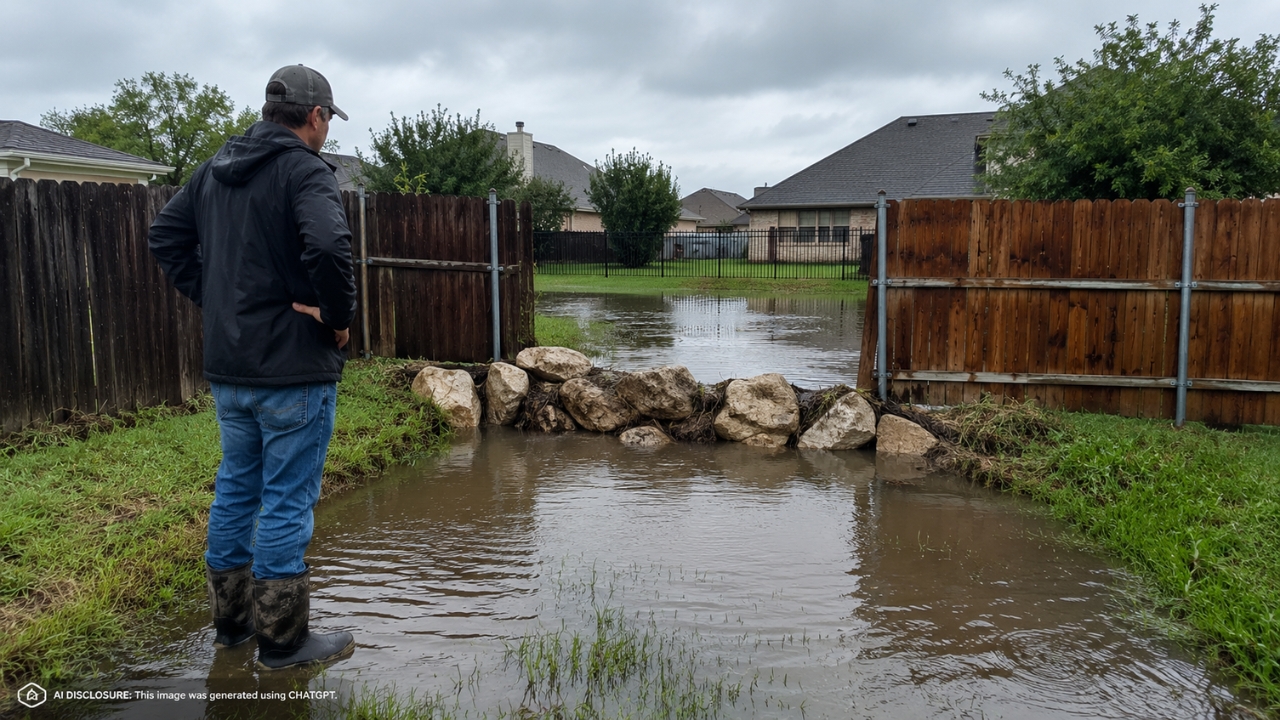
Homeowner Finds a Drainage Easement Blocked With Large Rocks — Then Learns the Neighbor Built the Dam Himself to Keep Water Off His Land
Photo credit: AI-generated image created using ChatGPT. Illustrative only.
When you buy a house, you expect the surprises to be the usual kind—an odd outlet, a sticky door, maybe a sprinkler zone that doesn’t work. This Texas homeowner got a different welcome: a drainage ditch that’s supposed to carry stormwater away, ending at a fence line where someone piled in boulders like they were building a mini levee.
In the original post, the homeowner explains that their property borders a city drainage easement. Most of the neighborhood’s storm drains appear to feed into that system, which moves water across their yard only when it’s actively raining or has recently rained. The setup seemed manageable—until the water hit the neighbor’s rock “dam” and stopped.
The ditch only ran during storms—until it couldn’t drain
The drainage easement cuts across the homeowner’s property through a ditch. Most days it looks harmless because it’s dry, just a low channel that waits for the next rain.
But the critical point is where that ditch meets the fence line shared with a neighbor. On the other side, the land dips and, according to the homeowner, the natural path continues toward a culvert under the road and into what looks like a creek. That’s where the system is supposed to empty out.
Instead, the neighbor has stacked large rocks along that fence line, blocking flow. The result is simple and brutal: water can come in, but it can’t leave.
A yard turning into a pond wasn’t the worst fear
The homeowner said the rock barrier causes stormwater to pool on their side of the fence. And when the rains are heavy—especially after a drought—the pooling isn’t a shallow nuisance.
They described one event where the water got waist-high at its deepest point. That’s not just soggy grass or a muddy patch. That’s the kind of flooding that can wipe out landscaping, kill trees, push water toward structures, and leave standing water sitting for days.
Their biggest worry isn’t only the frustration of losing a chunk of the yard for a week at a time. It’s the possibility that an extreme rain could back water up far enough to threaten the house itself.
The neighbor’s explanation didn’t match what they were seeing
The homeowners tried talking directly with the neighbor. They weren’t looking for a feud—they wanted the rocks removed so the ditch could do what it was designed to do.
The neighbor wasn’t interested. According to the homeowner, he deflected questions by claiming the previous owner built the dam and that it was done by the “Army Corp of Engineers.” The homeowner didn’t have any information to verify that, and the claim didn’t change the reality: the water was getting trapped on their side.
This is the part that makes these disputes so hard. One person sees a home-protection project—keep water off my land at all costs. The other person sees forced flooding—your fix is turning my yard into a retention pond.
When the city showed up, the answer wasn’t what the homeowners hoped
Thinking the drainage easement would make this straightforward, the homeowners reached out to the city. A city drainage easement sounds official. Like someone, somewhere, is responsible.
The city did come out to look. The homeowner said the city seemed surprised to see the fence line dammed up with rocks. But then came the letdown: they were basically told there was nothing the city could do.
Adding another wrinkle, the homeowner noted that their fence line with the neighbor is also the city limit line. That kind of boundary can turn a simple “call the city” problem into a jurisdiction headache, where nobody wants to claim authority over the messy part.
The real-world fallout: mud, mosquitoes, and a creeping threat to the house
Floodwater that hangs around isn’t just water. It’s sediment that fills low spots, it’s turf that dies off, and it’s the kind of saturated ground that can start shifting and slumping in ways you don’t notice until later.
And it’s also the stuff that attracts problems you can’t easily “fix” with a weekend project—standing water brings mosquitoes. Persistently wet areas can draw pests and make fence lines rot faster. If water is sitting against parts of the yard that were never meant to be wet, it can expose weak spots in grading that used to be fine.
What makes this one especially tense is the scale. The homeowner isn’t describing a puddle. Waist-high water is a signal that the drainage path is being seriously obstructed, and that a bigger storm could turn “annoying” into “expensive.”
Commenters pushed documentation and clear boundaries, not more arguments
The homeowner mentioned Texas Water Code 11.086 as a possible issue, but also admitted they weren’t sure how it applied. That uncertainty—mixed with a neighbor who won’t cooperate—is often where people start looking for practical next steps instead of another conversation over the fence.
While the post itself is centered on what they can do to get the rocks removed, the shape of the problem points to what homeowners in these drainage fights tend to focus on: proof and paper trails. Photos of water levels after storms, dates and times, and anything that shows the obstruction is man-made and located where the drainage path is supposed to continue.
Even the map the homeowner shared becomes part of that reality. When drainage is involved, “it feels like it floods more now” isn’t as persuasive as “here is where the water is supposed to go, here is the blockage, and here is how high it got when it couldn’t pass.”
And when the city response is essentially a shrug—especially with a city-limit boundary running down the fence—the need for clear documentation gets even sharper. The neighbor can dismiss a complaint as exaggeration. A set of consistent photos after multiple rains is harder to brush off.
The homeowner bought a house with a drainage system already in place, expecting it to behave like a drainage system. Instead, they’re living with a makeshift rock wall that turns storms into backyard flooding—and a neighbor who appears determined to keep the water moving in only one direction. For now, every heavy rain comes with the same question: how high will it get this time?
Like Fix It Homestead’s content? Be sure to follow us.