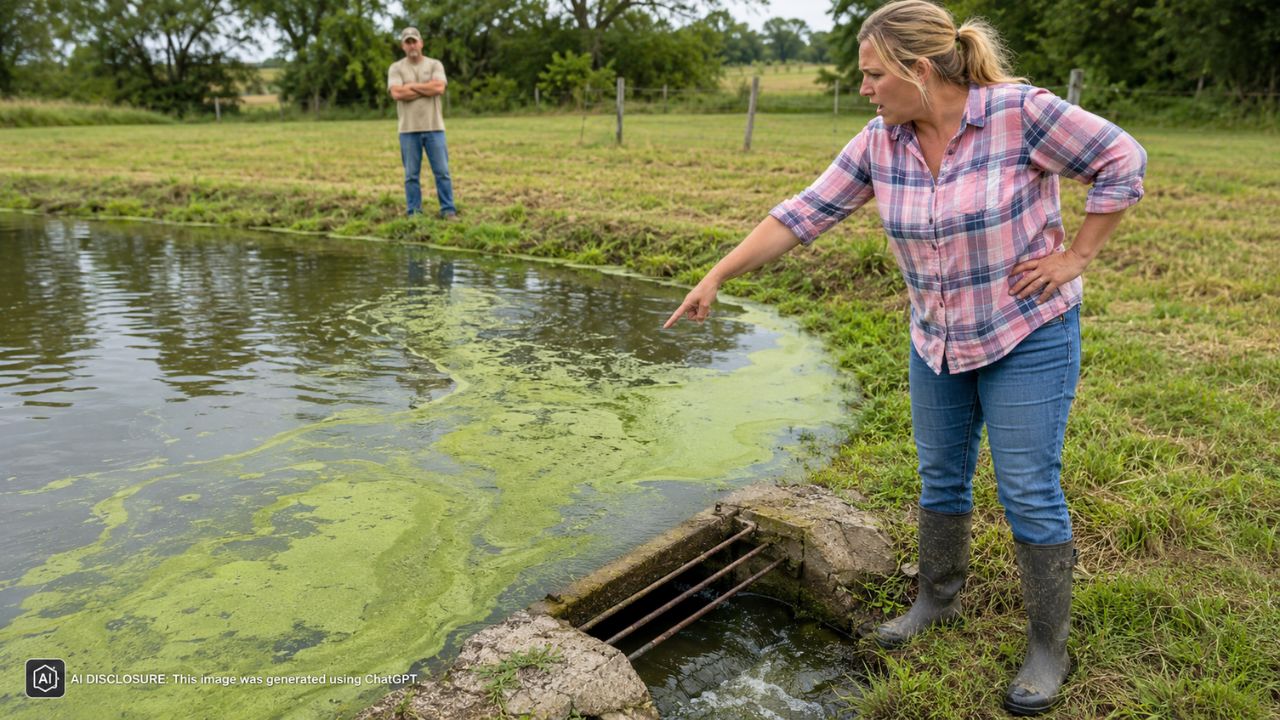
Rural Pond Owner Finds Scum From the Neighbor’s Half Flowing Onto Hers — Then Realizes Her Side Is the Only One With an Overflow
Photo credit: AI-generated image created using ChatGPT. Illustrative only.
A shared pond sounds peaceful on paper. In real life, it can turn into a slow-motion property-line fight where the water does all the arguing.
One rural pond owner laid out her problem in the original post: she has a 0.4-acre pond that straddles a boundary, with about 0.3 acres on her side and 0.1 acres on the neighbor’s. The neighbor’s corner stays “gross” and covered in pond scum—and the surface gunk keeps drifting into her cleaner water.
At first glance, it sounds like a simple case of “keep your mess on your side.” But the twist is structural: her side is the only one with an overflow. That means her shoreline isn’t just where the pond looks nicer—it’s also where the whole pond system is being relieved when water levels rise.
The small connection that causes a big headache
The two sides of the pond aren’t fully open to each other across a wide area. The owner described only about a 5-foot-wide gap where the two bodies of water communicate. That narrow choke point makes the problem feel fixable—like there should be a way to block the scum without triggering a bigger mess.
But it also makes the dynamic more frustrating. If the neighbor’s side stays coated in floating scum, it doesn’t take much wind or current to push that film right through the shared opening. And because her side is where water exits, the pond’s subtle movement is always pulling in her direction.
It’s the kind of rural detail that doesn’t show up on a real estate listing. A pond can look like a personal amenity until you realize it’s also shared infrastructure, and you might be the one maintaining the “working” parts without wanting the job.
The moment she realized the overflow made her the “downstream” neighbor
The owner’s main realization wasn’t just that the neighbor’s water quality was bad. It was that the pond’s natural flow favors her side because she has the only overflow.
Overflow isn’t a decorative feature. It’s the thing that decides where extra water goes after heavy rain, snowmelt, or weeks of spring runoff. In her setup, the neighbor’s portion effectively benefits from the same outlet, even though it sits on the other side of the line.
That’s where the resentment starts to creep in. If one property has the only “exit,” then one property is also the one that gets the constant movement—and whatever comes with it, including floating scum.
Two fixes… and both come with consequences
She boiled her options down to two ideas, both involving filling that 5-foot communication gap with dirt.
Option 1 was the simplest: fill the gap and separate the water. But she immediately saw the flaw. If she builds a dirt barrier and the neighbor’s side still receives the same rainfall and runoff, the water level on that side could rise until it spills over anyway—potentially right over the top of whatever she builds. In that scenario, she doesn’t just get scum drifting over; she gets overtopping water carrying whatever it wants.
Option 2 tried to be more controlled: fill the gap, but bury a 6-inch PVC pipe about 2 feet below the water line. The idea is classic in rural problem-solving—let the water equalize and overflow without pulling the surface layer. If the pipe draws from deeper water, maybe it reduces the transfer of floating scum that’s riding on top.
But even that “best of both worlds” fix comes with a gut-check: if she builds the structure that helps manage the neighbor’s water level, is she basically volunteering to keep serving as the neighbor’s overflow?
When the real question isn’t dirt or PVC—it’s obligation
Buried under the talk of fill dirt and pipe diameter was the question that makes neighbors stop waving and start avoiding each other at the mailbox: “Am I legally obligated to allow his side of pond to continue to utilize my overflow?”
That one sentence explains why the problem feels urgent. This isn’t just an algae bloom she can skim off with a rake. If she “fixes” it the wrong way, she could end up either creating a flood risk, damaging a shared water feature, or stepping into a legal gray area where the neighbor claims she interfered with something established.
And if she does nothing, she’s stuck with a predictable cycle: the neighbor’s surface scum forms, the water moves toward her overflow, and her side keeps getting the ugly part of someone else’s neglect.
Even worse, once you start moving earth around water, it stops being a weekend project and becomes a permanent change. Dirt berms settle. Pipes clog. Water finds the one weak spot. The “repair” becomes part of the landscape, and whoever built it gets blamed when anything goes sideways later.
How people typically react when a property line runs through water
Posts like this tend to push homeowners into a very specific mindset: don’t treat it like a casual yard project just because it’s outdoors. People who’ve dealt with shared drainage or boundary-line features usually start thinking in terms of proof, permanence, and who will be blamed.
Even without a long comment thread included here, the practical instinct is easy to predict. Before anyone starts dumping fill dirt, they want a survey map, clear photos of the existing condition, and documentation of where the overflow is and how water moves during heavy rain. The next thought is often local rules—because ponds, berms, and altering drainage can trigger requirements that aren’t obvious until someone complains.
And then there’s the neighbor angle. A shared pond can be friendly for years, right up until one side decides to “fix” it. People who’ve been through property disputes know that surprise construction near a boundary is the fastest way to turn a messy pond into a messy relationship.
A quiet standoff with a muddy margin for error
The owner is looking at a narrow strip of water—five feet wide—that’s acting like a conveyor belt for scum. The temptation is to block it off and reclaim her side of the pond. But the overflow changes the math. Her land isn’t just where the scum ends up; it’s where the pond drains.
If she blocks the opening, she risks pushing the water problem back onto the neighbor in a way that could escalate quickly. If she installs a deep pipe, she may reduce surface scum transfer but also cement the reality that her side functions as the system’s outlet.
It’s rural living in a nutshell: the most stressful home problems aren’t always inside the house. Sometimes they’re out at the water’s edge, where property lines blur, gravity decides who gets what, and every “simple fix” has a long tail.
Like Fix It Homestead’s content? Be sure to follow us.