Homeowner on a Private Road Loses Access to Twenty Feet of Land — Then a New Neighbor’s Gate Cuts Off the Right-of-Way
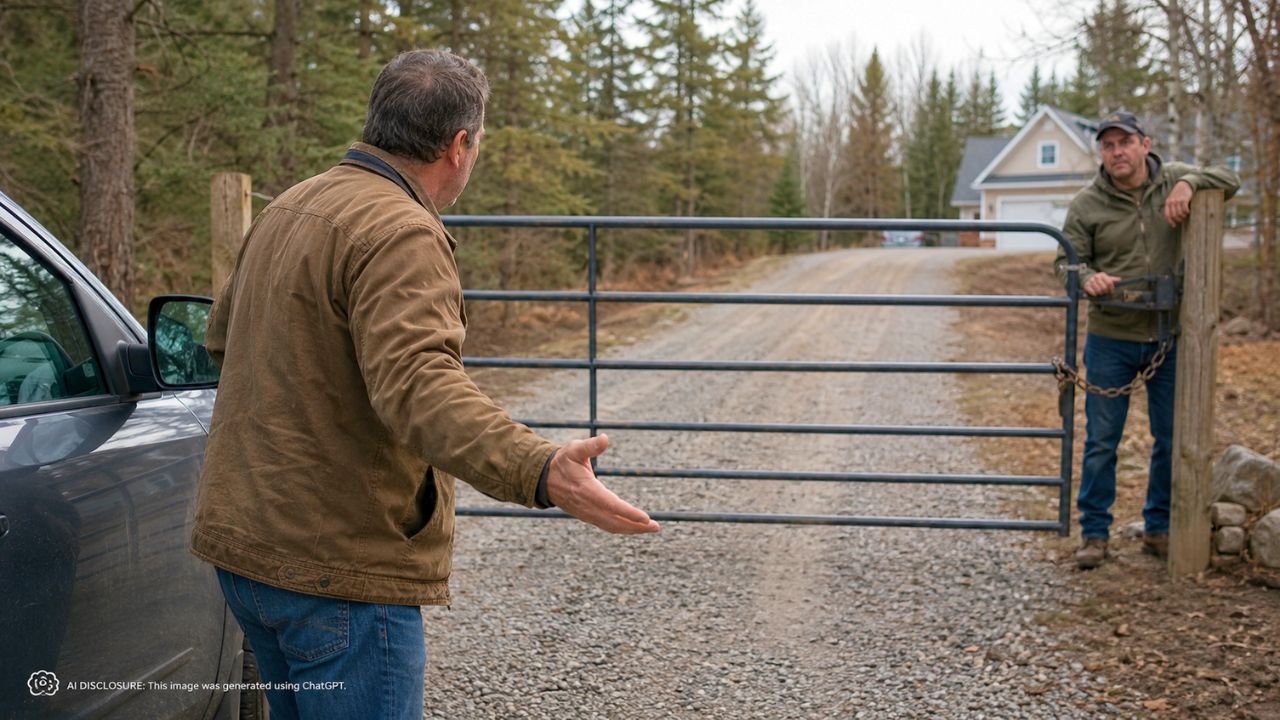
Photo credit: AI-generated image created using ChatGPT. Illustrative only.
Living on a private road can feel like the best of both worlds—quiet, tucked away, and mostly free from traffic that doesn’t belong there. But it also means the driveway is the lifeline, and when someone else controls the chokepoints, “easy access” can turn into a standoff fast.
That’s the corner one North Carolina homeowner found themselves in, as described in the original post. Their lot sits on the edge of a private subdivision, and a new neighbor outside the subdivision—landlocked except for a right-of-way through the private road—built a multi-million dollar home. During construction, a temporary gate went up. The gate didn’t just manage traffic. It reached about 20 feet past where it should have, cutting off access to the lower part of the homeowner’s property.
The first sign was a “temporary” gate that didn’t feel temporary
The homeowner’s description is the kind of detail that makes other property owners’ stomachs drop: a chain gate installed during construction, set in a place that “really doesn’t bother” them in principle—except for the part where it blocks them from getting to their own land.
This wasn’t a gate slapped across a random country lane. It was built on the access route that the landlocked neighbor relies on to reach their property. That right-of-way matters, and in rural or semi-rural setups, it often becomes the one strip of ground everyone is forced to share.
The homeowner noticed the alignment problem early and brought it up at the time the temporary gate was installed. According to their account, the gate was positioned about 20 feet over the end of the neighbor’s property line “into our subdivision,” which effectively pinched off access to a portion of their lot.
Twenty feet doesn’t sound like much—until it’s yours
In a normal yard, 20 feet might be the distance between a patio and a firepit. On boundary edges and access corridors, 20 feet can be everything. It can be the difference between dragging a hose down to a lower section, driving a mower or compact tractor in, getting a truck back to clear storm debris, or reaching a spot you need to check after heavy rain.
The homeowner wasn’t just worried about inconvenience. They were thinking like someone who has lived on a private road long enough to know how quickly “handshake arrangements” can turn into permanent headaches. Their goal wasn’t a neighbor blow-up; it was to “assure that I have continued access to my property and that access is passed to the next owner of my property.”
That last part is the pressure point. Once something like a gate sits in place long enough, people start treating it like it belongs there. Future owners may assume the blocked area was never part of the deal, or they may not have the energy to fight a battle that should have been prevented in the first place.
The tension jumped when the permanent gate showed up
Temporary gates are easy to excuse. Construction zones are messy; crews come and go; people want security. But the story escalated when the homeowner learned a permanent gate was going up in the same spot.
That’s when “we’ll fix it later” becomes “this is the new normal.” And for anyone who’s dealt with property lines, it’s not hard to see how it could spiral: a permanent structure goes in, contractors finish, landscaping and hardscaping follow, and suddenly moving anything feels like “tearing up improvements.”
The homeowner also flagged an additional layer that often complicates private-road disputes: the HOA. They weren’t sure what the HOA “might say about it,” which is a polite way of acknowledging that even if two neighbors are personally reasonable, the subdivision rules and road agreements might not be optional.
In neighborhoods like this, access isn’t just personal preference. It’s tied into recorded easements, plats, and private-road maintenance arrangements. If the gate is partly inside the subdivision, it’s not just a neighbor decision anymore—it can become a community problem.
Instead of a screaming match, it turned into a paperwork problem
One thing that kept this from instantly becoming an all-out feud: the homeowner communicated early, and they didn’t just vent. They notified the neighbor’s “boyfriend/manager” who was handling logistics, and the two sides talked about figuring out the “legal means” needed to protect access going forward.
That’s a very particular kind of rural/subdivision diplomacy. It’s not all warm and fuzzy, but it’s also not the scorched-earth approach. The homeowner wasn’t demanding the gate never exist; they were asking for the basics: don’t block my property, and put it in writing so this doesn’t reset with every sale.
That phrase—“passed to the next owner”—is what separates a mild annoyance from a property value issue. If a buyer hears, “Oh, yeah, technically you can’t reach the lower part because the neighbor’s gate is over the line,” you can imagine how quickly that turns into either a price cut or a deal breaker.
Commenters pushed for proof, not promises
The homeowner later posted an update thanking people for “excellent advice,” and while the specific comments weren’t included in the material, the outcome hints at what the crowd likely emphasized: documentation and leverage.
In access disputes, especially when gates and easements are involved, people tend to push the same fundamentals—get the boundary confirmed, get the easement language in front of you, and don’t rely on a friendly verbal agreement when a permanent structure is going in. Even the homeowner’s update suggests that simply mentioning a lawyer changed the tone of the conversation.
That’s not because everyone is eager to sue. It’s because permanent gates, right-of-way corridors, and private roads can turn into expensive problems later if they’re not corrected while the work is still fresh and movable.
The simplest fix was also the best one: move the gate
The story ends in the rare place these driveway disputes don’t always reach: a practical solution everyone can live with. In the homeowner’s update, they said they spoke with the owner’s manager and agreed that moving the gate was “the easiest, fastest, best long-term solution.”
That kind of resolution matters because it protects both sides. The landlocked neighbor still gets the secure access they want. The homeowner gets their reach to the lower section of their land back. And the subdivision avoids having a structure sitting where it doesn’t belong, inviting future arguments about who authorized what.
There’s also a quiet lesson in the timing. The homeowner didn’t wait until the permanent installation was finished and “set.” They raised it when the gate was temporary, raised it again when it was about to become permanent, and treated it like a real property issue—not a petty complaint.
On private roads, access is everything. Sometimes the difference between years of resentment and a clean fix is simply catching the problem early enough that the solution is still as straightforward as sliding a gate 20 feet back to where it should have been all along.
Like Fix It Homestead’s content? Be sure to follow us.