Rural Homeowner Reports a Rotting Dead Goat Left Outside a Neighbor’s Pasture on Her Land — Then He Ignores Every Reminder to Remove It
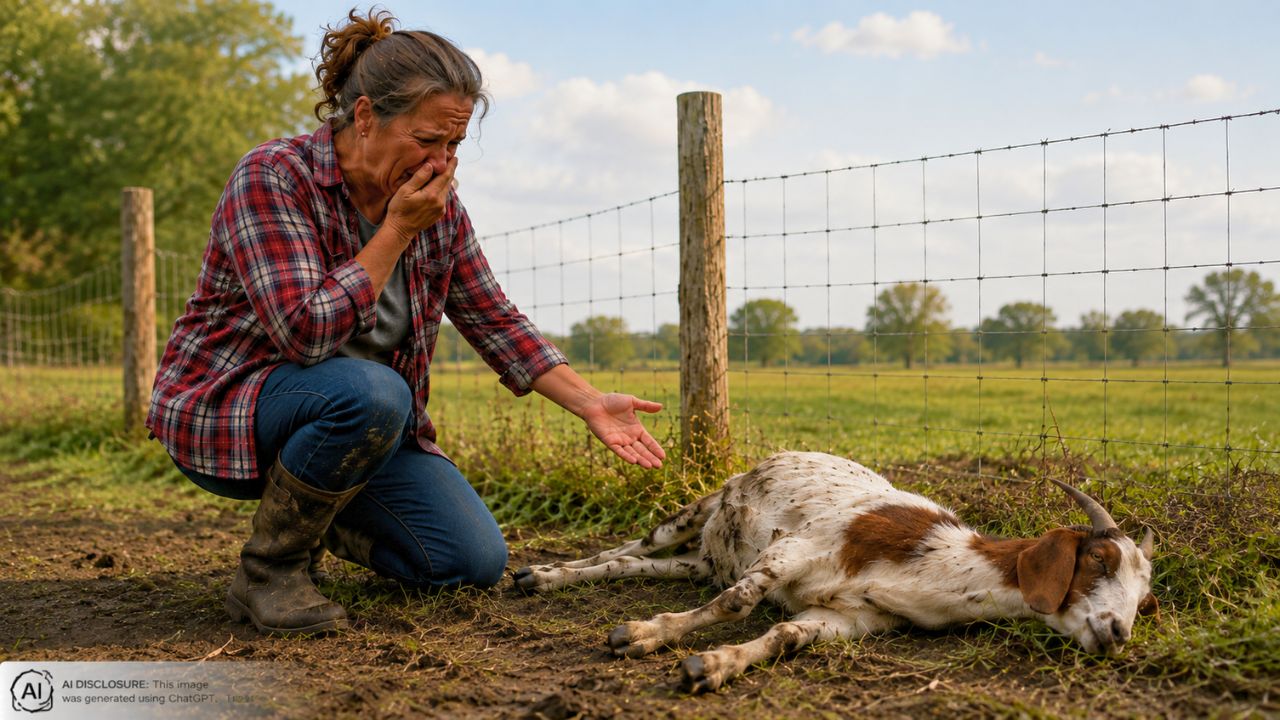
Photo credit: AI-generated image created using ChatGPT. Illustrative only.
Out in the country, you learn pretty quickly that “outside” problems don’t stay outside for long. One rural homeowner says that after two days of heat and time, a dead goat has turned from an unpleasant sight into a rotting, fly-attracting headache—because it was left on her land right next to the neighbor’s goat pasture.
In the original post, she explains that something attacked the goat and ate part of it. She notified the neighbor and followed up with reminders, but he still hasn’t removed the carcass. With ongoing property disputes involving her grandpa, she suspects the inaction may not be accidental.
A pasture line problem turns into a health-and-pest problem
The goat didn’t die neatly behind a fence where it could be handled quickly. According to the homeowner, it’s “right outside of his goat pasture,” and the twist is that this spot is on her property.
That little detail changes everything. If the carcass were fully inside the neighbor’s pasture, it would still be gross, but it wouldn’t be an immediate land-management problem for her. Instead, she’s stuck staring at it, smelling it, and worrying about what it could bring onto her side—flies, scavengers, and whatever else shows up when there’s a free meal.
Rural living comes with dead animals sometimes. What people don’t expect is having to beg someone to clean up their livestock remains from your own land.
“I told him about it”… and nothing happened
The homeowner says she did the normal, neighborly thing first: she notified the owner. Then she reminded him. Then she reminded him again.
And still, the carcass stayed put. The part that reads like a slow-burn feud is her sense that the neighbor doesn’t care to fix it—possibly because of “various property disputes” with her grandpa. When there’s already tension over lines, easements, and who’s allowed to do what near a fence, even a basic cleanup can start to feel like a power move.
Two days doesn’t sound like much until you picture what “two days” means for an animal body outdoors. The smell ramps up. Insects arrive. Scavengers test the edges of the yard. Then it becomes the kind of thing you can’t un-notice every time you step outside.
Why a dead animal on your land is more than just gross
The homeowner’s frustration isn’t only about the visual. A carcass left in the open can create practical problems fast—especially if it’s been partially eaten, as she described. Predators and scavengers that already found it once may come back. If you have pets, kids, or other livestock nearby, that’s an added layer of worry.
Even if the goat is “his responsibility,” it’s her property taking the hit. Odor doesn’t respect property lines. Neither do flies. And when a neighbor refuses to act, the person living closest to the problem ends up paying for it in the most annoying currency: daily quality of life.
There’s also a documentation angle lurking in the background. If this spot is truly on her land, leaving livestock remains there becomes another breadcrumb in an ongoing boundary dispute—one more way the neighbor can test what he can get away with.
The standoff: refusing to touch it, but needing it gone
The homeowner is clear about one boundary: she doesn’t want to handle it herself. Not because she can’t, but because she believes it’s the neighbor’s obligation. And once you pick up a job that isn’t yours, it has a way of becoming yours forever.
This is the part that homeowners in rural disputes recognize immediately. You can be completely capable of solving the immediate issue, but the long-term cost is what it “teaches” the other person. If you clean it up once, the next time there’s a mess on the shared edge, you’re the default cleanup crew again.
On top of that, there’s the obvious unpleasantness. A rotting carcass isn’t yard waste. It’s a biohazard-adjacent problem, especially when it’s already been attacked and partially eaten. Handling it means exposure, tools, disposal, and a plan for what happens if the neighbor later claims you tampered with evidence of an attack or moved his livestock remains without permission.
When neighbors stop cooperating, people start looking for leverage
The homeowner’s question gets right to the point: if the owner won’t remove it, can she call animal control on him?
That’s usually the moment a rural dispute changes gears. Friendly reminders become written records. Conversations become texts. Photos get taken. People start thinking about which authority actually has jurisdiction—animal control, code enforcement, a county health department, or whoever deals with livestock disposal rules where they live.
And because the carcass is on her land, the leverage isn’t just “your animal died.” It’s “your animal is decomposing on my property.” That’s a different kind of pressure, especially if the neighbor has other animals and doesn’t want official attention on his management practices.
Even without naming agencies or laws, the homeowner’s instincts are familiar: when someone ignores direct communication, the next move is often to document and escalate through whatever local channel exists.
What people pushed back on: proof, boundaries, and not escalating the wrong way
The post itself doesn’t include a full comment thread, but the shape of the problem points to the same practical priorities people bring up in these disputes: establish the property line, keep records, and be careful about taking an action that turns into an admission.
In a fence-line conflict, “on my land” is the key phrase—and also the one most likely to be challenged. That’s why homeowners in ongoing disputes tend to lean on simple, boring proof: photos with timestamps, notes of when the neighbor was notified, and any documents showing where the pasture sits relative to the boundary.
There’s also the strategic question of escalation. If the neighbor is ignoring reminders out of spite, a direct confrontation might not improve anything. But a documented complaint about an animal carcass left to rot can force a response without another face-to-face blowup.
And that’s the real tension here: the homeowner wants the goat gone, but she also wants to avoid doing anything that makes the bigger property dispute worse.
The rural version of “take out the trash” shouldn’t require a standoff with a neighbor. But when boundary disputes are already simmering, even a dead goat can become a test of who controls the edge of the property. For now, the carcass is still there, and the homeowner is left balancing two unpleasant options: remove it herself and risk setting a precedent, or push the issue into official channels and risk escalating a feud that’s already been brewing.
Like Fix It Homestead’s content? Be sure to follow us.