Property Owner Finds a Neighbor’s Dock Sitting Twenty-Five Feet Across the Line — Then He Picks the Water Right in Front of the House Anyway
Photo credit: AI-generated image created using ChatGPT. Illustrative only.
On the water, property lines can feel imaginary—right up until something solid shows up where it doesn’t belong. One homeowner in HRM, Nova Scotia, says that’s exactly what happened when a neighbor’s dock ended up sitting well past the boundary, pushing into the water frontage the homeowner considers theirs.
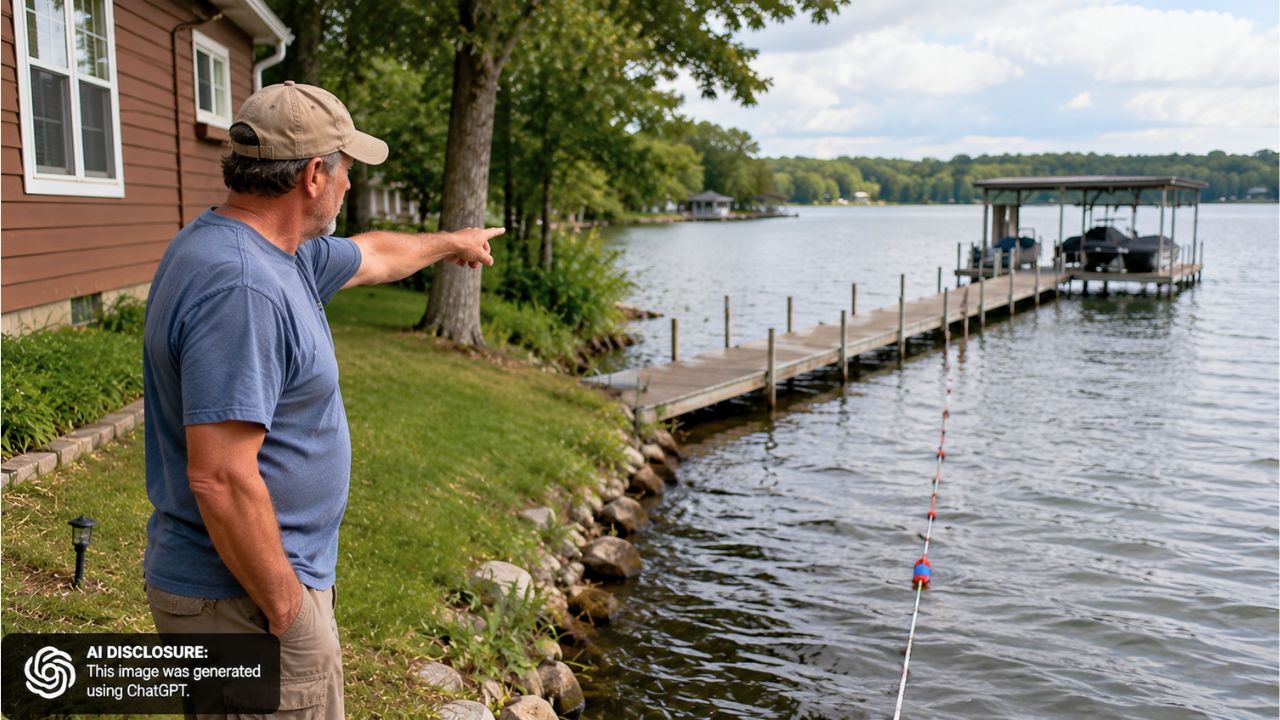
In the original post, the homeowner explains they paid for a survey and it showed the neighbor’s dock extends 25 feet across the property line. The detail that makes it sting: the neighbor has roughly 100 feet of shoreline available for a dock, but still chose the stretch of water in front of someone else’s house.
The dock wasn’t “kind of close” — it was 25 feet over
This wasn’t a case of two neighbors squinting at an old fence post and arguing over inches. The homeowner says they got a survey, and the survey put numbers to the problem: the dock, as placed, reaches 25 feet across their boundary line.
For waterfront owners, that number lands differently than it would on land. Twenty-five feet can mean the view you paid for. The spot you launch from. The place you keep kids swimming because you can see them from the kitchen window. A dock isn’t just a structure—it’s access, convenience, and a claim of “this is mine” every time someone walks down it.
And because the homeowner assumes the property line continues out into the water, the dock doesn’t just touch the edge of the issue. It extends the disagreement into the most valuable part of the property: the usable shoreline and water access itself.
What made it personal: he had plenty of shoreline
The homeowner’s frustration isn’t only about measurements. It’s about choice. They say the neighbor has approximately 100 feet of shoreline where he could place a dock—but decided he likes the water in front of their house.
That detail is the kind that escalates neighbor tension fast. If the neighbor had limited frontage or some obvious obstruction, people might assume it was a bad compromise or an honest mistake. But “he had space and picked mine anyway” reads as intentional, even if the neighbor would argue otherwise.
On the ground (and in the water), that intent matters because it changes how every future interaction feels. A misplaced dock can be fixed. A neighbor who acts entitled to your shoreline is a long-term problem.
The homeowner tried to keep the peace—temporarily
Instead of demanding an immediate removal, the homeowner says they told the neighbor it was okay to leave the dock there for the remainder of the year. But they made the boundary clear: they did not want it there the next year.
That’s a very homeowner move. People who have to live beside each other tend to look for off-ramps—solutions that avoid turning a summer into a cold war. Let it ride for a season, avoid a blow-up, deal with it when the weather changes.
But there’s a catch with being flexible: it can be misread as permission. The homeowner clearly intended it as a temporary accommodation. The worry underneath the question is obvious—if the neighbor pushes the dock across the line again next year, does this year’s “okay” weaken their position?
The next season is where these fights usually get ugly
The homeowner’s key question is simple: “Am I within my rights to request that?” The second question is more revealing: “What should be my next course of action if he extends across the boundary again?”
Because that’s the moment these disputes turn from awkward chats into expenses. If the dock goes back in the wrong place next year, it’s no longer a misunderstanding. It’s a repeated choice. And repeated choices are where people start documenting, sending letters, calling offices, and hiring professionals.
On waterfront properties, the practical stakes pile up quickly. A dock can affect how you use your own shoreline, where boats approach, and how safe it feels to have people coming and going near your yard. Even if the structure itself doesn’t damage anything, the access it creates can change day-to-day life—more foot traffic, more noise, and the uncomfortable feeling of someone else “owning” the view.
The homeowner also flags that they’re in HRM, Nova Scotia, Canada, which matters because shoreline rules can be local and specific. But whatever the jurisdiction, a survey is usually the first serious step—because at some point someone will ask, “Where’s your proof?” and the homeowner already has it.
Most people focused on the same idea: proof before emotions
Even with only the homeowner’s description available, the pattern of advice in property-line disputes is predictable: keep it factual, keep it written, and don’t rely on a handshake when the structure in question is a big, expensive piece of waterfront hardware.
When someone has a survey showing a 25-foot encroachment, the natural next steps most homeowners think about are not dramatic—they’re procedural. Make sure the survey is clear and current. Communicate the boundary in a way that can’t be “forgotten” by next spring. If a temporary allowance was given, make sure it’s equally clear that it expires.
Because once the dock is placed again, the conversation changes from “Can you move it?” to “Why did you do it again after I told you not to?” That’s when neighbors start taking photos, keeping notes on dates, and saving messages. Not because they want a fight, but because the only thing worse than an encroachment is an encroachment you can’t prove.
Living next door after this is the real cost
The homeowner is stuck in the part of the story that never makes it into glossy lake-life listings: you can pay for the view, but you can’t control the neighbor. They’ve already tried to be reasonable by allowing the dock to remain for the rest of the year, yet they’re still left wondering what happens when the neighbor decides to do it again.
Waterfront disagreements don’t stay on paper. They show up every weekend, every time family visits, every time you look out the window and see a structure that signals someone else’s priorities are now parked in your line of sight.
For now, the dock is the physical problem. The bigger one is the precedent. Next year’s placement will tell the homeowner whether they’re dealing with a one-time overstep—or a neighbor who plans to keep choosing the water in front of someone else’s house.
Like Fix It Homestead’s content? Be sure to follow us.