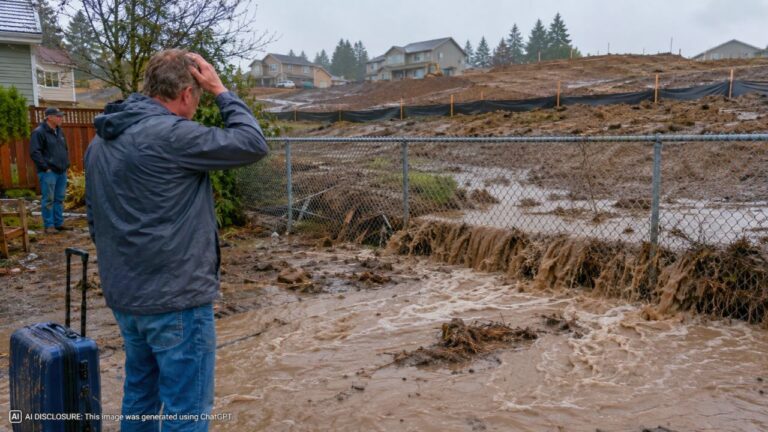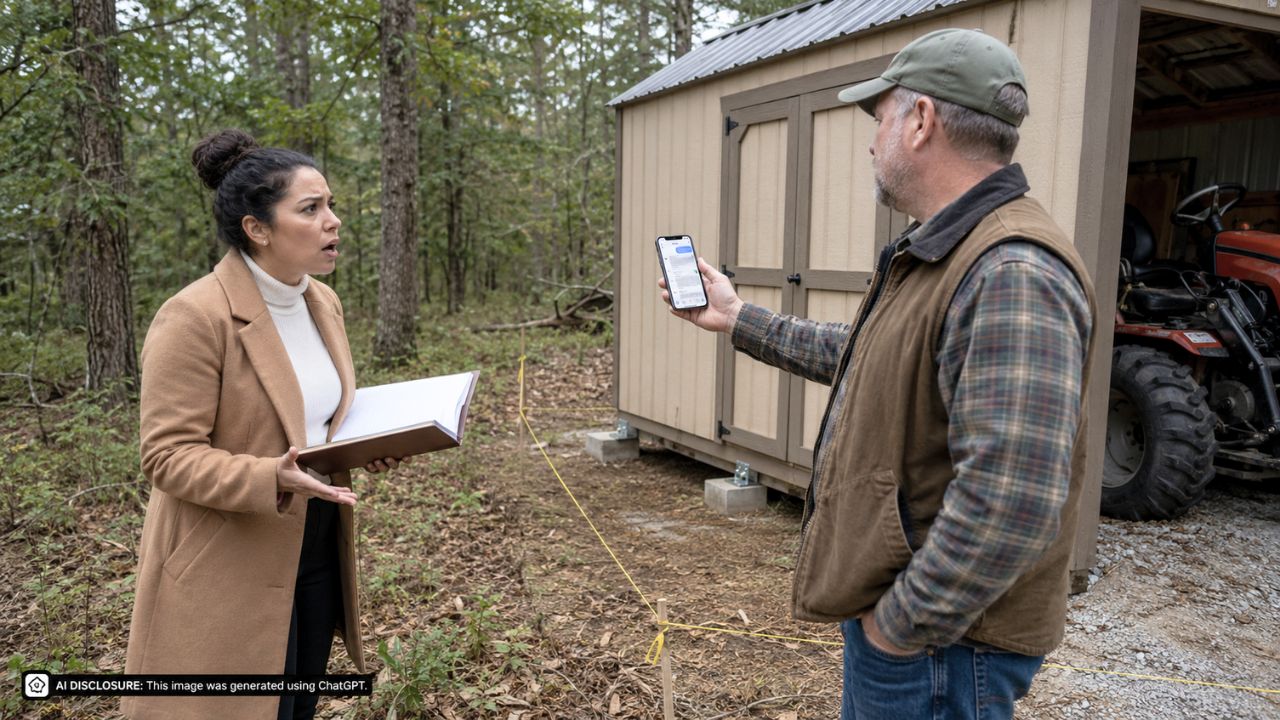
Buyer Closes on a Rural Wooded Lot and Finds a Neighbor’s Equipment Storage Shed Anchored to a Corner of the Property — Then the Neighbor Says the Previous Owner Gave Verbal Permission and Claims to Have Text Messages Proving It
Photo credit: AI-generated image created using ChatGPT. Illustrative only.
You don’t really “meet” your rural neighbors until you own the dirt. For one Ohio landowner, the welcome-to-the-neighborhood moment didn’t come with a pie or a wave from the driveway. It came with a structure going up right where the new owner thought they still had space—right up against the line, brushing past what they believed was an easement, and leaving a once-simple boundary feeling suddenly negotiable.
The owner laid out the problem in the source post: they live in Ohio, their neighbor started building right up to the property line, and it wasn’t just a “close enough” kind of build. The neighbor also removed a fence and verbally promised to restore it—then didn’t. County authorities were contacted, but nothing had happened yet, and the owner wanted to know how to protect their property rights before the build became permanent.
The first sign was the fence going missing
In the country, a fence isn’t just decoration. It’s a habit line. It’s where you mow to, where you spray to, where you stop when you’re dragging brush. It’s also the one physical thing that keeps “I thought that was mine” from turning into a month-long argument.
Here, the neighbor removed a fence and offered a verbal promise to put it back. That kind of handshake agreement is common in rural life—until it isn’t. Once the fence is down, the boundary becomes a guess, and the guess becomes leverage when someone decides to build.
Then the building started—and the easement didn’t seem to matter
The post describes the neighbor building right up to the property line and not respecting the easement. That’s the part that tends to spike a landowner’s blood pressure, because easements aren’t vibes—they’re supposed to be the “this strip stays clear for access/utility/drainage” rule everyone can point to when things get tense.
Even if you’re not using that easement every day, it’s there for a reason. A structure placed too close can limit access, complicate maintenance, and create future disputes that are much harder to unwind after concrete is poured and materials are sunk into the ground.
And once construction begins, every day feels like the clock is ticking. A boundary issue that might have been settled with a conversation starts to look like a “this will be here forever” problem.
The neighbor’s “verbal permission” claim is where things get sticky
The owner’s frustration wasn’t just about proximity. It was the sense that the neighbor was acting like the rules didn’t apply—building tight to the line, ignoring the easement, and failing to restore what they removed. This is also where these disputes often take a turn: the neighbor frames it as already-approved, already-agreed, already settled.
The source post itself focuses on the current owner’s experience—verbal promises, no follow-through, no action from the county—rather than a detailed back-and-forth from the neighbor. But the dynamic is familiar to anyone who’s dealt with rural property edges: someone points to a past conversation, a casual okay, a “the last guy didn’t care,” and suddenly the new owner is painted as the problem for wanting the line honored.
That’s the trap. A verbal agreement is easy to claim and hard to prove. And if the structure is allowed to stay, the longer it sits there, the harder it can be to fix without escalating into a real, expensive fight.
Calling the county didn’t produce the clean fix people expect
The owner said they had already contacted county authorities, but there had been no action. That’s another part that surprises first-time land buyers: you picture someone official showing up with a clipboard, pointing at a map, and halting the work.
But in many places, property-line fights aren’t something the county jumps into quickly, especially if it’s not a clear code violation that they’re obligated to enforce. If it’s framed as “civil,” it can sit. Meanwhile, the build continues, materials stack up, and the absence of quick enforcement starts to feel like permission.
That delay has consequences. The longer a neighbor builds with no interruption, the more confident they get—and the more awkward it becomes to step in later and demand changes.
Most reactions in these disputes revolve around proof, not volume
Even without a comment thread included in the source material, this kind of boundary-and-easement drama tends to bring out the same practical chorus from other homeowners: get documentation, don’t rely on memory, and don’t assume a “reasonable neighbor” approach will keep things reasonable once money and pride are involved.
When a fence is removed and a new structure is being placed right up against a line, the usual gut reaction is to argue from the hip—“You can’t do that.” But the stronger move is boring: paperwork, dates, measurements, and written notices. In real life, the person who can calmly show what the easement says and when the fence was removed often has a better chance of getting traction than the person who can deliver the best speech in the driveway.
People also tend to urge homeowners to stop leaning on verbal promises once a boundary has been tested. A verbal “I’ll fix it” is easy to offer and easy to delay. A written request with clear expectations changes the tone, even before any attorney gets involved.
The real fear: if you let it stand, you may be living with it forever
What makes this kind of problem so stressful is that it doesn’t stay theoretical. A structure close to a line affects future fencing, future access, and sometimes future resale. It can change how you move equipment through the property. It can complicate mowing and maintenance. It can become a daily reminder that the corner of your land is only yours on paper.
And there’s the emotional piece that homeowners don’t always say out loud: you don’t want to start a long-term feud with the people who live closest to you, especially in a rural setting where you might rely on neighbors for everything from keeping an eye out to pulling you out of a ditch. But you also don’t want to be the person who “let it go” and then pays for that decision for the next decade.
In the Ohio owner’s case, the question wasn’t whether the build was annoying. It was how to make sure their rights were protected when the neighbor had already crossed one line—removing a fence—and seemed comfortable pushing the next one by building tight to the boundary and brushing aside the easement. When the county doesn’t act quickly, the pressure shifts back onto the property owner to decide how far they’re willing to go to stop the momentum.
That’s the hard part of buying land: the deed is clean, the trees are quiet, and the closing documents feel final. Then a neighbor’s project reminds you that boundaries don’t enforce themselves.