Rural Property Owner Pays for a Fresh Survey With Marked Posts — Then Aggressive Neighbors Move Them and Police Call It a Civil Matter
Photo credit: AI-generated image created using ChatGPT. Illustrative only.
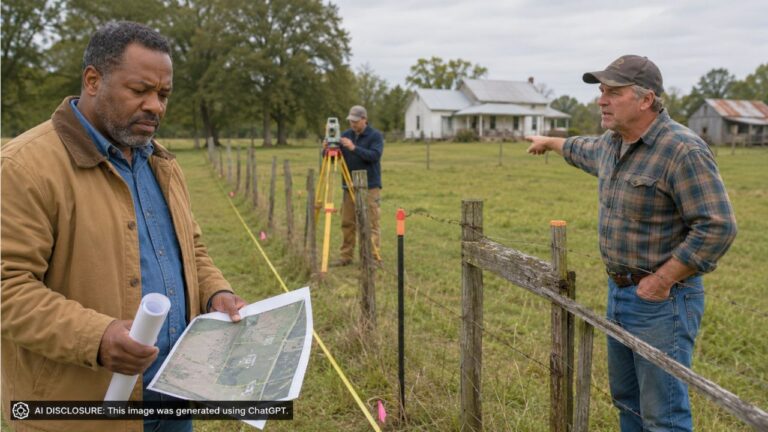
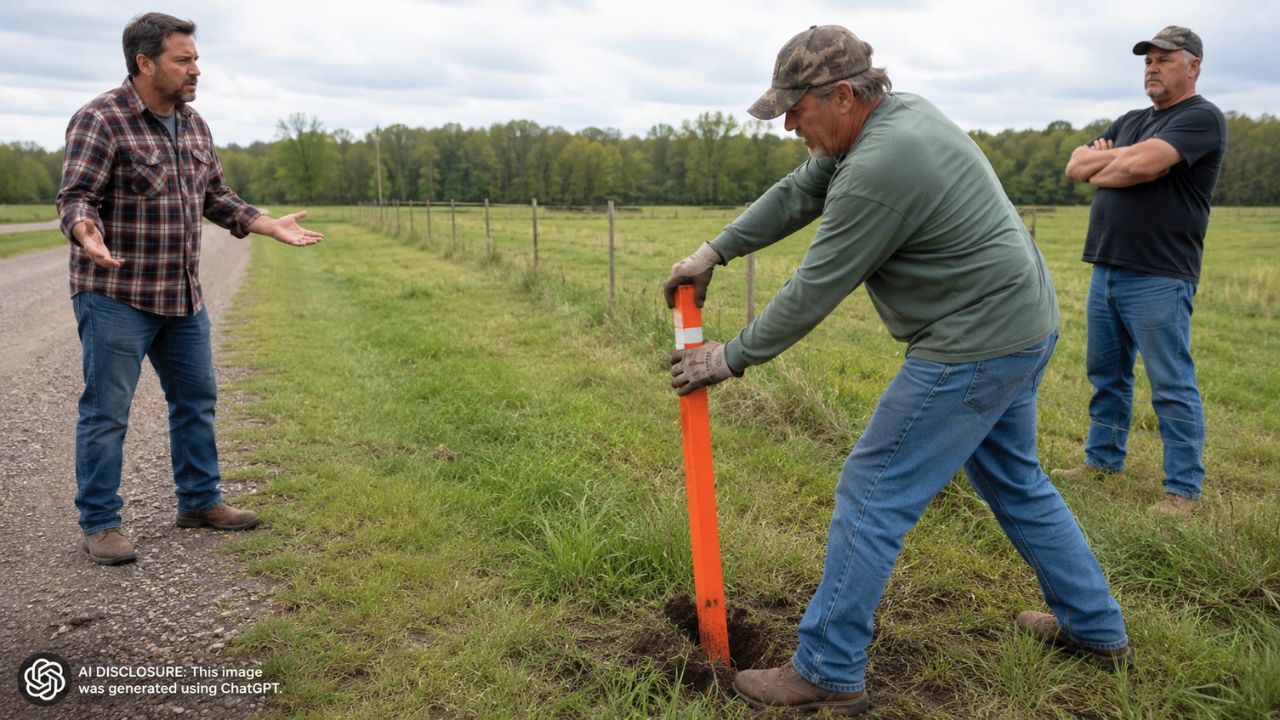
It started the way a lot of rural boundary fights start: somebody finally paid real money to stop guessing. A property owner said they hired a surveyor, got fresh corner posts placed, and thought that would settle things. Then the neighbors allegedly yanked a marked post and shifted it over.
When the owner called for help, they got the response that makes people feel helpless fast: police reportedly called it a civil matter. The owner’s short plea for “Any ideas here?” set off a flood of hard-nosed advice and grim realism in the discussion, because moving survey markers isn’t just petty—it can derail fences, driveways, tree work, and every improvement that depends on knowing where your land actually starts and ends.
You pay for certainty, and someone turns it back into chaos
A new survey with posts isn’t cheap, and it’s not something most homeowners do for fun. People order one when there’s already tension—when an old fence line is questionable, when a neighbor starts mowing “a little farther,” or when a build project is coming and nobody wants a boundary argument after concrete is poured.
That’s why the alleged tampering hits so hard. The whole point of paying for professional stakes or posts is to stop the arguing and have something objective on the ground. If someone can walk over, pull a marker, and shove it somewhere else, it’s like they’re trying to rewrite your paperwork with their hands.
And the homeowner wasn’t describing a missing flag that might’ve gotten knocked loose by a mower. They said the neighbors removed the post and moved it over. That’s not accidental. That’s a message.
Then comes the gut punch: “civil matter”
The homeowner said police told them it was civil. Anyone who’s dealt with property-line drama recognizes the tone of that: it’s a dispute between neighbors, and law enforcement doesn’t want to referee it. Even when there’s alleged tampering, you can get stuck in the gap between “that feels like a crime” and “prove it beyond a reasonable doubt.”
This is where rural living can feel especially isolating. You might have acres and quiet nights, but you also might have longer response times, fewer local resources, and the reality that you’ll run into the same people at the feed store and the gas station. That pressure makes people hesitate, and aggressive neighbors sometimes count on that.
The homeowner didn’t mention what they planned to build or protect—fence line, gate, driveway access—but once a boundary marker becomes a tug-of-war toy, every future project becomes riskier. Contractors don’t want to build next to a boundary fight, and if they do, the price tends to climb because nobody wants to get dragged into it.
Commenters pointed to laws that treat survey markers as a big deal
One detailed response focused on Washington state as an example of how serious this can be on paper. They cited RCW 4.24.630 as a civil remedy that can allow treble damages, attorney’s fees, and injunctive relief when someone damages or removes things on your property. They also cited RCW 58.04.015, describing intentionally disturbing a survey monument as a gross misdemeanor—potentially carrying jail time, fines, and liability for the cost of reestablishing the monument.
That reply captured the emotional whiplash homeowners feel in these fights: the law may say markers matter, but getting anyone to enforce it can feel like pushing a boulder uphill. Still, it mattered to commenters that the homeowner understand this isn’t always “just neighbor drama.” In some places, it’s explicitly addressed in statutes.
Of course, laws vary widely by state. But the underlying point traveled well: survey stakes and monuments aren’t supposed to be negotiable, and moving them can create real damages—especially if it leads to a fence being placed wrong, trees being cut, or a driveway being built in the wrong spot.
The thing everyone kept coming back to: proof
A second homeowner weighed in with a familiar caution: none of the legal muscle matters if you can’t prove who touched the stakes. They described their own experience in Washington: a neighbor moved survey stakes, they talked to local police and an attorney, and they were told video evidence would be needed to go further.
What made their story sting was how it played out. Once they installed a camera, the tampering stopped. That’s not a win that feels good—it’s a win that tells you exactly what was happening before. But it’s also a practical reality check: if a person is bold enough to move a stake, they may also be bold enough to deny it when a uniform shows up.
Another commenter asked the obvious question: wouldn’t the surveyor know where the stakes should be and be able to testify? The response was blunt. The person with the camera experience said even an admission wasn’t enough in their case to get meaningful action. Their neighbor removed “no trespassing” signs near the survey stake, and even though the neighbor later brought the signs back and talked about it—captured by a door camera—the police still didn’t want to proceed beyond taking a statement. They said the officer told them they “need a video,” because someone can always backtrack and claim they didn’t do it.
That kind of story changes how you think about the next step. It’s not just “call the police.” It becomes: document everything, assume denial, and plan for this to be slow.
Why moving a post can snowball into a much bigger property problem
On a homestead or rural parcel, a boundary marker isn’t an abstract line. It can be the difference between a fence that keeps livestock where they belong and a fence that starts a war. It can affect where you put a gate, whether a driveway stays on your land, and whether you can confidently clear brush without someone claiming you trespassed.
It also creates a trap: if you react emotionally—march over, yank it back, get into a shouting match—you can end up with a “he said, she said” that makes it even harder to sort out later. If you don’t react, you risk letting the shifted marker become the “new normal” in the neighbor’s mind, and maybe in the mind of anyone watching.
That’s why commenters zeroed in on cameras and documentation. Not because people love surveillance, but because boundary disputes have a way of turning basic home maintenance into legal chess. The person trying to stay honest ends up needing receipts, photos, recordings, and professionals, while the person willing to move posts gets to gamble on the other side getting tired.
The homeowner who posted sounded exhausted, and it’s easy to see why. They tried to buy certainty, and instead they got a new task: proving reality.
In the end, the tension in this story isn’t just about a shifted post in the dirt. It’s about what happens when the thing that should settle an argument becomes the next target. When that happens, rural peace can turn into a paperwork-and-camera lifestyle overnight—and the cost isn’t only financial. It’s the constant feeling that your own land can be challenged the moment you turn your back.
Like Fix It Homestead’s content? Be sure to follow us.