Homeowner Returns From a Work Trip to Find Nine Mature Trees Gone From Her Yard — Then a Jury Awards Maryland’s Largest Tree-Cutting Verdict at $933,000
Photo credit: AI-generated image created using ChatGPT. Illustrative only.
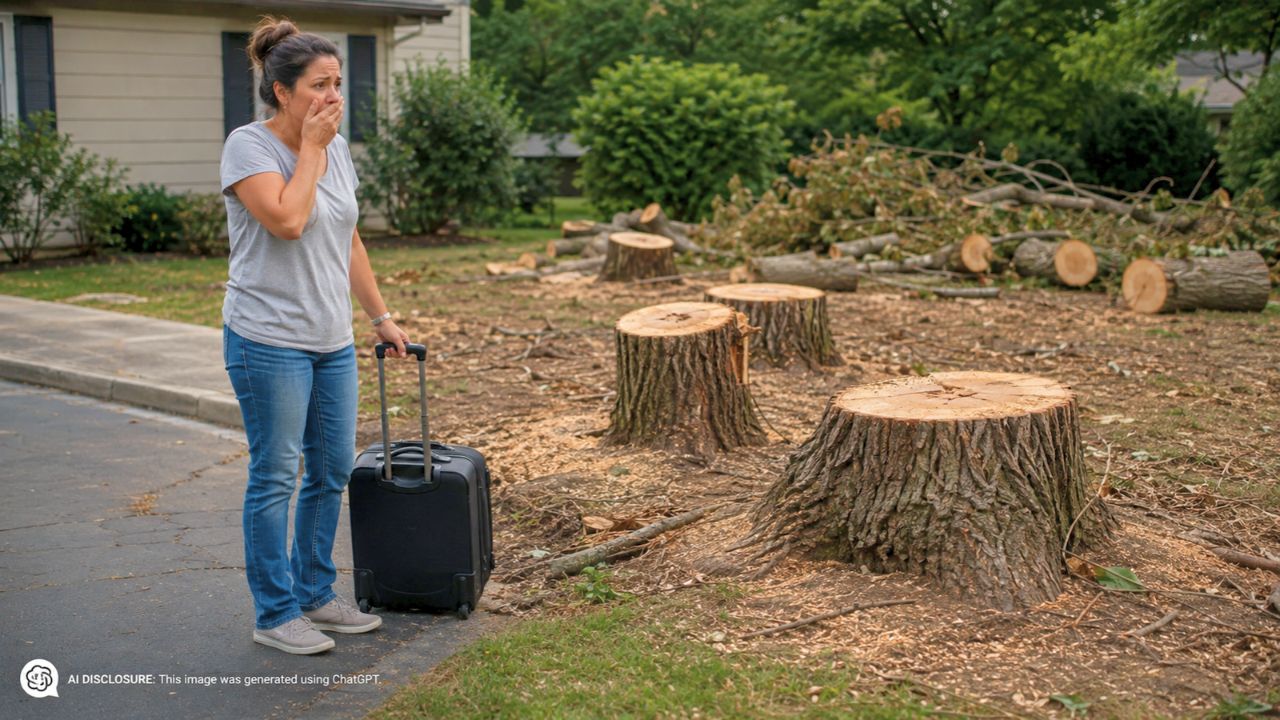
She was gone for a few days on a work trip, the kind where you come home expecting nothing more dramatic than a full mailbox and a fridge that needs restocking. Instead, she pulled into her Bowie driveway and saw it: the yard looked wrong. Not “a branch fell” wrong. More like someone hit fast-forward on a decade of storms and saws.
By the time she realized what had happened, nine large trees that had been standing on her property were already gone. And what followed turned into a record-setting courtroom fight in Prince George’s County, detailed in the original post: a jury verdict of $933,000 against Unlimbited Tree Service for trespass and negligence.
She left town, and a note became “permission”
The timeline is the part that will make most homeowners go cold. In February 2024, the homeowner traveled to San Diego for work for a few days. While she was away, her neighbor hired Unlimbited Tree Service to do work on his property.
According to the account in court, the neighbor left a note in her mailbox saying he intended to cut the trees down. That was it. No phone call. No knocking on the door. No email. No written agreement from the property owner. She didn’t even see the note until she got back—when the trees were already cut.
If you’ve ever had a neighbor “float” an idea like trimming limbs or clearing brush near a property line, you know how fast it can turn from casual to irreversible. Here, the irreversible part was measured in trunks, not twigs.
Nine mature trees don’t disappear quietly
This wasn’t a case of a couple of skinny volunteers getting cleared out. Many of the trees were mature, measuring over 30 inches in diameter. That’s not weekend-yardwork size. That’s equipment, crew, and a lot of heavy cutting.
The homeowner’s attorney, Matt Skipper, said the restoration cost was so high because the goal wasn’t to “green it back up” with saplings. It was to restore the property to what it was—meaning mature trees. He put the cost at nearly $90,000 per tree.
Even if you don’t care about the aesthetics (most people do), mature trees are infrastructure in their own way. They shade roofs and bedrooms, reduce wind, manage water, dampen road noise, and create privacy. Lose them all at once and a yard can feel exposed overnight.
The case turned on what the tree company didn’t do
The jury found Unlimbited Tree Service liable for trespass and negligence. That’s a big deal for homeowners because it frames the cutting as more than a neighbor dispute. It put legal responsibility on the contractor who showed up with saws.
Skipper’s reaction in a cease-and-desist letter was blunt: “It boggles my mind that a licensed company would take such action without ever speaking with or receiving written permission from the property owner.” He called the conduct “outrageous,” and said “any basic due diligence would have led Unlimbited to the conclusion that it needed to obtain my client’s consent.”
On the other side, the company owner, Chuck Preslipsky, said they believed the trees belonged to the neighbor who hired them and that both neighbors wanted them removed. He also said tree companies don’t usually check property lines. “I’m going to trust that (the client) is being honest with me,” he said.
That “we trusted the customer” defense might sound familiar to anyone who has watched contractors, fence installers, or grading crews follow a homeowner’s pointed finger right across a boundary. It’s easy—until it isn’t.
How $933,000 happened (and why the number changed)
The jury’s total verdict came to $933,000. The breakdown matters: $783,000 was awarded to restore the property to its original condition, plus $150,000 in noneconomic damages. Skipper said the defense “could not run from the pictures and the video showing the devastation.”
But there’s another layer. The homeowner sued both Unlimbited and the neighbor in January 2025. Shortly before trial, the neighbor settled and exited the lawsuit, with an insurance company paying $500,000, Skipper said.
Unlimbited then moved to reduce the verdict by that amount—to $433,000—and the homeowner consented. Skipper explained that because the tort was committed by two parties (the neighbor and the company), the jury had to decide the total damages suffered, not slice up the harm by defendant.
Preslipsky said the verdict was “extremely unreasonable” and that he intends to appeal. “It’s an unfortunate situation… It sucks for her, it sucks for (her neighbor), it sucks for me,” he said.
Homeowner reactions: cameras, surveys, and “get it in writing” energy
Whenever stories like this circulate among homeowners, the reactions tend to get practical fast. People don’t just argue about who’s “right.” They start running through the checklist of how to keep a neighbor’s project from becoming your disaster.
The themes are predictable because the risks are predictable: exterior cameras that actually capture the property line, a survey on file (not just an old plat you can’t read), and refusing to treat verbal “heads-up” messages as consent. A note in a mailbox feels neighborly until it’s used as a substitute for permission.
There’s also a contractor angle that makes homeowners nervous in a different way: if a company will take down large trees without confirming ownership, what else will a crew do based on a customer’s directions? Fence lines, grading, drainage swales, even where to dump debris—small “assumptions” can get expensive when they cross into someone else’s land.
And from the contractor side, there’s a harsh lesson too: “we don’t usually check property lines” is exactly the kind of habit that turns into a six-figure mistake when the wrong job meets the wrong boundary.
After the sawdust settles, the yard is still changed
The legal numbers are eye-popping, but they’re also a proxy for something simpler: a homeowner left for work and came back to a permanently altered property. Even with money awarded for restoration, replacing mature trees isn’t like replacing a water heater. You can pay for big plantings, but you can’t instantly replace decades of growth.
This is one of those neighbor-and-yard dramas that starts with a “we’ll take care of it” attitude and ends in a courtroom with photos and video. And for anyone who lives next to a property line where trees, fences, and crews come and go, it’s a reminder that the most expensive home projects are sometimes the ones you didn’t authorize at all.
Like Fix It Homestead’s content? Be sure to follow us.