Families Find a Locked Gate Blocking the 165-Year-Old Cemetery Where Their Ancestors Are Buried — Then a Second Neighbor Installs Another Gate Behind It
Photo credit: AI-generated image created using ChatGPT. Illustrative only.
You know the kind of place families don’t visit for fun, but still treat like it’s part of the household—like an old well, a family dock, a churchyard, a tiny patch of land everyone quietly maintains. On St. Helena Island in South Carolina, that place is the Big House Cemetery. And for the last year, people say they’ve been staring at a locked gate where an open path used to be.
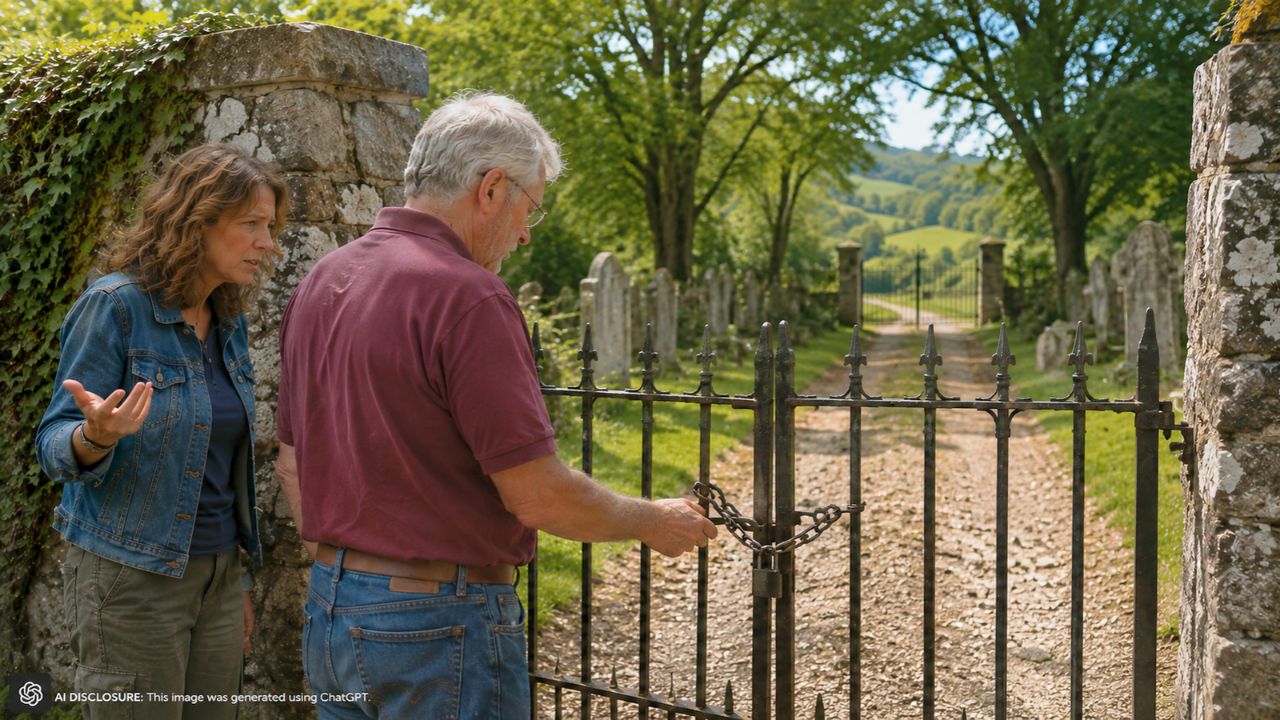
What made it worse wasn’t just one barrier. After the first neighbor locked a gate, a second set of nearby property owners allegedly installed another gate behind it, cutting off vehicle access to a 165-year-old Gullah Geechee burial ground still used today, as detailed in the source post. Now it’s in court, because “just walk around” isn’t really a solution when the thing you’re trying to reach is sacred—and when the community says it has legal rights to get there.
The cemetery sits where new property lines keep tightening
The Big House Cemetery is about an acre, tucked between Seaside Road and the Harbor River, and it traces back to plantation days. Families say it has been part of community life for generations: a place for burials, for upkeep, for visiting, and for practices tied closely to Gullah Geechee beliefs.
But the land around old cemeteries is exactly where modern coastal pressure shows up first. New homes go in. Older parcels change hands. People who didn’t grow up with the “everybody knows how we get back there” understanding start asking, “Whose road is this?”
That’s where these disputes tend to live: not in dramatic property flips, but in the quiet stuff—driveway access, gates, dirt roads that aren’t labeled, and a long history of use that was never formalized the way a new buyer expects.
One locked gate turned into two
According to the lawsuit, Theresa Aigner bought her property about four years ago and initially allowed cemetery visitors to pass through. The complaint says that changed in May 2024, when a gate was locked and access for vehicles was blocked. It also says attempts to negotiate a workable arrangement failed.
Aigner has previously said she was tired of being villainized and that there is no legal or historic route to the cemetery across her property. She also said she stopped allowing access after a funeral procession allegedly caused thousands of dollars in damage and left trash behind.
Then came the escalation that makes neighbors’ jaws clench: the lawsuit claims Robert Cody Harper and Walter Robert Harper Jr. installed a separate gate that blocked access to the cemetery entrance itself. In other words, even if you solved the first gate problem, you’d still be standing in front of another.
In rural and semi-rural areas, gates are a common “fix” for everything from trespassing to dumping to liability fears. But once a gate goes up, it’s not just a latch. It’s a statement about control of a route—and it forces everyone else to prove their right to be there.
When access isn’t just “visiting,” it becomes an emergency
The community says this isn’t about a once-a-year Memorial Day walk. The cemetery is still used for burials, and without a passable route, you can’t bring in vehicles, tools, supplies, or—most critically—carry out burials the way families intend.
The lawsuit describes a brutal moment that made the dispute impossible to ignore: after a three-car crash killed five community members, their families could not bury them alongside relatives in Big House Cemetery and instead had to use a cemetery roughly 20 miles away.
That’s the part outsiders sometimes miss. Blocking a path to a burial ground isn’t like blocking a shortcut to the beach. It changes funeral plans, costs families more money, and forces decisions during the worst week of their lives.
Even the day-to-day maintenance gets complicated. A cemetery isn’t “set it and forget it.” Grass grows. Headstones tilt. Trees drop limbs. If you can’t drive in, every cleanup becomes a manual haul.
The lawsuit is about an old road, an easement, and rights that outlast deeds
The plaintiffs—community residents and the Big House Cemetery Committee, along with multiple named individuals—filed suit in Beaufort County Court of Common Pleas against Aigner and the Harpers. They’re represented by the Center for Constitutional Rights, with co-counsel Tyler Bailey of the Bailey Firm.
At the heart of the filing is a claim many homeowners have heard in a different context: long-standing access. The lawsuit argues there is an easement or right-of-way on the road used for decades to reach the cemetery, and that the defendants’ gates violate South Carolina law protecting the right to access private burial grounds for burials and visits.
That’s where these disputes often get painfully technical. One side talks about decades of use—family processions, maintenance, shared understanding. The other side talks about surveys, deed language, and whether a “route” across their property was ever legally established.
The suit asks the court to order access and to award money for emotional and economic harm. Aigner declined to comment further on Wednesday because she had not been served. The Harpers were not immediately available for comment.
People aren’t just arguing—there’s a push to change the penalties
Even before the court case, the locked gates had already sparked action at the State House. Rep. Michael Rivers, D–St. Helena Island, introduced legislation in December that would add fines and possibly up to 30 days in jail for blocking access to a private cemetery.
Rivers’ point was blunt: the current law says you shouldn’t block access, yet people still do it. Without meaningful consequences, a locked gate becomes a “cost of doing business” for someone determined to keep the public— or even extended family networks—off their land.
The proposed bill has been sitting in the judiciary committee since December, according to Rivers. Meanwhile, similar fights over Gullah Geechee burial grounds have played out on other Sea Islands, including Tybee Island and James Island.
The most practical reactions focus on receipts, routes, and damage
If you’ve ever watched neighbors square up over a shared driveway, you can predict the advice people trade in the background. Don’t argue in the road. Document everything. Get the history in writing. Figure out what the law actually says before someone pours concrete, installs posts, or calls a tow company.
This case also shows the flip side: property owners who feel they’re being asked to absorb all the wear-and-tear. Aigner’s earlier comments referenced alleged damage during a funeral procession and litter left behind. That’s the kind of detail that tends to harden positions fast, because “access” starts sounding like “unlimited use without accountability.”
At the neighborhood level, the practical fix is usually some mix of designated access hours, keys held by committee members, clear rules about cleanup, and a route that’s officially recognized so it doesn’t depend on goodwill. But when trust is already gone—and now there are two gates—people stop negotiating in the driveway and start negotiating through filings.
On St. Helena Island, families say they’re not asking for special treatment. They’re asking to reach their people. And until a judge orders a clear path—or the parties find a way to unlock one without locking horns again—the cemetery remains where it’s always been, waiting behind hardware that turned a sacred place into a property-line standoff.
Like Fix It Homestead’s content? Be sure to follow us.